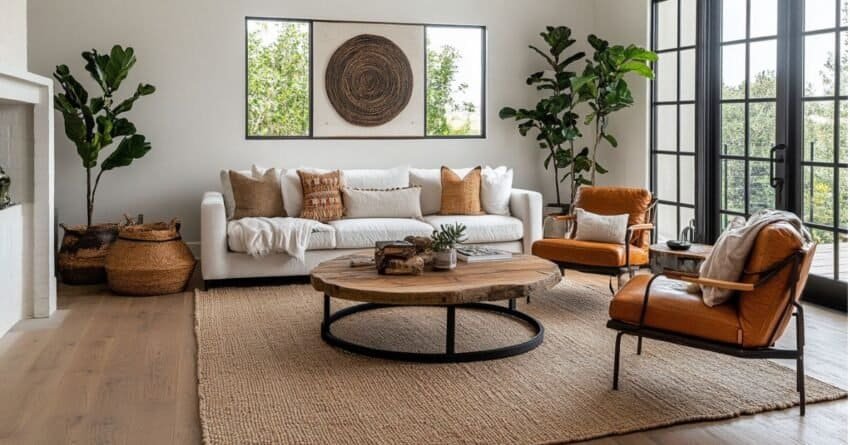
A modern living room can have a beautiful sofa, a clean coffee table, soft lighting, and calm colors, but one wrong rug size can make the whole room feel off.
The rug might look too small under the coffee table. The sofa may look like it is floating. The chairs might feel disconnected, even when everything else in the room looks carefully chosen.
That is why learning how to choose the right rug size matters.
A rug is not just something soft underfoot. It helps pull the sofa, chairs, coffee table, and floor space into one clear seating area.
In a modern living room, rug size affects the room more than people expect. It can make the space feel wider, cozier, calmer, or more awkward.
The good news is that you do not need to guess.
You can use simple sizing rules based on your sofa, sectional, coffee table, wall spacing, and room shape. Once you understand those rules, it becomes much easier to choose a rug that feels right before you buy it.
This post walks through rug sizes for sofas, sectionals, small apartments, large living rooms, and open plan spaces. You will also see common mistakes, quick testing tips, and easy placement rules you can use in a real home.
Table of Contents
How to Choose the Right Rug Size That Makes the Room Feel Connected
A rug should connect the seating area, not just fill an empty patch of floor.
That is the first rule. Before looking at colors, texture, or pattern, look at the furniture group. Your sofa, chairs, and coffee table should feel like they belong together.
Room & Board explains that a rug works best when it is a bit longer than the sofa and reaches at least 8 to 12 inches past each side. Their guide to how rug size defines the seating area also recommends placing the front legs of the sofa or chairs on the rug.
That one detail can change the whole room. A rug that touches the main furniture makes the seating area feel grounded. A rug that sits alone under the coffee table can make the room feel unfinished.
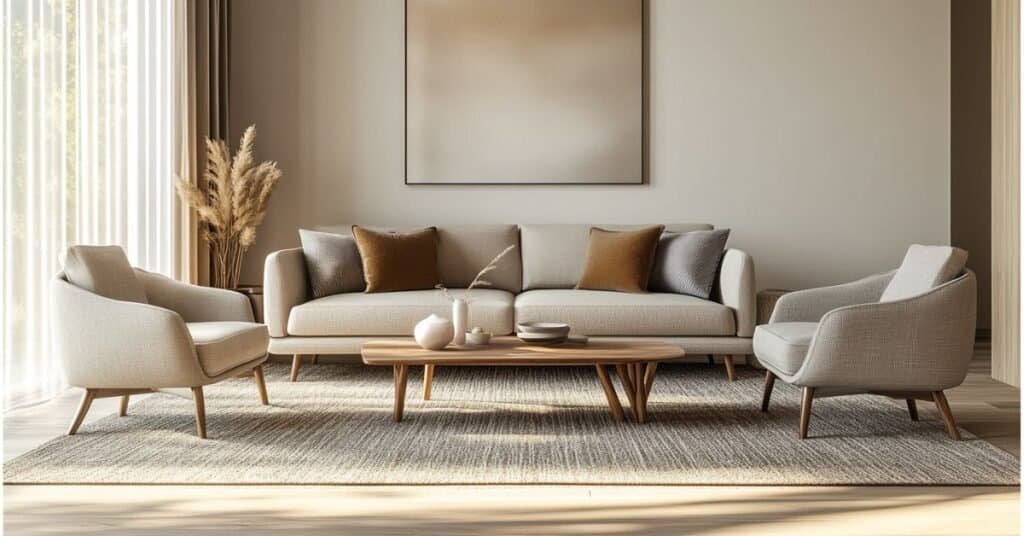
Start With the Seating Area, Not the Whole Room
Do not measure the full living room first.
Measure the area where people actually sit.
For example, if your sofa is against one wall and two chairs face it, measure the space from the front of the sofa to the front of the chairs. Then measure from side to side, including the width of the chairs.
That gives you the real seating zone.
A modern living room rug size should help frame that zone. It does not need to cover every inch of the floor.
A simple way to check:
- The rug should be wider than the sofa
- The coffee table should sit fully on the rug
- The front legs of the sofa should touch the rug
- Main chairs should touch the rug if possible
- There should still be visible floor around the edges
This is where many rooms go wrong. The rug gets chosen by price or color first, then the size feels awkward once it is under the furniture.
A soft neutral rug may look beautiful online, but if it is too small, the sofa can look heavy and disconnected.
Use the Front Legs Rule for Most Modern Living Rooms
For many homes, the front legs rule is the easiest place to start.
This means the front legs of your sofa and main chairs sit on the rug, while the back legs can stay off.
Becki Owens gives similar living room advice in her post about the front legs on the rug rule. She explains that a rug should anchor the seating setup and suggests leaving at least a one foot border between the rug and the walls.
That is useful for modern living rooms because it keeps the rug from looking like a random island.
Picture a warm beige sofa, two black accent chairs, a low wood coffee table, and a textured wool rug. If only the coffee table sits on the rug, the room can feel scattered. If the front legs of the sofa and chairs touch the rug, everything feels connected.
A good front legs setup usually looks like this:
| Furniture Piece | Rug Placement |
|---|---|
| Sofa | Front legs on the rug |
| Accent chairs | Front legs on the rug if space allows |
| Coffee table | Fully on the rug |
| Side tables | Usually off the rug or partly near the edge |
If your room is small, do not force every chair leg onto the rug. Let the rug connect the main seating pieces first.
If your room is large, you can use a bigger rug and place all furniture legs on it. That works best when the rug has plenty of floor border around it and does not touch the walls.
Living Room Rug Size Guide for Sofas and Sectionals
The easiest way to choose rug size is to start with the biggest furniture piece in the room.
For most modern living rooms, that means the sofa or sectional. Once that piece feels connected to the rug, the rest of the layout becomes easier to place.
A rug should not look like a small mat floating under the coffee table. It should help the sofa, chairs, and table feel like one seating area.
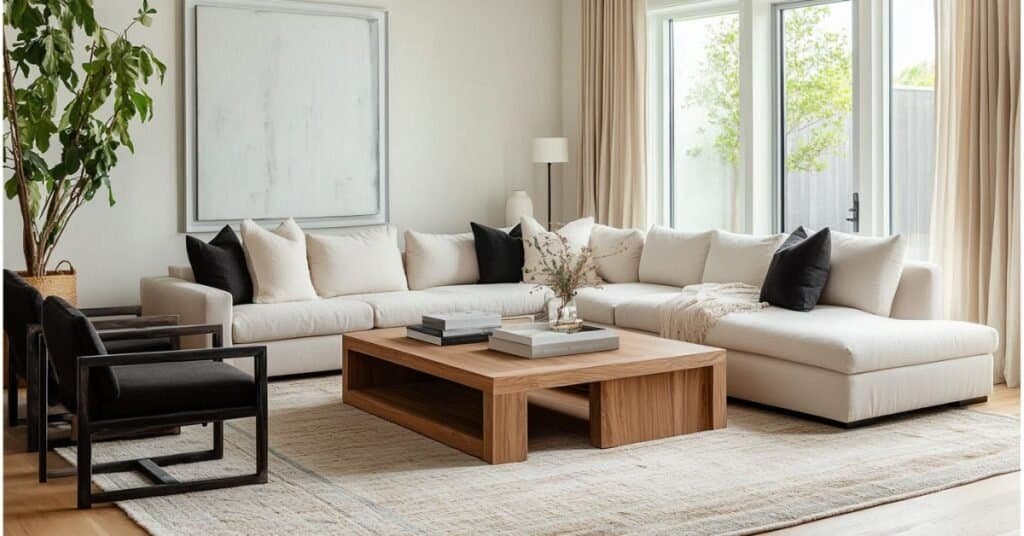
Rug Size for a Standard Sofa
A standard sofa usually works best with an 8×10 or 9×12 rug, depending on the room size.
For many average living rooms, an 8×10 rug gives enough space for the front legs of the sofa and chairs to sit on the rug. It also gives the coffee table room to sit fully on the rug without looking squeezed.
The DIY Playbook notes in its standard living room rug sizes guide that 8×10 and 9×12 rugs are common choices for living rooms, while a 5×7 rug is often too small for full seating areas.
That does not mean a 5×7 rug never works. It means you need to use it carefully.
Here is a simple way to think about sofa layouts:
| Sofa Setup | Rug Size to Try | Why It Works |
|---|---|---|
| Small sofa in compact room | 5×7 or 6×9 | Works if the rug stays close to the sofa and table |
| Standard sofa | 8×10 | Holds the front sofa legs and coffee table |
| Large sofa with chairs | 9×12 | Connects more of the seating area |
| Sofa floating away from wall | 9×12 or larger | Helps the layout feel grounded |
If your sofa is 84 inches wide, look for a rug that extends at least a little past each side of the sofa. Even 8 to 12 inches on each side can help the room feel more balanced.
A rug that ends exactly at the sofa arms can look too tight. A rug that extends past the sofa gives the seating area a softer, more planned look.
Rug Size for a Sectional Sofa
Sectionals usually need larger rugs because they take up more visual space.
A small rug under a sectional can make the seating area feel chopped up. The rug should run under the front legs of the sectional, or at least connect the longest side of the sectional with the coffee table.
For many sectional layouts, start by testing a 9×12 rug.
LoveYourRug Canada shares several living room placement options in its guide to rug size for sectional sofa layouts, including all legs on the rug, front legs on the rug, and coffee table only layouts.
For a modern living room, the front legs layout is often the most practical. It gives the sectional a clear base without requiring a huge rug that reaches too close to the walls.
Try this layout:
- Place the front legs of the sectional on the rug
- Keep the coffee table fully on the rug
- Let the rug extend past the coffee table by at least 12 inches
- Leave visible floor between the rug and walls
- Keep the chaise side connected to the rug if possible
If your sectional has a chaise, avoid using a rug that stops halfway under it. That can make the chaise look cut off.
A larger rug usually looks better because it respects the size of the sectional. The sofa is already a strong piece, so the rug needs enough width to hold it visually.
Small Space Note
In a small apartment, you may not have room for a 9×12 rug.
That is fine.
Use a 5×7 or 6×9 rug if it fits the seating area better. The key is to place it close enough to the sofa so it does not look stranded in the middle of the room.
A compact rug can still work if the coffee table sits fully on it and the front sofa legs sit close to the rug edge or partly on it.
Standard Rug Sizes and What They Look Like in Real Rooms
Rug sizes can sound simple online, but they feel very different once they are under a sofa.
A 5×7 rug may look generous in a product photo, then feel tiny in a full living room. An 8×10 rug may look large before it arrives, then become the size that finally makes the seating area feel right.
This is why it helps to picture each rug size in a real layout.

When a 5×7 Rug Works
A 5×7 rug can work in a living room, but it needs the right setting.
It is best for a small apartment, a compact seating nook, a reading corner, or a narrow room where a larger rug would block walkways.
In many standard living rooms, a 5×7 rug can feel too small because it usually sits under only the coffee table. When that happens, the sofa and chairs may look disconnected from the rest of the room.
Use a 5×7 rug when:
- The sofa is small
- The room is compact
- The coffee table is narrow
- The rug sits close to the sofa
- You still have clear walkway space
A budget option is to use a 5×7 rug first, then layer it over a larger neutral flatweave later. That gives you more coverage without replacing the smaller rug right away.
When an 8×10 Rug Works
An 8×10 rug is often the most useful size for a modern living room.
It can usually hold the front legs of a sofa and chairs while keeping the coffee table fully on the rug. This makes the seating area feel connected without covering the whole floor.
All Sorts Of recommends larger rugs such as 8×10 for medium to large rooms because they help anchor the space when the rug sits partly under the sofa in its guide to medium living room rug size ideas.
Picture a soft wool rug under a cream sofa, two accent chairs, and a round coffee table. With an 8×10 rug, the chairs can touch the rug, the coffee table sits fully on it, and the sofa front legs feel grounded.
Use an 8×10 rug when:
- You have a standard sofa
- You have one or two accent chairs
- The coffee table needs full rug coverage
- The room is not tiny but not oversized
- You want a balanced seating area
For many homes in the US and Canada, this is the size to test first.
When a 9×12 Rug Works
A 9×12 rug works best in larger living rooms, open layouts, and seating areas with sectionals.
It gives the furniture more room to breathe. It also helps hold several pieces together, especially when the sofa floats away from the wall.
Ruggable notes in its 9×12 rug in living room layouts guide that larger rugs can work well in bigger rooms and defined living areas, especially when there is enough floor border around the rug.
A 9×12 rug is a good choice when:
- The living room is large
- The sofa is long
- The furniture floats away from the walls
- You have a sectional
- You have multiple chairs
- The room is open to a dining area or kitchen
If the rug feels too large, check the floor border. You usually want some visible flooring around the rug so it looks placed, not wall to wall.
Quick Rug Size Comparison
| Rug Size | Best For | Simple Placement Tip |
|---|---|---|
| 5×7 | Small rooms or compact seating | Keep close to sofa and coffee table |
| 8×10 | Average living rooms | Place front legs of sofa and chairs on rug |
| 9×12 | Large rooms or open layouts | Hold the full seating group together |
The common mistake is choosing the smaller rug because it costs less, then trying to make it work with a full size sofa.
If you are between two sizes, the slightly larger rug usually feels better in a modern living room, as long as it still leaves a clear floor border.
Rug Placement Rules That Prevent an Awkward Look
A rug can be the right size on paper and still look wrong in the room.
Placement matters just as much as size. The rug needs to sit under the furniture in a way that feels connected, practical, and easy to walk around.
A few inches can make a big difference. If the rug is too far from the sofa, the furniture can feel disconnected. If it sits too close to the wall, the room can feel squeezed.

Leave the Right Floor Border Around the Rug
Most living rooms need a visible floor border around the rug.
That border helps frame the rug and keeps the room from feeling wall to wall. In many living rooms, 12 to 18 inches of exposed floor works well. In a smaller room, 8 to 12 inches can still look good.
Décor Surfaces suggests measuring the room, defining the living area, and testing rug dimensions with tape in its article on living room rug border guidance.
That is a smart step because borders can look different once furniture is in place.
For example, a 9×12 rug may look too large in an empty room. Once the sofa, chairs, and coffee table sit around it, the size may feel right.
Use this simple floor border guide:
| Room Type | Floor Border to Try | Why It Helps |
|---|---|---|
| Small living room | 8 to 12 inches | Keeps the rug from feeling squeezed |
| Standard living room | 12 to 18 inches | Gives the rug a clean frame |
| Large living room | 18 inches or more | Helps the room feel open |
If your living room has a wall of windows, fireplace, or built in cabinet, adjust the border slightly so the rug works with those fixed features.
The goal is not a perfect number. The goal is a rug that feels placed, not cramped.
Keep the Coffee Table Fully on the Rug
Your coffee table should usually sit fully on the rug.
This helps the seating area feel stable. It also prevents the rug from looking like a small mat floating under one piece of furniture.
A good rule is to let the rug extend past the coffee table on all sides. Aim for at least 12 inches of rug around the coffee table when the room allows.
If the coffee table feels too large for the rug, that is a sign the rug may be too small for the seating area.
This is also where styling matters. Once the rug and coffee table are placed, the tabletop should feel calm and useful too. You can pair the layout with modern coffee table styling formulas so the rug and table work together instead of fighting for attention.
Watch the Distance Between Sofa, Rug, and Coffee Table
The rug should help the furniture feel connected, but the spacing still needs to feel comfortable.
A coffee table is usually easiest to use when it sits about 14 to 18 inches from the sofa. That leaves enough room to walk through while still keeping drinks and books within reach.
If your rug sits too far forward, the coffee table may drift away from the sofa. If the rug sits too far back, it may bunch under the sofa and leave the chairs disconnected.
Try this layout check:
- Sit on the sofa and reach toward the coffee table
- Walk between the sofa and table
- Check whether chair legs touch the rug
- Make sure the rug edge is not right under your feet
- Look at the room from the doorway
The doorway test is helpful. If the rug looks too small from the entrance, it will probably feel too small every day.
How to Test Rug Sizes Before Buying
Buying a rug without testing the size can feel risky.
The color may look right. The texture may feel right. Then it arrives, rolls out, and suddenly the sofa looks too far away or the chairs no longer feel connected.
A quick floor test can save you from that.

Use Painter’s Tape on the Floor
Painter’s tape is one of the easiest ways to test rug size before buying.
Mark the rug outline on the floor, then step back and look at it from the doorway, sofa, and kitchen or hallway entrance. This helps you see how the rug will feel from the places you actually view the room.
Try taping out these common sizes:
| Rug Size | Good Test For |
|---|---|
| 5×7 | Small apartment or compact seating nook |
| 6×9 | Narrow living room or smaller sofa |
| 8×10 | Standard sofa with coffee table |
| 9×12 | Sectional, large sofa, or open room |
After taping the outline, place your furniture where it would sit.
Check these details:
- Do the front sofa legs touch the rug area?
- Does the coffee table sit fully inside the taped shape?
- Do accent chairs connect to the rug?
- Is there enough floor border near the walls?
- Can people walk through the room without stepping awkwardly on rug edges?
If the taped size feels small before the rug is even there, the real rug will likely feel smaller once furniture is on top of it.
Check Walkways, Door Swings, and Chair Placement
A rug should make the room feel calmer, not harder to use.
Before buying, check every walkway around the seating area. You should be able to move from the sofa to the doorway, window, side table, or hallway without tripping over a rug edge.
If the room has a patio door, cabinet, storage ottoman, or nearby dining chair, test those movements too.
A rug can look beautiful in a still photo and still be annoying in real life if it blocks how the room works.
For a high traffic family room, pay attention to pile height as well. Low pile and flatweave rugs are usually easier around kids, pets, snacks, and daily foot traffic.
A thicker rug can feel soft, but it may catch on doors or make chairs harder to move.
Budget Option: Test Before You Spend
The cheapest rug mistake is the one you catch before buying.
Use painter’s tape, kraft paper, or even old sheets to test the footprint. You do not need a perfect mockup. You just need to see the size on the floor.
Walk around it for a day if you can.
Notice where your feet land. Notice whether the coffee table feels centered. Notice if the rug edge lands in an awkward walkway.
If the size feels good after a full day of normal use, you are much closer to choosing the right rug.
Rug Size Mistakes That Make a Modern Living Room Feel Off
A rug can change the whole mood of a living room.
When the size is right, the sofa, chairs, coffee table, and floor all feel connected. When the size is wrong, even a beautiful room can feel a little awkward.
Most rug mistakes come from choosing the rug before checking the furniture layout.

Mistake 1: Choosing a Rug That Is Too Small
This is the mistake that shows up most.
A small rug can make the coffee table look like it is sitting on a tiny island. The sofa and chairs may feel separate from the seating area instead of part of it.
A rug may be too small if:
- Only the coffee table fits on it
- The sofa does not touch it
- The chairs sit far away from the rug edge
- The rug looks lost in the middle of the room
- The furniture feels disconnected
If your budget is tight, try looking for a larger flatweave, jute, or neutral rug before choosing a smaller thick rug. Size matters more than a plush feel when the goal is a balanced modern living room.
Mistake 2: Letting the Rug Touch the Walls
A living room rug usually needs some visible floor around it.
If the rug touches the walls, it can start to feel like carpet instead of an area rug. That can make a modern living room feel heavy, especially if the furniture is already large.
Try leaving:
- 8 to 12 inches of floor in a small room
- 12 to 18 inches in a standard room
- 18 inches or more in a large open room
These are not strict rules. They are starting points.
If your room has a fireplace, window wall, or built in cabinet, adjust the rug so it looks balanced with those features.
Mistake 3: Ignoring the Furniture Layout
A rug should be chosen after you know where the sofa, chairs, and coffee table will sit.
If you choose the rug first, you may end up forcing the furniture around it. That can make the room feel stiff.
Start by placing the furniture in the layout that works for real life. Then choose the rug size that connects those pieces.
For example, a sofa against the wall and two chairs across from it may work well with an 8×10 rug. A floating sectional in an open living room may need a 9×12 rug or larger.
Mistake 4: Forgetting How the Room Is Used
A living room is not a showroom.
People walk through it. Kids sit on the floor. Pets stretch out. Drinks get placed on the coffee table. Chairs move a few inches during real conversations.
That is why the rug has to work with daily habits.
If the rug edge lands right where people walk, it can become annoying. If the rug is too thick under a chair, the chair may wobble or drag. If the rug is too light for a busy family room, it may show every crumb.
A low pile or flatweave rug often works better in busy spaces. It keeps the room feeling clean and makes furniture easier to move.
Rug Size Tips for Small, Large, and Open Living Rooms
Every living room does not need the same rug size.
A small apartment may need a tighter rug layout. A large modern living room may need a bigger rug so the sofa and chairs do not feel scattered. An open plan room may need the rug to mark the seating area clearly.
The best rug size depends on how the room is shaped, where people walk, and how the furniture sits.

Small Apartment Living Room
Small living rooms need a rug that feels useful without swallowing the floor.
A 5×7 or 6×9 rug can work if the room is compact. Place it close to the sofa so the rug does not float alone under the coffee table.
For a small apartment, try this:
- Keep the front sofa legs on or near the rug
- Choose a low pile rug to reduce bulk
- Let the coffee table sit fully on the rug
- Leave clear walking space around the seating area
- Use a calm color if the room already feels tight
A rug that is too small can make the room feel choppy. A rug that is too large can make the floor look crowded.
The sweet spot is a rug that connects the coffee table and sofa without blocking the natural walkway.
If your small living room also needs a cleaner look, pair the rug plan with simple minimalist decor ideas for small rooms so the layout feels lighter.
Large Modern Living Room
A large living room needs a rug with enough size to hold the furniture group.
If the rug is too small, the sofa, chairs, and coffee table can look spread out, even when the furniture is placed well.
For a large modern living room, start with an 8×10, 9×12, or larger rug. The rug should be wider than the sofa and large enough to touch the main chairs.
A larger room can handle:
- All front legs on the rug
- A wider rug border around the furniture group
- More space between the rug and walls
- A larger coffee table fully placed on the rug
- A heavier texture, such as wool or jute
If the sofa floats away from the wall, the rug becomes even more helpful. It gives the seating area a clear base.
A good test is to stand at the room entrance. If the rug looks like it belongs to the whole seating area, the size is probably close. If it looks like it belongs only to the coffee table, go bigger.
Open Plan Living and Dining Area
Open plan rooms need rugs to create zones.
The living area may sit beside a dining table, kitchen island, hallway, or large window wall. Without a rug, the furniture can feel like it is drifting.
The Rug Market offers a Canada focused Canadian rug sizing guide for living rooms, which is useful if you are comparing common rug sizes for living, dining, and bedroom layouts.
For an open living and dining area, use the living room rug to mark the seating zone. Then give the dining area its own space, either with another rug or clear floor between the two zones.
Try these open plan tips:
- Use a larger rug for the living area
- Keep 12 to 18 inches of floor between rugs if using two
- Choose rugs that share tone or texture
- Avoid two bold patterns fighting in the same sightline
- Let the sofa, chairs, and coffee table connect to one rug
The rugs do not need to match. They just need to feel calm together.
For example, a neutral wool rug in the living area can pair well with a flatweave rug near the dining table if both share warm beige, gray, cream, or natural fiber tones.
Quick Rug Size Cheat Sheet
Use this quick chart when you need a simple starting point.
Your exact rug size will still depend on your sofa, chairs, coffee table, and walkway space. But this gives you a clear place to begin before measuring.
| Living Room Type | Rug Size to Try | Placement Rule |
|---|---|---|
| Small apartment | 5×7 or 6×9 | Keep close to sofa and coffee table |
| Standard sofa layout | 8×10 | Front legs on rug |
| Sofa plus two chairs | 8×10 or 9×12 | Connect all main seating |
| Sectional layout | 9×12 or larger | Front legs of sectional on rug |
| Open living area | 9×12 or larger | Define the living zone |
A 5×7 rug can work in a compact room, but it needs to sit close to the sofa and coffee table.
An 8×10 rug is often the best starting size for a standard modern living room.
A 9×12 rug works better for sectionals, floating furniture, large sofas, and open plan layouts.
Here is the simplest way to choose:
- Small room: try 5×7 or 6×9
- Average room: try 8×10
- Large room: try 9×12 or larger
- Sectional sofa: start with 9×12
- Open plan space: use the rug to mark the living area
The rug should help the room feel connected. If the sofa, chairs, and coffee table still feel like separate pieces, the rug may be too small.
Frequently Asked Questions
How much floor should show between the rug and the wall?
A good starting point is 12 to 18 inches of visible floor around the rug.
In a small living room, 8 to 12 inches can still work. The goal is to give the rug a clean border so it feels placed, not squeezed against the walls.
Should all furniture legs be on the rug or just the front legs?
For most modern living rooms, the front legs rule works best.
Place the front legs of the sofa and main chairs on the rug. If the room is large, you can place all furniture legs on the rug for a more grounded seating area.
Is a 5×7 rug ever acceptable in a living room?
Yes, a 5×7 rug can work in a small apartment, reading corner, or compact seating nook.
It usually feels too small for a full sofa and chair layout. If you use one, keep it close to the sofa and make sure the coffee table sits fully on it.
What rug size works best for an open plan living and dining area?
A 9×12 rug or larger often works best for the living zone in an open plan space.
The rug should help separate the seating area from the dining area, kitchen, or walkway. Leave enough open floor between zones so the room does not feel crowded.
How do I test rug sizes before buying?
Use painter’s tape to mark the rug size on the floor.
Try taping 5×7, 8×10, and 9×12 outlines if your room allows. Then place the furniture where it would sit and check the view from the sofa, doorway, and walkway.
What rug pile or weave is best for high traffic family rooms?
Low pile, flatweave, wool, or washable rugs are often easier for busy living rooms.
They are usually simpler to clean and less likely to catch under furniture. Thick rugs can feel soft, but they may be harder with pets, kids, snacks, and moving chairs.
How much larger should a rug be than my coffee table?
The rug should extend beyond the coffee table on all sides.
Aim for at least 12 inches of rug around the coffee table when the room allows. The coffee table should sit fully on the rug and still feel connected to the sofa or chairs.
How do I choose a rug size for a sectional sofa?
Start with a 9×12 rug for many sectional layouts.
Place the front legs of the sectional on the rug and keep the coffee table fully on it. If the sectional floats in a large room, you may need a larger rug to hold the full seating area.
Are there different rug rules for small apartments versus large living rooms?
Yes, the same idea applies, but the scale changes.
Small apartments can use tighter floor borders and smaller rugs. Large living rooms need rugs that connect more furniture so the sofa, chairs, and coffee table do not feel scattered.
Do rug size rules change for Canadian versus US homes?
The core rug rules are the same in Canada and the US.
The main difference is room size, store size labels, and how much floor border your layout allows. Measure your seating area first, then compare rug sizes before buying.
Conclusion
Learning how to choose the right rug size can make a modern living room feel calmer, warmer, and more connected.
Start with the seating area, not the full room. Look at the sofa, chairs, coffee table, walkways, and floor border before choosing a size.
For most modern living rooms, an 8×10 rug is a strong starting point. For sectionals, floating furniture, and open plan spaces, a 9×12 rug or larger often works better.
If the room is small, a 5×7 or 6×9 rug can still work when it sits close to the sofa and coffee table.
The best rug size is the one that supports the way your living room is used every day. It should connect the furniture, leave room to walk, and make the whole seating area feel easy to live with.
For more ideas that help you plan the full room around your sofa, rug, and coffee table, visit the Epic Modern Living Room Guide.