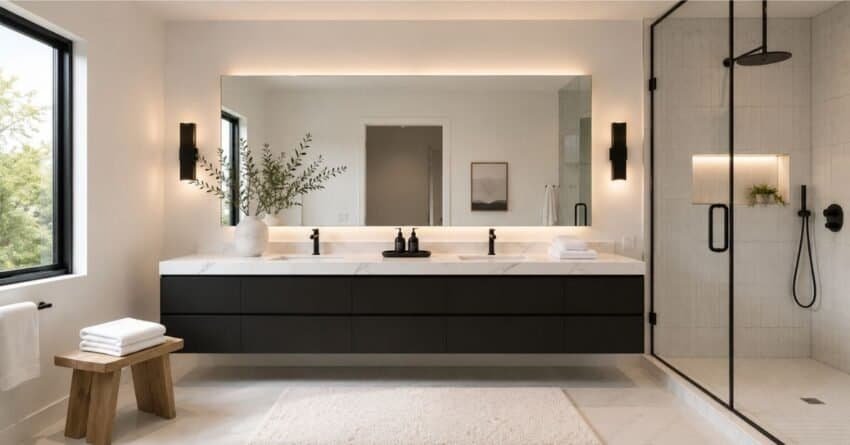
A black and white bathroom can look striking in photos, then feel colder than expected once you try it at home.
Maybe the white tile feels too sharp. The matte black faucet looks strong, but the room still feels unfinished. Or the contrast is so bold that the softer details seem lost.
White and black bathroom decor works best when one color leads and the other adds depth. Warm lighting, soft towels, natural wood, and a few textured pieces can keep the room polished without making it feel harsh.
If you are still choosing your palette, these bold bathroom color schemes that still feel livable can help you compare stronger color combinations before changing tile, paint, or cabinetry.
Picture a charcoal vanity beneath a white quartz counter. Add an arched black mirror, warm brass sconces, folded cream towels, and a pale oak stool near the shower. The room still has strong contrast, but it feels warmer and easier to live with.
This color pairing can suit a modern hotel bathroom, a small powder room, a farmhouse space, or an Art Deco inspired guest bath. The final mood depends on the balance between dark and light surfaces.
You do not need to cover half the bathroom in black. A black vanity, mirror frame, shower trim, or floor pattern may be enough. White walls, soft fabric, clear counter space, and warm bulbs can carry the rest of the room.
The sections ahead show how to use tile, fixtures, lighting, mirrors, storage, and simple accessories to make black and white feel rich, welcoming, and confidently bold.
Table of Contents
White and Black Bathroom Decor That Looks Fearlessly Luxe
A luxe black and white bathroom rarely uses both colors in equal amounts.
One color should form the base. The other should draw attention to the vanity, mirror, shower, flooring, or lighting. This keeps the contrast clear without making every surface compete.
The Coolist describes how black and white bathrooms can feel bold and chic through contrast, pattern, and classic details. At home, the easiest way to use that idea is to choose one strong black feature, then surround it with lighter surfaces and soft texture.

Use More of One Color Than the Other
A 70 and 30 color split is a useful starting point.
In a full bathroom, use white across about 70 percent of the visible room. This may include the walls, shower tile, countertop, ceiling, towels, and curtain. Use black across the remaining 30 percent through the vanity, mirror frame, shower trim, hardware, or floor pattern.
A bright version could include:
- Soft white walls
- White shower tile
- White quartz countertop
- Charcoal vanity
- Black framed mirror
- Matte black shower trim
- Cream towels
- One pale wood accent
A powder room can handle a darker mix because guests spend less time there. Try soft black walls with a white pedestal sink, bright ceiling, white towels, and a large mirror that reflects the light.
The common mistake is dividing the room into obvious equal halves. Black lower walls with white upper walls can work, but repeating the split across the vanity, shower, flooring, and accessories may make the room feel busy.
Pick One Main Black Feature
Choose one larger black element to carry the drama.
A charcoal vanity is often the easiest choice because it sits beneath a bright countertop and mirror. The black feels grounded, while the white surface keeps the vanity area open.
Other strong focal choices include:
- Matte black shower frame
- Deep charcoal floor tile
- Black framed arched mirror
- Dark painted vanity wall
- Graphic black and white shower niche
- Black freestanding bathtub
Once you choose the main feature, keep the other black details smaller. A dark vanity may need only a black mirror frame and two towel hooks. Adding a black floor, black shower wall, black ceiling fixture, and black storage cabinet may take attention away from the vanity.
Repeat black two or three times across the room. Space those repeats apart so the eye moves from one area to another.
Let White Create Breathing Room
White surfaces give bold black details space to stand out.
Keep the wall around a black mirror clear. Leave some open countertop beside the sink. Use white towels rather than layering several dark fabrics near a charcoal vanity.
Empty space is part of the look. A white wall with one large mirror can feel richer than a wall filled with small frames and shelves.
Warm white often feels softer than a bright blue white. Test wall paint beside the tile, countertop, and vanity during the morning and evening. A white that looks clean in daylight may look cool under the vanity lights.
In a windowless bathroom, use soft white walls with warm bulbs. Add cream towels or a woven basket to keep the contrast comfortable.
Add Warmth Without Weakening the Contrast
Black and white should still be the main colors, but one warm finish can stop the room from feeling severe.
Good choices include:
- Brushed brass sconces
- Pale oak stool
- Woven storage basket
- Cream linen shower curtain
- Taupe bath mat
- Soft green branches
- Warm stone flooring
Use the warm material in two small places. For example, pair brass sconces with brass cabinet pulls. Or place a pale oak stool beside a woven basket.
The room will still read as black and white, but it will feel more inviting in morning light and after dark.
Build a Warm Black and White Bathroom Color Scheme
Black and white does not have to feel icy.
The warmth comes from the exact shades you choose and the materials placed beside them. A soft white wall, charcoal vanity, cream towel, and pale wood stool will feel very different from bright white tile paired with pure black on every surface.
Ideal Home calls black and white a confident bathroom color choice. The pairing has lasted because it can move between modern, traditional, farmhouse, Art Deco, and hotel styles without losing its strong identity.

Choose Warm White Instead of Blue White
White takes up a large part of most bathrooms, so its undertone can change the whole room.
A blue white can feel crisp beside chrome and glossy tile. It may also make matte black fixtures look sharper than you planned, especially in a bathroom with no window.
Warm white has a touch of cream, beige, or soft gray. It sits more comfortably beside brass, pale wood, woven baskets, and charcoal cabinetry.
Good places to use warm white include:
- Painted walls
- Shower curtains
- Towels
- Vanity cabinetry
- Ceiling paint
- Ceramic accessories
- Wall tile with a handmade finish
Test paint on at least two walls before making a choice. Place one sample near the mirror and another near the shower tile. Look at both samples in morning light and again after the vanity lights are turned on.
A warm white that looks creamy in one room may look clean and balanced in another. Tile, window direction, and bulb color can all change it.
Use Soft Black, Charcoal, or Deep Gray
Pure black makes a strong graphic mark.
It works well on slim details such as mirror frames, faucets, towel hooks, shower trim, and cabinet pulls. On a large vanity or full wall, charcoal may feel softer and easier to live with.
Use pure black for:
- Slim metal frames
- Small hardware
- Faucet finishes
- Wall sconces
- Narrow grout lines
- One geometric pattern
Use charcoal or deep warm gray for:
- Large vanity cabinets
- Painted walls
- Floor tile
- Storage cabinetry
- Wainscoting
- A broad shower wall
A charcoal vanity still reads as dark, but it reflects a little more light than pure black. It also pairs nicely with warm brass, white quartz, and cream fabric.
In a small bathroom, keep the largest dark surface below waist height. A charcoal vanity or dark floor gives the room weight, while white walls and a large mirror keep the upper half open.
Add One Warm Supporting Finish
A warm finish keeps the room from looking like a flat black and white photograph.
Pale oak is a natural fit for modern and rustic bathrooms. Walnut adds deeper warmth and works well with Art Deco or traditional details. Brass gives the room a richer glow, while woven fiber adds softness near tile and stone.
Useful warm layers include:
- Pale oak shelf
- Walnut mirror frame
- Brushed brass sconces
- Cream linen curtain
- Woven laundry basket
- Taupe bath mat
- Soft green leaves
- Beige stone flooring
Pick one main warm material and repeat it twice.
For example, use a pale oak stool near the shower and a pale oak shelf above the toilet. Or use brushed brass on the sconces and cabinet pulls.
Repeating the same finish keeps the room calm. Mixing brass, copper, chrome, black metal, and silver in one small bathroom can make the contrast feel scattered.
Match the Color Mix to the Bathroom Mood
The same black and white palette can create several different looks.
| Bathroom Mood | Main Color | Black Feature | Warm Layer |
|---|---|---|---|
| Bright hotel style | Warm white | Charcoal vanity | Brushed brass |
| Modern and clean | Crisp white | Black mirror frame | Pale oak |
| Moody powder room | Soft black | White sink and ceiling | Cream towels |
| Farmhouse | Warm white | Black hardware | Woven basket |
| Art Deco | White marble look tile | Black geometric floor | Brass lighting |
| Rustic modern | Soft white | Deep gray vanity | Natural wood stool |
For a bright main bathroom, use white across the walls and shower, then place black around the vanity. For a dramatic guest powder room, use a darker wall color with a white sink, large mirror, and warm sconces.
Keep Undertones in the Same Family
A bathroom can feel slightly off when the undertones do not work together.
A blue black vanity beside yellow cream walls may clash. Warm white tile beside cool silver gray flooring can also feel disconnected.
Lay samples beside each other before buying large amounts of tile or paint. Compare the vanity finish, wall white, countertop, floor tile, and metal under the same bathroom light.
Aim for one of these directions:
- Warm white, warm charcoal, brass, and wood
- Crisp white, pure black, chrome, and glass
- Soft white, deep gray, brushed nickel, and pale stone
The colors do not need to match exactly. They should feel comfortable beside each other.
Black and White Bathroom Tile Ideas That Feel Polished
Tile can carry most of the personality in a black and white bathroom.
The color palette may be simple, but the tile shape, finish, scale, and grout color decide whether the room feels calm or overly busy. A strong floor can work beautifully when the shower walls and vanity stay quiet.
Backsplash.com shows how black and white can feel both elegant and clean across classic and modern bathrooms. The easiest way to use that contrast at home is to choose one main tile feature, then surround it with simpler surfaces.

Pair White Tile With Dark Grout Carefully
White tile with dark grout gives a bathroom crisp structure.
The grout outlines every tile, so the wall becomes more graphic. This works well with subway tile, square tile, stacked rectangles, and small hexagon patterns.
Black grout creates the strongest lines. Medium gray or charcoal grout feels softer and may be easier to pair with stone floors, warm white walls, or a charcoal vanity.
Try one of these combinations:
- Glossy white subway tile with medium gray grout
- Matte white square tile with charcoal grout
- Warm white handmade look tile with soft gray grout
- White hexagon floor tile with small black accents
- White stacked shower tile with slim black framing
Use dark grout in one main area. If the shower has strong black lines, keep the backsplash and wall paint quiet.
A common mistake is pairing black grout with checkerboard flooring, striped wallpaper, veined stone, and a graphic shower curtain. Each feature may look good alone, but together they can make the bathroom feel crowded.
Use Checkerboard Tile as the Main Pattern
Checkerboard tile gives a black and white bathroom a classic but dramatic base.
Larger squares create a calmer floor because there are fewer grout lines. Smaller checks feel playful and work well in a compact powder room or narrow guest bath.
For a full bathroom, tiles around 12 by 12 inches or larger can feel less busy. In a small powder room, an 8 by 8 inch pattern can add charm without taking over the walls.
Balance checkerboard flooring with:
- Plain warm white walls
- Simple shower tile
- Solid color vanity
- One black framed mirror
- White or cream towels
- Minimal counter styling
Repeat black only once or twice above the floor. A black mirror and black faucet may be enough.
For a softer version, use charcoal and warm white instead of pure black and bright white. Natural stone with slight variation can also make the checkerboard feel less sharp.
Add Marble Look Surfaces for Softer Movement
Marble look tile can bridge black and white without creating hard blocks of color.
A white base with gray or charcoal veining adds movement around the vanity or shower. It works well with black cabinetry because the veining connects the dark and light surfaces.
Good places for marble look tile include:
- Vanity backsplash
- Shower wall
- Shower niche
- Bathroom floor
- Wall behind a freestanding tub
- Small ledge below the mirror
Keep the veining soft if the bathroom already has checkerboard flooring or dark grout. A heavily veined wall beside a graphic floor can feel restless.
A simple vanity area could use a charcoal cabinet, white quartz counter, small marble look backsplash, and arched black mirror. Add warm sconces and cream towels so the stone does not feel cold.
Limit Pattern to One Main Area
Pattern looks richer when it has quiet space around it.
Choose the floor, shower, backsplash, or wall as the main patterned surface. Do not ask every area to compete for attention.
Good combinations include:
- Checkerboard floor with plain white shower tile
- Graphic shower wall with pale stone flooring
- Marble look backsplash with a solid charcoal vanity
- White subway tile with dark grout and a plain floor
- Black hexagon floor with warm white walls
Stand at the bathroom doorway and check what appears in one view. If you can see a strong floor, dark grout, patterned curtain, and bold wall art at the same time, remove one or two layers.
The goal is not to make the room empty. It is to let the tile feature look clear and confident.
Match Tile Finish to the Surface
Glossy and matte finishes behave differently in a bathroom.
Glossy white tile reflects window and vanity light. It can brighten a small shower or a bathroom with no window. Too much gloss may create glare, so pair it with a matte floor or painted vanity.
Matte black and charcoal tile absorbs more light. It works well on floors, shower niches, and one dark wall, but it needs warm lighting nearby.
A useful finish mix could include:
- Glossy white shower tile
- Matte charcoal floor
- Smooth white quartz counter
- Brushed brass faucet
- Soft linen curtain
- Woven storage basket
This mix gives the room shine, softness, and texture without adding more colors.
Keep Small Bathrooms Light Above Eye Level
A small bathroom can still use graphic tile.
Place the darker tile lower in the room through the floor, vanity backsplash, or shower niche. Keep the upper walls and ceiling warm white so the room feels taller.
A narrow bathroom could use black hexagon floor tile, white shower walls, a floating white vanity, and a large black framed mirror. The dark floor adds weight, while the light upper half protects the open feeling.
For a powder room, one full dark wall can work because the room is used for shorter periods. Pair it with a white sink, bright ceiling, large mirror, and warm sconces.
Choose Grout for the Mood You Want
Grout changes how clearly the tile pattern appears.
| Grout Choice | Visual Result | Works Well With |
|---|---|---|
| White grout | Soft and quiet | White tile and simple walls |
| Light gray grout | Gentle tile definition | Warm white tile and stone floors |
| Medium gray grout | Balanced contrast | Subway tile and charcoal vanity |
| Black grout | Strong graphic lines | Simple white tile and plain flooring |
| Warm gray grout | Softer hotel mood | Cream tile, brass, and pale wood |
White grout makes a tiled wall feel more unified. Dark grout brings attention to every tile edge. Medium gray sits between the two and can be easier to use in a busy family bathroom.
Choose the grout after viewing the tile in your bathroom light. A dark grout sample may look softer in daylight and much stronger under evening sconces.
The tile should support the room rather than compete with every mirror, towel, and fixture around it. One clear pattern, one quiet surface, and one warm texture can make black and white bathroom tile feel rich without making the space tiring.
Style the Vanity, Mirror, and Fixtures for a Luxe Look
The vanity wall is usually the first area people notice.
A dark cabinet under a white countertop gives the room strong contrast in one clear place. The mirror, faucet, sconces, and cabinet pulls can then repeat that contrast in smaller amounts.
Cove Bath shows how matte black fixtures and classic tile can add polish to both modern and traditional bathrooms. The most useful way to apply that idea is to keep the fixture shapes simple and repeat the finish only where it helps connect the room.

Pair a Black Vanity With a White Countertop
A black or charcoal vanity can anchor a bright bathroom.
White quartz keeps the top light and gives the sink area a clean edge. A stone surface with soft gray veining adds movement without competing with the cabinet color.
For a vanity wider than 48 inches, charcoal may feel softer than pure black. It still looks dark, but it does not absorb as much light across a large wall.
A balanced vanity area could include:
- Charcoal shaker or fluted cabinetry
- White quartz countertop
- White undermount sink
- Black framed mirror
- Brass or chrome faucet
- Cream hand towel
- One ceramic soap tray
Keep the floor lighter when the vanity is large. Pale stone, warm white tile, or light gray flooring can stop the cabinet from making the lower half of the room feel heavy.
For a small bathroom, a floating black vanity leaves the floor visible. Even 8 to 10 inches of open space below the cabinet can make the room feel less crowded.
Refresh a White Vanity With Black Hardware
A white vanity can still carry bold contrast.
Black cabinet pulls, a black faucet, and a black mirror frame can change the vanity wall without replacing the cabinetry. This works well for a budget update or rental bathroom where the cabinet color needs to stay.
Repeat black in three places:
- Mirror frame
- Cabinet hardware
- Towel hook or faucet
Three small repeats usually feel connected without covering the wall in dark details.
For a 30 inch vanity, pulls around 4 to 6 inches long often feel balanced on wide drawers. Smaller knobs can work on narrow doors, but mixing too many hardware shapes may make the vanity look busy.
Leave the countertop mostly open. A soap pump, folded towel, and one tray are enough for daily use.
Choose the Mirror Shape Based on the Room
The mirror changes how the vanity wall feels.
A round mirror softens square tile and straight cabinetry. An arched mirror adds height and works well with modern hotel, Art Deco, traditional, and French Country rooms. A rectangular mirror gives the wall clean symmetry.
Keep the mirror slightly narrower than the vanity.
Useful size ranges include:
- 24 to 28 inch mirror above a 30 inch vanity
- 28 to 34 inch mirror above a 36 inch vanity
- 36 to 44 inch mirror above a 48 inch vanity
Leave about 2 to 4 inches of visible wall on each side when possible. This gives the mirror breathing room and leaves space for sconces.
A thin black frame gives a crisp outline. Brass adds warmth. Pale wood suits rustic or biophilic styling. A frameless mirror works when the vanity and shower already include strong black edges.
Place Sconces for Softer Vanity Light
Sconces beside the mirror give the face more even light than one bright fixture above it.
Place the center of each sconce around 60 to 66 inches from the floor. Keep them roughly 28 to 36 inches apart, depending on the mirror width and wall space.
For a narrow vanity wall, use one slim fixture above the mirror. Choose a warm bulb so the white surfaces do not look blue and the black finishes do not feel severe.
Match the sconce finish to one other detail:
- Brass sconces with brass drawer pulls
- Black sconces with a black mirror frame
- Chrome sconces with a chrome faucet
- Brushed nickel sconces with matching hooks
The finishes do not need to match every object. Two clear repeats are enough.
Choose One Main Metal Finish
Too many metal finishes can weaken the black and white palette.
Choose one main metal for the faucet, cabinet pulls, sconces, and towel hardware. A second finish can appear in one small place, but it should not compete.
| Finish | Bathroom Mood | Easy Pairing |
|---|---|---|
| Matte black | Bold and modern | White tile and pale wood |
| Brushed brass | Warm and rich | Charcoal vanity and cream towels |
| Chrome | Bright hotel style | Marble look tile and clear glass |
| Brushed nickel | Soft and calm | Warm white walls and gray stone |
Brass works well when the room needs warmth. Chrome suits crisp white tile and polished stone. Matte black creates the strongest outline, while brushed nickel gives a quieter look.
Keep the Counter Clean but Useful
A luxe vanity does not need an empty counter, but every item should have a place.
Use one tray near the faucet for soap and a small daily item. Fold a hand towel beside the sink or hang it from a nearby ring. Keep bottles inside a drawer or cabinet.
For a double vanity, avoid placing matching decor at every corner. One vase in the center, two soap pumps, and open space near each sink can feel calmer than several trays and jars.
A practical counter setup could include:
- One soap pump at each sink
- One low ceramic tray
- One small vase between the mirrors
- One folded towel near the outer edge
White and black bathroom decor looks richer when the vanity wall has clear shapes, warm light, and enough open space for every finish to stand out.
Lighting and Texture That Keep White and Black Bathroom Decor Inviting
Black and white bathrooms need more than strong contrast.
Lighting controls how the colors appear throughout the day. Texture keeps the room from feeling hard, flat, or similar to a showroom. Together, these layers can soften dark cabinetry and bright tile without weakening the bold palette.
Boca do Lobo shows how texture can keep a black and white bathroom from feeling dull. Matte cabinetry, glossy tile, stone, fabric, glass, and metal each react to light differently, giving the room depth without adding more colors.

Layer Vanity and Ceiling Light
One ceiling fixture rarely gives a bathroom enough warmth.
It may light the floor and shower, but it can leave shadows around the face and make a dark vanity look heavier. Add lighting near the mirror so the vanity wall feels softer and easier to use.
For a wider mirror, place one sconce on each side. Set the center of each sconce around 60 to 66 inches from the floor. Keep them evenly spaced so the mirror feels balanced.
A bathroom lighting plan may include:
- Two sconces beside the mirror
- One soft ceiling fixture
- Recessed light near the shower
- Natural window light during the day
- Low hidden light below a floating vanity
Under vanity lighting can work well in a modern hotel bathroom. A warm strip beneath the cabinet makes the floating vanity appear lighter and adds a soft glow across the floor.
Keep it subtle. Bright lighting below the vanity may look harsh and draw attention to dust or uneven flooring.
Use Warm White Bulbs
Bulb color can change black and white finishes more than expected.
Cool light can make white tile appear blue and matte black fixtures look severe. Warm white light softens both colors and works well with cream towels, brass, wood, and woven accents.
A range near 2700K to 3000K usually gives bathrooms a warmer evening mood. Choose the same bulb temperature for the sconces and ceiling fixture so the room does not have patches of yellow and blue light.
Check the bathroom after sunset before deciding the lighting is finished.
Look at:
- White wall paint
- Shower tile
- Dark vanity color
- Metal fixtures
- Countertop veining
- Towels and fabric
If the white surfaces look icy or the dark surfaces seem flat, warmer bulbs may help before you change paint or decor.
Mix Matte and Glossy Surfaces
A monochrome bathroom feels richer when light moves across different finishes.
Matte black absorbs light and gives the room depth. Glossy white tile reflects light and keeps the space bright. Smooth quartz, clear glass, soft towels, and woven fiber add more variation.
Useful material pairings include:
- Matte charcoal vanity with glossy white tile
- Polished chrome faucet with soft cotton towels
- Smooth quartz counter with a ribbed ceramic tray
- Clear glass shower with a linen curtain
- Matte stone floor with a plush bath mat
- Brushed brass sconces with warm white plaster walls
Avoid making every surface glossy. Bright tile, polished stone, chrome, glass, and a shiny vanity can cause glare near the mirror.
The opposite can also feel heavy. Matte black walls, dark floor tile, charcoal cabinets, and flat black fixtures may absorb too much light.
Use shine in one or two areas, then calm it with softer finishes.
Add Soft Texture Near Hard Surfaces
Bathrooms contain many hard materials.
Tile, stone, mirrors, glass, metal, and quartz are practical, but the room can feel cold when nothing soft sits beside them.
Add fabric and natural texture where it will stay useful:
- Cream or white towels on an open shelf
- Linen shower curtain near glossy tile
- Woven basket beside a smooth vanity
- Cotton bath mat over stone flooring
- Pale wood stool near a glass shower
- Fabric Roman shade at the window
Three texture types are usually enough for a small bathroom.
For example, combine cotton towels, one woven basket, and a wood stool. The room gains warmth without filling the counter or walls with decor.
A larger bathroom may support a linen curtain, woven hamper, textured rug, and upholstered vanity stool. Keep the colors within white, cream, taupe, black, and natural wood so the room still reads as black and white.
Let Towels Soften the Dark Details
White towels give a charcoal vanity a clean edge.
Cream towels feel softer against pure black and warm white walls. Pale taupe can also work if the bathroom includes wood, brass, or beige stone.
Fold open shelf towels in thirds so the smooth edge faces outward. Stack two or three rather than packing the entire shelf.
For a double vanity, place a folded hand towel near each sink. Keep larger bath towels on hooks or a rail away from the countertop.
Avoid mixing many towel colors. Black towels, bright white towels, gray towels, and beige towels in one small bathroom can weaken the clear palette.
Choose one main towel color and repeat it.
Use Natural Wood in Small Amounts
Wood is one of the easiest ways to warm black and white.
A pale oak stool works well beside a shower. A slim wood shelf can soften white tile. A walnut mirror frame can add depth in an Art Deco or traditional bathroom.
Good wood placements include:
- Stool beside the bathtub or shower
- Floating shelf above the toilet
- Small vanity tray
- Mirror frame
- Open vanity shelf
- Narrow bench below a window
Keep wood away from areas with constant water exposure unless the material and finish suit bathroom use.
One or two wood pieces are enough. Too much rustic wood can pull the room away from the clean hotel mood.
Add Woven Texture Without Clutter
A woven basket adds warmth and storage at the same time.
Use one larger basket rather than several small ones. Place it under a floating vanity, beside the shower, or near the towel rail.
A basket around 14 to 18 inches wide can hold rolled towels or extra paper goods without taking over the floor. In a narrow bathroom, use a taller basket with a smaller footprint.
Keep the contents tidy. Fold or roll towels in the same direction so the basket looks calm rather than overfilled.
For a cleaner modern look, choose a simple woven shape with no tassels or heavy pattern.
Balance Black Fixtures With Warm Light
Matte black fixtures look strongest when they are clearly visible but not surrounded by darkness.
A black faucet against a white counter reads cleanly. A black shower frame against white tile gives the room structure. Warm sconces nearby soften the edges after sunset.
If the vanity, faucet, mirror, sconces, and wall are all black, some pieces may disappear into each other. Place dark fixtures against lighter surfaces so each shape remains clear.
A black framed mirror on a warm white wall may need only brass sconces and a charcoal vanity below it. The materials stay bold, but the light keeps the wall welcoming.
Keep the Window Area Light
Natural light can make a high contrast bathroom feel calmer.
Use a light linen Roman shade, sheer curtain, or simple privacy film rather than a heavy dark covering. This lets the window brighten white tile and show the texture in stone or wood.
Position a mirror where it can reflect some window light without causing glare. In a narrow bathroom, a mirror opposite or beside the window can make the room feel wider.
Keep the window ledge simple. One small plant or ceramic jar is enough.
White and black bathroom decor feels more comfortable when light reaches the hard surfaces and soft materials sit close by. Warm bulbs, mixed finishes, fabric, wood, and woven texture give the room depth while keeping the bold contrast clear.
Black and White Bathroom Accessories and Wall Decor
Accessories can soften a bold bathroom without hiding its contrast.
The strongest rooms use a few useful pieces rather than filling every shelf and counter. A large mirror, one framed print, folded towels, a simple tray, and a storage basket can make the room feel finished while leaving enough open space around the black details.
Wall decor should support the vanity, tile, and lighting. It should not compete with them.

Use One Strong Mirror or Art Piece
A black framed mirror may already act as the main wall detail.
If the mirror has an arched, round, or wide rectangular shape, give it clear wall space. Avoid placing several small frames directly beside it because the vanity wall can start to feel crowded.
A simple layout could include:
- One large mirror above the vanity
- One medium framed print beside it
- Two sconces placed evenly
- One towel hook below the artwork
- Clear wall space between each item
For a narrow wall, use one vertical print around 16 by 20 inches. A wider wall can hold a print around 20 by 24 inches, but keep it smaller than the mirror so the vanity remains the main focus.
Hang artwork about 6 to 8 inches above a towel bar or shelf. Place it high enough to stay away from splashes, but not so high that it feels disconnected from the vanity.
Black and white line art, simple photography, botanical sketches, and soft abstract prints work well. Choose artwork with plenty of white space if the floor or shower tile already has a strong pattern.
Match the Frame to the Room Mood
The frame finish can push the bathroom toward a different style.
A thin black frame feels clean and modern. Brass brings warmth and works well with Art Deco or hotel inspired rooms. Pale oak feels softer and suits modern rustic or biophilic decor.
Useful frame pairings include:
- Black frame with warm white walls
- Brass frame with charcoal vanity
- Pale oak frame with matte black fixtures
- White frame on a dark painted wall
- Chrome frame with white marble look tile
Repeat the frame finish once somewhere else. A black art frame can connect with the mirror. A brass frame can connect with the sconces. A wood frame can connect with a shelf or stool.
Avoid using a black mirror, brass artwork frame, chrome faucet, nickel towel bar, and copper tray in one small area. Too many finishes can weaken the clean black and white palette.
Keep the Counter Useful
A bathroom counter should look calm, but it still needs to work each morning.
Start with what stays on the counter every day. Place those items in one compact group rather than spreading them across the full vanity.
A simple setup could include:
- One soap pump
- One low ceramic tray
- One folded hand towel
- One small jar
- One short vase or branch
Place the tray near the faucet so it feels connected to the sink. Leave at least 8 to 12 inches of open counter space when possible.
For a narrow vanity, use only the soap pump and folded towel. Skip extra jars or greenery if they interfere with the sink.
A double vanity can use one low vase in the center and one soap pump at each sink. Keep the area below each mirror mostly clear.
Choose Counter Pieces With Different Textures
Black and white looks richer when the counter includes a soft mix of surfaces.
Pair a smooth quartz countertop with one ribbed ceramic tray. Use a matte black soap pump beside a soft cotton towel. Place a small glass vase near a warm brass faucet.
Good material combinations include:
- Matte ceramic and polished stone
- Clear glass and soft linen
- Black metal and pale wood
- Woven fiber and white cotton
- Brushed brass and warm white plaster
Keep the colors quiet. White, black, cream, taupe, wood, and soft green will support the room without changing its main palette.
Add Storage Without Making the Wall Feel Heavy
Bathroom storage often needs to sit above the toilet, beside the vanity, or under a floating cabinet.
A bulky dark cabinet can make a small bathroom feel narrow. A slim shelf, light cabinet, or open vanity shelf may feel easier.
Storage ideas that work well include:
- One pale oak shelf above the toilet
- White wall cabinet on a charcoal wall
- Woven basket under a floating vanity
- Cream towels on an open lower shelf
- Matte black hooks beside the shower
- Narrow ledge beneath the mirror
Keep shelf depth around 6 to 8 inches in a small bathroom. This gives enough room for folded towels and jars without extending too far into the walking area.
Place shelves at least 10 to 12 inches above the toilet tank so the area remains easy to clean and use.
Style Open Shelves With Space Between Items
An open shelf does not need to be filled from edge to edge.
Try a simple group of three:
- Two folded towels
- One ceramic jar
- One small branch in a vase
Leave open space at one end. This makes the shelf feel lighter and keeps the objects easy to see.
On two shelves, use towels on one and a basket or jar on the other. Avoid repeating the same arrangement on every level.
A shelf around 24 to 30 inches wide may need only three or four items. A small shelf around 16 inches wide may need only towels and one jar.
Use Towels as Part of the Decor
Towels are useful, soft, and easy to change.
White towels give a black vanity a crisp finish. Cream towels warm pure black. Pale taupe towels work well with wood, brass, and beige stone.
Fold hand towels in thirds and hang them with the smooth edge facing forward. Stack bath towels with the folds facing the room.
Good towel combinations include:
- White towels with black vanity
- Cream towels with black fixtures
- Warm gray towels with white cabinetry
- White towels with one taupe accent towel
- Cream towels beside pale wood shelving
Avoid mixing black, white, gray, beige, and patterned towels in one small bathroom. One main color and one softer accent will feel calmer.
Bring in One Soft Accent Color
A small accent color can make black and white feel less severe.
Sage, olive, warm beige, taupe, pale oak, and muted blush can work in small amounts. Use the accent through one plant, towel, artwork detail, or vase.
A good rule is to repeat the accent no more than two or three times.
For example:
- Olive branches in a vase
- Sage detail in framed art
- One muted green hand towel
The bathroom will still read as black and white, but the small color repeat gives the eye a softer place to rest.
Use Greenery With Restraint
Greenery works well because it adds an organic shape beside straight tile, square cabinets, and metal fixtures.
Use one plant or vase rather than placing greenery on every shelf.
Good locations include:
- Counter corner near the mirror
- Window ledge
- Pale wood stool beside the shower
- Open vanity shelf
- Narrow shelf above the toilet
Keep the plant size in scale with the room. A small vase around 6 to 10 inches tall works well on a vanity. A taller floor plant may suit a larger bathroom with open floor space.
Keep Wall Decor Quiet Near Patterned Tile
A checkerboard floor, marble look shower, or black grout already adds visual movement.
Near those features, keep the wall decor plain. Use one mirror, one print, and simple sconces.
If the floor is quiet and the walls are mostly white, the artwork can have a stronger geometric shape or deeper black area. The room still needs one clear focal point.
Stand at the doorway and look at the full view. If the tile, mirror, artwork, shelves, and curtain all demand attention at once, remove one layer.
Build a Simple Styling Plan
A clean vanity wall can follow this mix:
- One large black framed mirror
- Two warm sconces
- One framed print
- One low ceramic tray
- One folded hand towel
- One woven basket
- One pale wood shelf
This gives the room useful storage, texture, and personality without covering every surface.
White and black bathroom decor feels more luxurious when each object has space around it. A few well sized pieces, warm materials, and clear counter space will support the bold palette without making the bathroom look empty or crowded.
White and Black Bathroom Decor for Small Bathrooms
A small bathroom can carry black and white without feeling boxed in.
The safest plan is to keep the largest surfaces light, then place black where it adds shape. A dark vanity, mirror frame, faucet, or shower trim can give the room definition while warm white walls and pale flooring protect the open feeling.
Led Mirror World shows how small black and white bathrooms can still feel glamorous through sleek details and carefully placed accents. The scale of each piece matters more in a tight room because the vanity, mirror, shower, and storage may all appear in one view.
For help planning the floor area before choosing decor, these small bathroom layouts that protect walking space can help you compare vanity sizes, shower positions, and storage placement.

Keep the Largest Surfaces Light
White should carry most of the visual weight in a small bathroom.
Use warm white on the walls, ceiling, shower tile, or curtain. Add black through smaller fixed details that outline the room rather than filling it.
A useful mix could include:
- Warm white walls
- White shower tile
- Pale stone flooring
- Charcoal floating vanity
- Black framed mirror
- Matte black faucet
- Cream towels
- One wood or woven accent
This keeps the room bright while still giving it clear contrast.
If you want dark wall paint, limit it to the vanity wall or the lower part of the room. Keep the ceiling and nearby walls white so the dark color has a clean border.
In a powder room, a full dark wall can work because the space is used for shorter periods. Place a white sink, bright mirror, and warm sconces against it so the room does not feel closed.
Place Dark Color Below Eye Level
Dark surfaces often feel less heavy when they sit lower in the room.
A charcoal vanity, black floor border, or dark bath mat gives the space weight without surrounding your face with black walls. White upper walls and a tall mirror help the room feel higher.
A floating vanity works especially well because the visible floor continues beneath it. Even 8 to 10 inches of open space can help a tight room feel lighter.
For a vanity around 24 to 30 inches wide, use:
- One wide drawer or two slim drawers
- A white countertop
- One compact sink
- A mirror close to the vanity width
- A narrow towel ring on the side wall
Avoid placing a deep floor cabinet beside the vanity if it narrows the walking path. Wall storage or a shelf above the toilet may use the same space more comfortably.
Use One Pattern Only
Pattern can make a small black and white bathroom memorable, but it needs quiet space around it.
Choose one main pattern:
- Checkerboard floor
- White tile with dark grout
- Black hexagon floor
- Geometric wallpaper
- Marble look shower wall
- Black and white shower curtain
Keep the other surfaces plain.
A checkerboard floor works best with solid walls, a simple vanity, and a quiet shower. Dark grout on white tile looks cleaner when the flooring has little movement.
If the bathroom includes marble look tile, avoid adding another strong veined surface nearby. One patterned area will look richer than several competing patterns.
For a very narrow bathroom, use a larger tile pattern. Fewer grout lines can make the floor look calmer and less broken up.
Use a Mirror That Nearly Matches the Vanity Width
A small mirror can make a vanity wall feel chopped into pieces.
Choose a mirror close to the width of the vanity without extending past it. Leave around 2 to 3 inches of wall on each side when space allows.
Useful pairings include:
- 22 to 26 inch mirror above a 24 inch vanity
- 26 to 29 inch mirror above a 30 inch vanity
- 30 to 34 inch mirror above a 36 inch vanity
A round mirror softens narrow walls. An arched mirror adds height. A wide rectangular mirror can make the wall appear broader.
Use a thin black frame rather than a thick heavy border. The outline will still support the black and white palette without taking up too much visual space.
If the room has a window, place the mirror where it can reflect some daylight. Natural light moving across white tile and pale stone can make a small bathroom feel more open.
Use Glass to Keep Sight Lines Open
A clear glass shower door lets the eye travel to the back wall.
This can make a compact bathroom feel deeper because the shower does not look like a separate closed block. White shower tile and a slim black frame give the enclosure shape without hiding the space behind it.
Keep the shower frame thin. Heavy black grids can look strong, but several thick lines may make a narrow room feel busier.
If a glass door is not part of the room, use a warm white or light cream shower curtain. Hang the rod close to the ceiling so the curtain adds height.
A curtain mounted 4 to 8 inches above the usual height can make the shower wall look taller. Let the fabric fall close to the floor without pooling.
Choose Storage That Leaves Floor Visible
Small bathrooms need storage, but heavy cabinets can take away open space.
Wall mounted pieces keep the floor line clear and make cleaning easier.
Useful choices include:
- Floating vanity
- Narrow shelf above the toilet
- Wall mounted medicine cabinet
- Slim ledge below the mirror
- Hooks behind the door
- Basket under an open vanity
- Recessed shower niche
Keep wall shelves around 6 to 8 inches deep so they do not extend too far into the room.
Place a shelf above the toilet at least 10 to 12 inches above the tank. Use two folded towels, one jar, and one small plant rather than filling the full shelf.
A mirrored medicine cabinet can give you hidden storage without adding another dark object to the wall. Choose a simple frame or frameless front if the vanity already has several black details.
Keep the Counter Nearly Clear
A small counter can look crowded after only a few items.
Keep daily pieces together in one compact area. A soap pump, folded hand towel, and small tray may be enough.
Try this setup:
- Soap pump beside the faucet
- Small ceramic tray near the wall
- Hand towel on a nearby ring
- Daily bottles stored inside the vanity
- One small vase only if space remains
Leave at least 6 to 8 inches of open countertop beside the sink when possible.
A clear counter makes a small vanity feel wider. It also lets the black faucet, white stone, and mirror frame stand out.
Use Warm Light at the Mirror
Strong contrast can feel sharper in a small room because the dark and light surfaces sit close together.
Warm vanity lighting softens that contrast. Place slim sconces beside the mirror if the wall width allows. A narrow fixture above the mirror can work when side space is limited.
Keep the bulb temperature around 2700K to 3000K for a softer glow. Use the same temperature in the ceiling fixture so the room does not look warm near the vanity and cool near the shower.
A mirror with built in backlighting can add a hotel mood, but the light should be soft rather than bright blue white.
Dark fixtures need enough light around them to keep their shape visible. A black faucet against white quartz and a black mirror against warm white paint will look clean without making the wall feel heavy.
Add One Warm Natural Material
One warm material can keep a compact black and white bathroom from feeling severe.
Good choices include:
- Pale oak shelf
- Small wood stool
- Woven basket
- Cream linen curtain
- Taupe bath mat
- Brass sconces
- Soft green plant
Use the material in one or two places only.
A pale oak shelf can connect with a small wood tray. A woven basket can connect with a linen curtain. Brass lighting can connect with small drawer pulls.
Too many warm finishes may make the small room feel mixed rather than calm. Choose one main direction and repeat it lightly.
Keep Towels and Fabric Light
Dark towels can absorb light near a black vanity or shower frame.
White, cream, oatmeal, or pale taupe towels are softer choices. They keep the bathroom bright and add fabric beside tile, stone, and metal.
Use one main towel color.
Fold open shelf towels in thirds, with the smooth edge facing the room. Two towels on a narrow shelf will often look better than a tall packed stack.
For a small powder room, one folded hand towel and one spare inside a basket may be enough. Avoid hanging several towels around the room because they can interrupt the clear wall space.
Use Black in Three Small Repeats
Repeating black helps the room feel connected.
Three spaced accents may be enough:
- Black mirror frame
- Black faucet
- Black shower trim
Another combination could use:
- Charcoal vanity
- Black towel hook
- Black framed artwork
Keep the repeats separated. One near the vanity, one near the shower, and one near the doorway can guide the eye through the room.
Avoid adding black to every available detail. Black toilet accessories, black baskets, black towels, black wall shelves, black art, and black fixtures may make the room feel crowded.
Small Bathroom Styling Plan
A practical black and white plan for a compact room could look like this:
| Area | Light Choice | Dark Accent | Warm Layer |
|---|---|---|---|
| Walls | Warm white paint | Black mirror frame | Brass sconces |
| Vanity | White quartz counter | Charcoal cabinet | Cream towel |
| Shower | White stacked tile | Slim black frame | Linen curtain |
| Floor | Pale stone tile | Small black pattern | Taupe bath mat |
| Storage | White cabinet | Black hooks | Woven basket |
White and black bathroom decor can feel bold in a small room without making it look cramped. Keep the broad surfaces light, use one main dark feature, leave the floor visible, and add warm light near the mirror.
The room will feel more polished when each black detail has a purpose and enough white space around it.
Budget Black and White Bathroom Updates
A bathroom does not need new tile, cabinetry, or plumbing to look more polished.
The strongest budget updates usually happen around the vanity wall. A mirror, cabinet hardware, towels, lighting, and one tidy counter group can change the room while the larger surfaces stay in place.
Start with the items that appear in the same view from the doorway. If the mirror, vanity, shower curtain, and floor all look disconnected, choose one black finish and repeat it in two or three spots.
For rental homes or changes that need to stay easy to remove, these renter friendly bathroom decor ideas with removable updates can help you work around existing tile, paint, and cabinetry.

Change the Mirror and Hardware First
The mirror is one of the largest details on the vanity wall.
A plain frameless mirror may make the room feel unfinished, especially above a basic white vanity. A black framed round, arched, or rectangular mirror adds a clear outline without using much wall space.
Choose the shape based on the room:
- Round mirror to soften square tile and cabinet doors
- Arched mirror to add height
- Rectangular mirror for a more traditional layout
- Thin black frame for a cleaner modern mood
- Wider black frame when the walls and vanity are very light
Keep the mirror slightly narrower than the vanity.
A mirror around 24 to 28 inches wide often suits a 30 inch vanity. A 28 to 34 inch mirror can work above a 36 inch vanity. Leaving 2 to 4 inches of wall on each side keeps the vanity area from feeling packed.
After the mirror, change the cabinet hardware.
Matte black pulls can give a white vanity stronger contrast. Choose one pull shape and use it across every drawer and door. Mixing knobs, long bars, cup pulls, and several metal finishes may make a small vanity look busier.
Repeat the black hardware through one or two nearby pieces:
- Black mirror frame
- Black faucet
- Black towel hook
- Black shower curtain rod
- Black toilet paper holder
Three black repeats are usually enough to connect the room.
Use Fabric to Change the Mood
Fabric gives you a large visual change without touching permanent surfaces.
A shower curtain can cover much of one wall, so its color and texture matter. Warm white or cream linen softens black fixtures and bright white tile.
For a stronger graphic look, choose:
- White curtain with a thin black border
- White curtain with narrow black stripes
- Soft black curtain against white tile
- Warm white waffle texture with a black rod
- Cream curtain with one black band near the lower edge
Keep the pattern quiet if the floor already has checkerboard, hexagon, or dark grout.
Towels can repeat the same softer white. Use white, cream, oatmeal, or pale taupe rather than filling the room with dark towels.
A neat towel set might include:
- Two cream bath towels
- Two white hand towels
- One pale taupe bath mat
Fold open shelf towels in thirds, with the smooth edge facing the room. Two or three folded towels often look cleaner than a tall packed stack.
A dark bath mat can work in a mostly white bathroom, but place it away from a charcoal vanity or black floor. Too many dark items near the floor can make the lower half feel heavy.
Paint One Existing Piece
Paint can give an older vanity or mirror a new role in the room.
If the vanity cabinet is sturdy and the layout works, changing the color may have more visual impact than replacing small accessories.
Good vanity colors include:
- Warm white
- Soft black
- Charcoal
- Deep warm gray
- Muted greige
A charcoal vanity works well with white counters and warm walls. A warm white vanity can brighten a room with black floor tile or dark shower trim.
Keep the cabinet finish smooth and quiet. Decorative distressing can work in a farmhouse or shabby chic bathroom, but heavy wear marks may fight the polished luxury mood.
A wood stool or small shelf can also be refreshed. Pale oak keeps the room warm. Matte black gives stronger contrast. Warm white helps the item blend into the wall.
Paint one main piece rather than several unrelated items. A painted vanity will have more impact when the mirror, towels, and lighting remain calm.
Repeat One Update Three Times
A low cost update looks stronger when it appears across the room.
Black hardware on one cabinet door may feel random. The same finish repeated through the mirror, cabinet pulls, and towel hook feels connected.
Try one of these groups:
Modern black detail group
- Black mirror frame
- Matte black cabinet pulls
- Black faucet
Warm hotel group
- Brass sconces
- Brass cabinet pulls
- Brass towel hook
Natural texture group
- Pale wood stool
- Woven basket
- Linen shower curtain
Soft fabric group
- Cream bath towels
- Cream shower curtain
- Taupe bath mat
Keep each group small. Repeating every finish on every item can make the bathroom look too matched.
Refresh the Lighting Before Buying More Decor
A bathroom can feel flat because of the bulbs rather than the decor.
Cool overhead light may make white walls look blue and black hardware feel severe. Try warm white bulbs before replacing tile, paint, or accessories.
Light near 2700K to 3000K gives a softer glow around the vanity. Match the bulb color in the sconces and ceiling fixture so the sink area does not look warm while the shower looks icy.
If changing the fixture is possible, look for a shape that fits the mirror.
- Slim sconces beside a round mirror
- Small shaded sconces beside an arched mirror
- One horizontal fixture above a wide rectangular mirror
- Warm brass lighting near matte black details
- Black lighting against a warm white wall
Keep the light fixtures in scale. Large shades beside a narrow mirror can crowd the wall. Slim sconces leave more white space around the mirror.
Make the Counter Look Neater
Counter styling costs little when you use pieces already in the bathroom.
Group daily items rather than spreading them from one end of the vanity to the other. Place soap and one small jar on a low tray near the faucet.
A useful counter group might include:
- One soap pump
- One ceramic tray
- One folded hand towel
- One small jar
- One short vase if space remains
For a small vanity, keep only the soap pump and tray on the counter. Store bottles, brushes, and extra towels inside the cabinet.
Leave at least 8 inches of open surface beside the sink when possible. Open counter space helps the white countertop look wider and gives the black faucet a clean background.
Add One Basket for Warmth and Storage
A woven basket can solve two problems at once.
It adds texture beside smooth tile and metal, and it hides extra towels or paper goods. Place one basket under a floating vanity, beside the cabinet, or near the shower.
A basket around 14 to 18 inches wide works well in many full bathrooms. Use a taller narrow basket when the walking path is tight.
Do not overfill it. Fold or roll towels in the same direction and keep the top layer below the basket edge.
A natural basket works well with:
- Matte black hardware
- White vanity cabinetry
- Cream towels
- Pale stone flooring
- Linen shower curtain
- Wood stool
One larger basket usually looks calmer than several small containers around the floor and shelves.
Use Art Without Filling the Wall
Wall art can help a rental or older bathroom feel personal.
Choose one medium print rather than several small frames. Black and white photography, simple line art, botanical drawings, or a soft abstract print can work beside a black mirror.
Hang the frame around 6 to 8 inches above a towel bar or shelf. Keep it away from direct shower spray and strong humidity when possible.
Match the frame to one nearby detail:
- Black frame with black mirror
- Pale wood frame with wood stool
- Brass frame with brass sconces
- White frame on a charcoal wall
Leave open wall around the art. A bold black frame looks richer when it is not crowded by hooks, signs, shelves, and several smaller pictures.
Build a Budget Update in the Right Order
Start with the most visible change, then add smaller pieces only if the room still needs them.
| Update Order | What to Change | Why It Helps |
|---|---|---|
| 1 | Mirror | Gives the vanity wall a clear shape |
| 2 | Cabinet hardware | Repeats black in a useful place |
| 3 | Towels and shower curtain | Adds softness across larger areas |
| 4 | Warm bulbs | Softens black and white contrast |
| 5 | Counter tray | Keeps daily items grouped |
| 6 | Woven basket or wood stool | Adds natural texture |
| 7 | One framed print | Finishes an empty wall |
Take a photo from the doorway after each change. The photo can show areas that feel too dark, crowded, or disconnected more clearly than standing inside the room.
White and black bathroom decor can look rich on a small budget when the updates repeat across the room. A black mirror, matching pulls, warm bulbs, soft towels, and one woven basket may be all the bathroom needs.
Common Mistakes That Make Black and White Bathrooms Feel Harsh
Black and white bathrooms can lose their polished mood when too many strong choices appear at once.
The palette already has sharp contrast. Adding several patterns, dark surfaces, mixed metals, and harsh lighting can make the room feel busy rather than rich.
Stone & Chrome advises that too much equal contrast can feel cluttered and forced. A cleaner result comes from letting one color lead while the second color appears in a few clear places.
These bathroom decor mistakes that create a cheaper look can also help you spot issues with scale, clutter, finishes, and lighting before adding more decor.

Mistake 1: Splitting Black and White Too Evenly
An exact half black and half white split can make the bathroom feel rigid.
This happens when the room has black lower walls, white upper walls, a checkerboard floor, black and white towels, black and white art, and equal color across the shower. The eye has no quiet place to rest.
Use one color as the base.
A 70 and 30 mix is a useful starting point:
- Warm white walls and shower tile
- Charcoal vanity
- Black mirror frame
- Black shower trim
- Cream towels
- Pale stone floor
For a moodier powder room, reverse the mix:
- Soft black vanity wall
- White sink
- White ceiling
- Bright mirror
- Cream towel
- Warm sconces
The colors do not need exact measurements. The goal is to make one color clearly stronger than the other.
Mistake 2: Using Too Many Patterns
Black and white patterns are easy to layer because the colors match.
The problem is that matching colors do not always make matching patterns.
A checkerboard floor, dark grout, striped shower curtain, marble veining, and geometric wall art can all compete in one view. The room may feel smaller because every surface has movement.
Choose one main pattern.
Good combinations include:
- Checkerboard floor with plain white shower tile
- White subway tile with charcoal grout and quiet flooring
- Marble look shower wall with solid black vanity
- Geometric wallpaper with plain white sink and floor
- Black hexagon floor with warm white walls
Use texture instead of another pattern. A linen curtain, woven basket, ribbed ceramic tray, or soft towel can add detail without adding more lines.
Stand at the doorway and look at the full bathroom. If three or more bold patterns appear in the same view, remove one.
Mistake 3: Using Harsh Ceiling Light Alone
A single ceiling fixture can flatten the room.
It may create dark shadows around the mirror and make white tile look blue. Matte black finishes can appear dull when there is no light near the vanity.
Add light at face level.
Place sconces beside the mirror with their centers around 60 to 66 inches from the floor. If the wall is too narrow, use one warm fixture above the mirror.
A simple lighting mix could include:
- Two vanity sconces
- One soft ceiling fixture
- One shower light
- Natural daylight
- Low under vanity glow in a modern bathroom
Keep the bulb temperature near 2700K to 3000K for a warmer mood. Use the same light color across the bathroom so the vanity does not look yellow while the shower looks blue.
Before buying more decor, change the bulbs and view the room after sunset. Lighting may be the missing layer.
Mistake 4: Skipping Wood, Fabric, and Woven Texture
Tile, glass, mirrors, metal, and stone are hard surfaces.
Without softer materials, a black and white bathroom can feel cold even when the colors are balanced.
Add at least three texture types:
- Cotton towels
- Linen shower curtain
- Woven basket
- Pale wood stool
- Textured bath mat
- Ribbed ceramic jar
- Natural stone flooring
A simple mix could use white cotton towels, one woven basket, and a pale oak stool. That is enough to soften a small bathroom without adding clutter.
Place soft materials beside the hardest areas. Hang a linen curtain near glossy tile. Put a plush mat over stone flooring. Set a woven basket beside a smooth vanity.
Keep the colors within cream, warm white, taupe, black, and natural wood so the palette stays clear.
Mistake 5: Mixing Too Many Metal Finishes
Black and white can support several metal finishes, but a small bathroom may look scattered when every fixture is different.
A black faucet, brass sconces, chrome shower hardware, nickel towel bar, and copper tray can make the room feel pieced together.
Choose one main metal finish.
Use it on two or three larger details:
- Faucet
- Sconces
- Cabinet pulls
- Towel hooks
- Shower hardware
A second finish can appear once in a small decorative piece.
Good combinations include:
- Matte black with a few brass accents
- Brushed brass with black mirror frame
- Chrome with matte black cabinet pulls
- Brushed nickel with charcoal vanity
The finishes do not need to match perfectly, but they should have a clear order.
Mistake 6: Making Every Large Surface Dark
Black can make a bathroom feel rich, but too many dark surfaces may absorb the available light.
A black vanity, black floor, black shower wall, dark ceiling, and dark storage cabinet can make a full bathroom feel smaller.
Keep one or two larger surfaces light:
- Warm white walls
- White countertop
- White shower tile
- Pale floor
- Bright ceiling
- Cream fabric
A charcoal vanity can look bold against white quartz and warm white walls. A black floor can work with white shower tile and a light vanity.
For a small bathroom, place dark color lower in the room. Keep the walls above eye level lighter so the room feels taller.
Mistake 7: Crowding the Vanity Counter
A black and white vanity looks strongest when the shapes remain clear.
Too many bottles, trays, jars, candles, towels, and decorative objects can hide the countertop and faucet. The vanity may look smaller than it is.
Group daily pieces in one area.
Use:
- One soap pump
- One low tray
- One folded hand towel
- One small jar
- One short vase if space allows
Leave at least 8 to 12 inches of open counter near the sink when possible.
Store tall bottles and backup items inside drawers or cabinets. One neat group looks calmer than several small groups spread across the counter.
Mistake 8: Choosing Decor That Is Too Small
Tiny mirrors, small artwork, narrow bath mats, and several miniature baskets can make the room feel broken into pieces.
Choose fewer items with enough scale.
A mirror should sit close to the width of the vanity. One medium art print often looks better than four small frames. One basket can hold more and look calmer than three small containers.
Useful size examples:
- 24 to 28 inch mirror above a 30 inch vanity
- 28 to 34 inch mirror above a 36 inch vanity
- Art hung 6 to 8 inches above a shelf or towel bar
- Shelf depth around 6 to 8 inches in a small bathroom
- Basket around 14 to 18 inches wide for towels
Larger pieces need open wall around them. Avoid filling every gap with another item.
Quick Fixes for a Harsh Black and White Bathroom
| Mistake | Why It Feels Off | Simple Fix |
|---|---|---|
| Equal black and white | The room feels busy | Let one color lead |
| Too many patterns | Surfaces compete | Keep one main pattern |
| Cool overhead light | White looks sharp | Add warm vanity lighting |
| No soft texture | The room feels cold | Add towels, linen, and wood |
| Too many metals | Finishes feel scattered | Choose one main finish |
| Too many dark surfaces | The room feels smaller | Keep walls or shower light |
| Crowded counter | The vanity loses impact | Use one tray and open space |
| Tiny decor | The wall feels broken up | Choose fewer, larger pieces |
A polished bathroom does not need more black, more white, or more decor.
It needs one clear focal area, warm light, a controlled color ratio, and enough empty space around each strong feature. Those small changes can make white and black bathroom decor feel bold without becoming cold or tiring.
Frequently Asked Questions
Is black and white still a stylish bathroom color combo in 2026?
Black and white still works because it suits modern, traditional, farmhouse, Art Deco, and hotel inspired bathrooms. Newer rooms soften the contrast with warm lighting, natural wood, cream fabric, and stone surfaces.
How do I make a black and white bathroom feel warm instead of cold?
Use warm white bulbs, cream towels, woven baskets, pale wood, and soft fabric near dark fixtures. Brushed brass can also warm a charcoal vanity or black framed mirror without changing the main palette.
What accent colors work best with black and white bathrooms?
Sage, olive, taupe, warm beige, pale wood, and muted brass all pair nicely with black and white. Choose one accent color and repeat it two or three times through towels, artwork, greenery, or a small vase.
Are matte black fixtures hard to maintain in a bathroom?
Matte black fixtures can show dust, water spots, and soap marks more clearly than some lighter finishes. Wipe them with a soft cloth and mild soap, then dry the surface to reduce marks.
Avoid rough scrubbers or strong cleaners that could damage the finish.
How do I decorate a small black and white bathroom without making it feel smaller?
Keep the walls, ceiling, shower tile, or flooring mostly light. Add black through one main feature, such as a floating vanity, mirror frame, faucet, or slim shower trim.
A large mirror and visible floor space below the vanity can make the room feel more open.
Which finish looks most luxurious: matte black, chrome, or brass?
Matte black feels bold and modern, while chrome gives a bright hotel mood. Brass adds warmth and works beautifully with charcoal cabinetry, cream towels, and marble look surfaces.
Choose one main finish and repeat it across two or three fixtures.
Should grout be black or white for a modern black and white look?
Black grout creates strong graphic lines and makes each tile stand out. White grout gives the wall a quieter appearance, while medium gray offers softer contrast and may hide daily marks better.
Use dark grout with simple flooring so the room does not become too busy.
Can I mix patterns in a black and white bathroom?
You can mix one bold pattern with one quiet texture. A checkerboard floor can sit beside plain shower tile, or dark grout can pair with a soft stone floor.
Avoid placing several strong patterns in the same view from the doorway.
What lighting works best for a high contrast bathroom?
Use warm sconces near the mirror and a soft ceiling light for the rest of the room. Bulbs around 2700K to 3000K help soften white tile and keep black fixtures from feeling severe.
Keep the bulb color similar across every fixture.
How can I make a budget black and white bathroom look expensive?
Start with the mirror, hardware, warm bulbs, towels, and one neat counter tray. Repeat black in three small places, then add one natural texture such as a woven basket or pale wood stool.
For a softer hotel mood, these spa bathroom accessories that create a polished hotel feel can help you style the counter and towels without filling the room with decor.
Conclusion
White and black bathroom decor looks richer when one color leads and the other adds clear contrast.
Start with the area that feels weakest. A plain vanity wall may need a black framed mirror and warmer sconces. A cold shower area may need cream towels, a linen curtain, or a pale wood stool. A busy room may need fewer patterns and more open space.
You do not need black on every fixture or white across every wall. One charcoal vanity, white quartz counter, warm light, soft towels, and a woven basket can give the bathroom a bold hotel mood without making it harsh.
Keep the broad surfaces calm, choose one main pattern, and repeat black in two or three useful places. The room will look polished while still feeling comfortable during daily use.
For more clean room styling that does not feel bare, these minimalist decorating ideas that still feel welcoming can help you use fewer pieces with better scale and placement.
For more bathroom refresh ideas, visit Bathroom Decor Ideas: The Surprising Before and After I Didn’t Expect.