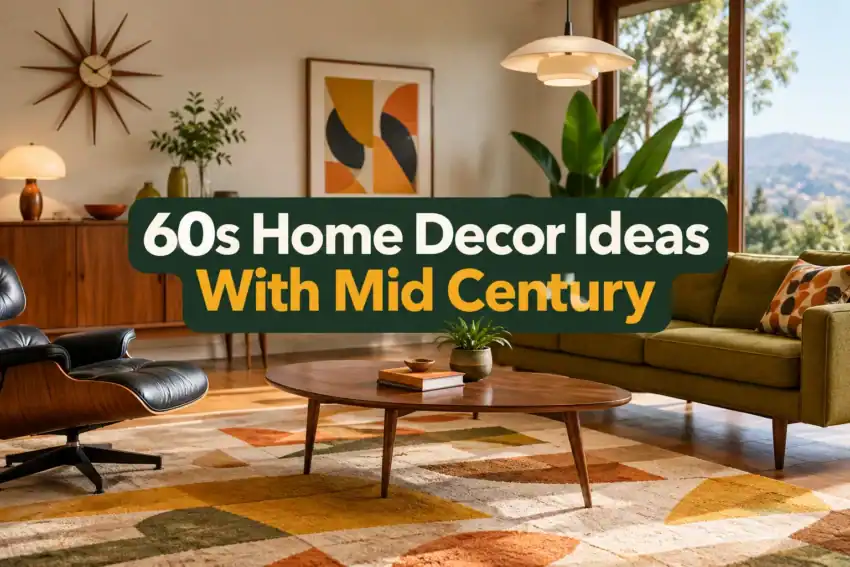
Quick Answer
The most reliable way to use 60s home decor ideas with mid century modern style is to buy structure from the era and softness from now: one or two warm wood pieces with tapered legs, a low-profile sofa in olive, mustard or rust, a geometric rug, and a sculptural light fixture.
Keep walls neutral, limit yourself to two or three patterns per room, and let modern upholstery handle comfort. Designers consistently recommend anchoring a contemporary room with a few standout 60s pieces rather than recreating a full period set, and The Spruce reports midcentury modern is shifting toward warmer, layered rooms rather than stark period reproduction.
Table of Contents
Key Takeaways
- Three anchors are enough: warm wood (walnut, teak, oak), a low seat line, and one retro light fixture.
- Palette rule: two earthy neutrals (cream, soft brown) plus one saturated accent (mustard, rust, olive, burnt orange).
- Pattern limit: one bold geometric (usually the rug), one small-scale texture, one solid. More than that reads like a film set.
- Mix eras on purpose: one authentic vintage piece per room gives age and patina; new seating gives depth and support.
- Budget route: thrifted teak, a secondhand credenza, and a reproduction mushroom lamp cost far less than a licensed reissue.
- Small spaces win with legs: exposed tapered legs and open bases make floors visible, so rooms feel larger.
- Avoid the biggest mistake: matching everything to one “retro” set, which flattens the look instantly.
- Still current: mid century forms remain a top designer choice, cited by roughly a quarter to a third of designers in a 1stDibs interior design trends survey.
What Defines Mid Century Modern Design From the 1960s?
Sixties mid century modern is defined by clean lines, visible legs, warm wood, and low horizontal furniture, with bolder color and more organic shapes than the 1950s version. Function leads, ornament is minimal, and rooms connect to the outdoors through large windows and plants.
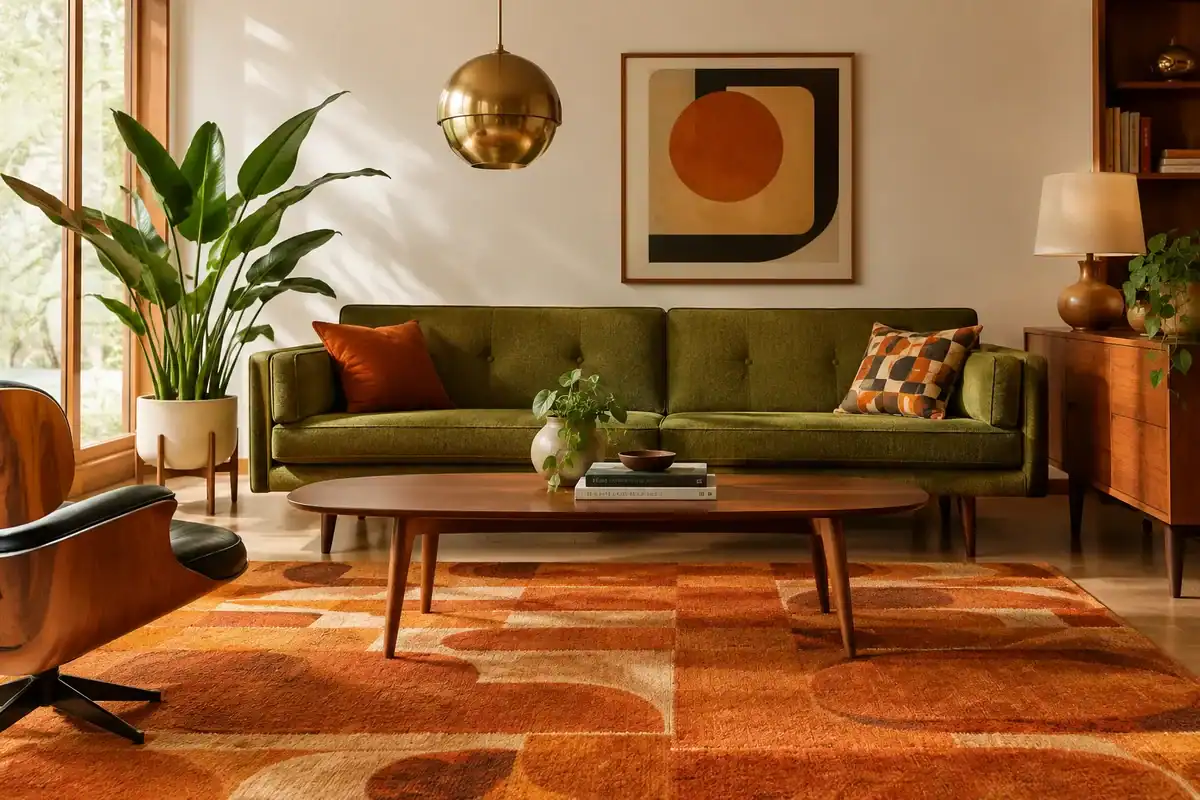
The signatures worth copying:
- Woods: walnut and teak first, then oak and ash, usually oiled rather than glossy.
- Legs: tapered, splayed, or hairpin, lifting furniture off the floor.
- Seating: low-profile sofas, curved lounge chairs, slim arms.
- Shapes: circles, kidney curves, and simple geometry. Current style guides note rounded sofas and sculptural forms replacing boxy shapes.
- Details: brass or chrome hardware, globe glass, ceramic vessels, abstract art.
Edge case: in a house with heavy traditional molding, skip the furniture-only approach and add a flat-panel door or simple square trim in one room first. Otherwise the ornate frame fights the clean lines.
Mid Century Modern vs Retro 60s Decor: What’s the Difference?
Mid century modern is a furniture and architecture movement built on restraint; retro 60s decor is the pop culture layer on top (psychedelic prints, flower power, shag, bright plastics). Most livable homes use mid century bones with a small dose of retro.
| Mid century modern | Retro 60s | |
|---|---|---|
| Palette | Earthy, tonal, wood-led | High-contrast, saturated |
| Pattern | Sparse, geometric | Florals, swirls, op art |
| Materials | Teak, walnut, wool, leather | Plastic, chrome, shag, vinyl |
| Risk | Can feel cool or sparse | Can feel costume-like |
Decision rule: choose mid century modern as your base if you plan to keep the room for years; add retro through swappable items (a flower-print pillow, a tiled tray, a poster). Wayfair’s guide to 60s flower power interiors shows how florals and bold tile read best as accents, not whole rooms.
Best Colors for a 1960s Mid Century Modern Living Room
The strongest 60s palette pairs warm neutrals with one or two saturated accents: cream, soft brown, and oat as the base, then olive green, mustard, rust, or burnt orange on upholstery and textiles. Spanish design coverage describes 2026 living rooms dominated by olive green, terracotta, mustard and soft browns, which echoes late-60s naturalism.
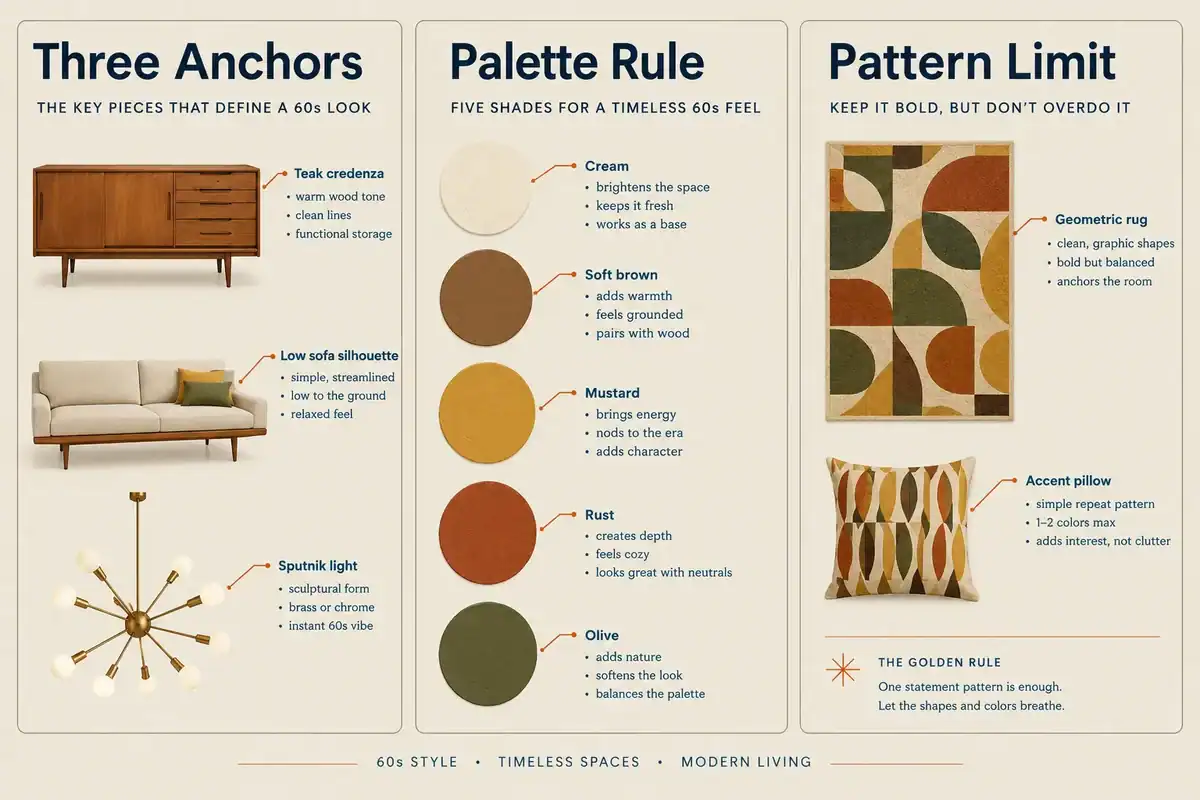
A simple formula for 60s living room decor:
- 60% neutral: walls, large rug field, wood tones.
- 30% secondary: sofa or chairs in olive, chocolate, or caramel.
- 10% punch: mustard, orange, or teal in pillows, ceramics, art.
For a kitchen or dining area, the same logic works with warmer woods; see these earth tone kitchen decor ideas for pairing suggestions.
What Flooring and Wall Colors Go With 1960s Decor?
Medium-to-warm wood flooring (white oak, walnut-stained engineered plank) suits 60s decor best, with walls in warm white, oat, or a soft clay tone. Avoid cool gray flooring, which drains the warmth out of teak and brass.
- Flooring: warm oak, cork, or terrazzo-look tile. Low-pile wool or jute rugs on top.
- Walls: creamy white (the safe default), olive or caramel for one accent wall, or wood panelling on a single wall for a 60s reference.
- Ceiling: leave it white in small rooms. Color-drenching a ceiling works only when the room has good natural light.
- Common mistake: painting all four walls orange. One warm accent wall plus wood does the same job without the glare.
How to Mix 60s Decor With Modern Furniture
Mix by keeping silhouettes compatible and limiting your wood tones. Use modern pieces for anything you sit on or store a lot in, and vintage pieces for character: a credenza, a side table, a lamp, a mirror.
A workable ratio is one vintage piece per three modern ones. Then tie them together:
- Repeat one wood tone at least twice (credenza plus picture frames, for example).
- Repeat one metal finish (brass or chrome, not both).
- Keep seat heights within a few inches so the room reads level.
- Put a modern, deep-seated sofa with a slim vintage armchair, not two fussy vintage chairs.
For more on layering old and new without theme overload, see these modern vintage living room ideas and this guide to modern living room layouts and styling.
What Kind of Lighting Works Best for 60s Style Homes?
Sculptural, warm lighting works best: globe pendants, mushroom lamps, Sputnik chandeliers, cone pendants, and tripod floor lamps. Use 2700K bulbs on dimmers and plan three light sources per room instead of one ceiling fixture.
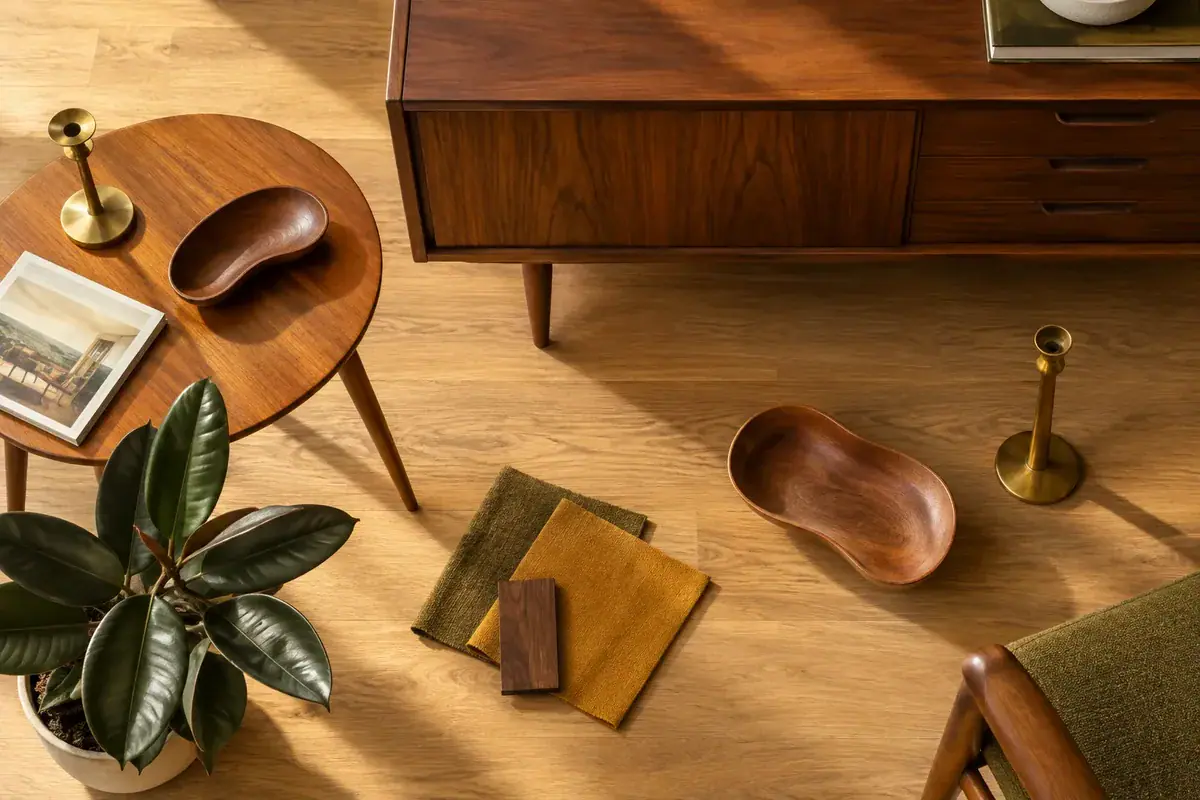
- Dining: Sputnik or a single large globe, hung 30-34 inches above the table.
- Living: tripod or arc floor lamp beside the sofa, mushroom lamp on the credenza.
- Entry: one opal glass globe flush mount.
- Bedroom: small mushroom lamps on both nightstands.
Design academies list Sputnik chandeliers, cone pendants and tripod floor lamps among returning mid century fixtures. Edge case: in a rental with no ceiling box, a plug-in pendant hung on a cord hook delivers the same silhouette.
60s Home Decor Ideas With Mid Century Modern Style for Small Apartments
In small apartments, choose 60s pieces with open bases, slim arms, and visible legs so sightlines stay clear. One credenza, one curved chair, one geometric rug, and one retro lamp are enough for a convincing 60s aesthetic living room under 400 square feet.
Small space variation:
- Swap a full sideboard for a wall-mounted teak shelf unit (frees floor space, keeps the wood tone).
- Use nesting tables instead of one wide coffee table.
- Pick a loveseat-scale low sofa with a tight back rather than a sectional.
- Hang art higher and in one column to stretch the wall.
- Choose a round dining table on a pedestal or tripod base for tight corners.
Storage benches and sofa beds keep the look practical; smaller floor plans are exactly where multifunctional mid century furniture earns its keep. Pair with these small home organization and space-saving ideas.
Can You Do 60s Mid Century Modern on a Budget, and What Does a Room Cost?
Yes. A convincing room can come together for a few hundred dollars if you buy the wood secondhand and the soft goods new. Costs vary by city and condition, so treat the figures below as planning estimates, not quotes.
Where to look, cheapest first: estate sales and auctions, Facebook Marketplace and Craigslist, Habitat ReStore, thrift chains, university-town consignment shops, then online vintage marketplaces. Mainstream retailers now carry mid century-inspired lines with clean lines and warm wood at entry prices, which Living Spaces’ decor trends coverage places inside the current eclectic mix.
Budget option: a $60 thrifted teak side table, a $40 reproduction mushroom lamp, a $120 geometric area rug, two $25 mustard corduroy pillows, and three $10 thrifted ceramic vases will shift a plain room decisively 60s.
60s Mid Century Room Budget Estimator
Planning estimates in USD for one room, based on typical US and Canadian resale and retail prices.Room Living room Bedroom Dining space Entryway Sourcing approach Mostly thrifted and secondhand Mix of vintage finds and new Mostly new reproductions
$450 – $1,100
Estimates only. Shipping, reupholstery and licensed reissues raise totals significantly.
Vintage vs reproduction: buy vintage when the piece is solid wood storage (credenzas, dressers, side tables) because joinery and patina hold up. Buy new when it involves foam, springs, or daily use. Reupholstering an authentic frame often costs more than a new sofa.
60s Home Decor Ideas With Mid Century Modern Style, Room by Room
Living rooms carry the boldest 60s moves; bedrooms should stay calmer, with color in textiles rather than walls. Dining rooms get the statement light, and entryways need only three pieces.
- Living room: low sofa, teak media console, geometric rug, one curved accent chair, record player on the credenza. Style the coffee table in three heights: a stacked book, a ceramic bowl, something green.
- Bedroom: walnut headboard, two tapered-leg nightstands, matching globe lamps, nubby boucle or corduroy throw. Keep walls soft and skip the pattern on the bed. More ideas in this guide to modern bedroom decor that looks luxe.
- Dining: round table, spindle-back or shell chairs, Sputnik overhead, one vintage ceramic centerpiece. Tight footprint? Try these small dining room ideas.
- Entryway: slim console, round or sunburst mirror, globe flush mount, small ceramic dish for keys.
Common Mistakes People Make Decorating With 60s Style
The top mistake is buying a matching retro collection, which turns a home into a showroom. The second is pattern pile-up: wallpaper plus patterned rug plus printed sofa plus op-art pillows in one room.

Also worth avoiding:
- Too many themed accessories. Cap retro trinkets at about five visible per room.
- Mixing four wood tones. Two is plenty, three if one is a small accent.
- Cool gray paint with teak. It makes the wood look orange and cheap.
- Ignoring comfort. Vintage seat depths are shallow; pair them with one genuinely deep modern seat.
- No negative space. Leave a bare wall and an empty surface. Restraint is what keeps the look modern, the same principle behind minimalist decor that still feels warm.
Is Mid Century Modern Still in Style?
Yes, and the 60s branch is holding up especially well because its warm woods and earthy colors fit current taste for softer, layered rooms. Designer polling shows the style cooled slightly, then warmed again, and it remains a leading choice for roughly 26% of US designers and 30% of designers outside the US, according to 1stDibs’ designer survey.
What has changed is how it’s used: mixed with Scandinavian, industrial, and global pieces instead of reproduced wholesale, with velvet and corduroy upholstery, curved silhouettes, and plenty of plants.
FAQ
What is the easiest first purchase for a 60s look?
A teak or walnut credenza on tapered legs. It delivers storage, warmth, and the right silhouette in one piece.
Do I need an authentic vintage piece?
No, but one real vintage item per room adds patina that new furniture cannot fake. Storage pieces are the best candidates.
Which single color says “60s” fastest?
Mustard. Olive and rust run a close second and are easier to live with on large pieces.
Can 60s mid century style work in a rental?
Yes. Focus on furniture, rugs, plug-in lamps, and art. No paint or wallpaper required.
How many patterns should one room have?
Two to three: one bold geometric, one subtle texture, and solids everywhere else.
Is shag carpet a good idea?
Only in a small dose, like a 3×5 accent rug. Wall-to-wall shag reads dated and traps dust.
What rug works with a 60s living room?
A low-pile wool rug with a geometric or abstract pattern in olive, rust, and cream. Vintage-inspired geometrics are a current favorite.
Does a record player actually fit modern living?
Yes, and it doubles as decor. Put it on a credenza with a short row of records rather than a full wall of storage.
How do I keep the style from feeling cold?
Layer texture: corduroy or velvet upholstery, a jute rug, linen curtains, ceramics, and two or three plants.
What lighting temperature should I use?
2700K warm white, on dimmers. Cool white light flattens wood tones and kills the mood.
Conclusion
Sixties mid century style works in a current home when you treat it as structure, not costume: warm wood, a low seat line, earthy color with one saturated accent, and a single sculptural light per room.
Next steps:
- Pick your three anchors for one room (wood piece, seating, light fixture).
- Lock a palette: two neutrals, one accent. Write it down before shopping.
- Set a pattern budget of three maximum, and let the rug take the lead.
- Source the wood secondhand this month; buy the soft goods new.
- Before adding anything else, remove two items. Empty space is what makes the look feel modern.