Quick Answer
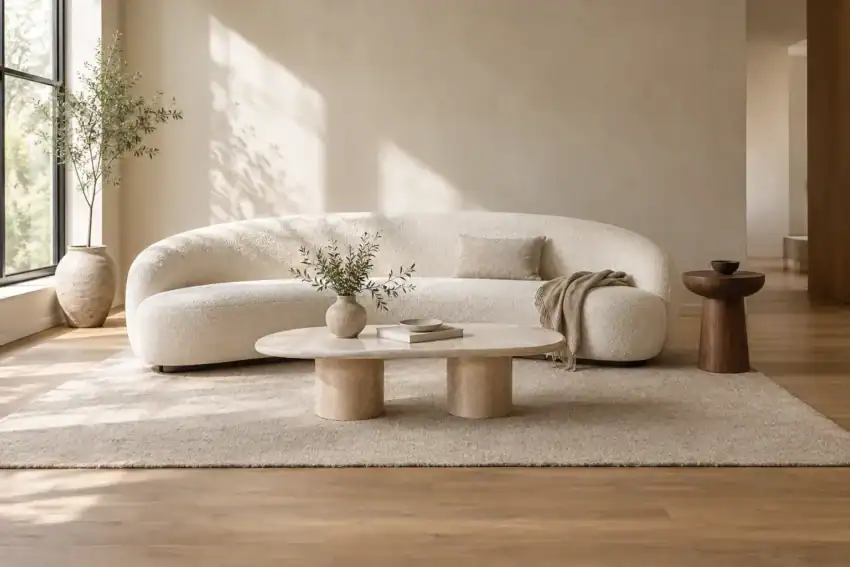
Curved minimalist living room furniture softens a boxy room by replacing sharp, blocky silhouettes with gentle rounded shapes, without adding visual weight.
The trick is proportion, not size: choose low-profile frames under about 30 inches tall, keep arms slim or skip them entirely, pair one curved statement piece with simpler straight-lined supporting furniture, and protect at least 30 to 36 inches of walkway. Done well, a curved sofa or barrel chair makes a small living room feel warmer and more open, not more crowded.
Table of Contents
Key Takeaways
- One curve leads. Let a single rounded piece be the sculptural focal point, then keep everything around it quiet and low.
- Low beats large. A curved sofa under 30 inches high reads light even at 85 inches wide; retailers specifically group low curved sofas for exactly this reason.
- Small-space sizing exists. Compact curved loveseats start around 67 inches wide, with apartment-friendly curved sofas in the 83 to 89 inch range.
- Round tables win in tight rooms. No corners means easier movement and fewer bruised shins.
- Mix shapes deliberately. Curves need straight lines (a console, a shelf, a window frame) to feel intentional rather than wobbly.
- Texture does the warming. Bouclé, linen, cotton, and velvet in calming neutral tones add softness without bulk.
- Float, don’t flatten. Pushing a curved sofa flat against a wall wastes the shape and creates awkward dead triangles.
- Budget entry points are real. A barrel chair, round ottoman, or arched side table delivers the look for a fraction of a full sofa.
What is curved minimalist living room furniture, and how is it different from regular minimalism?
Curved minimalist living room furniture keeps the pared-back discipline of minimalism (few pieces, clean surfaces, calming neutral tones) but swaps rigid right angles for rounded, sculptural forms. Traditional minimalism leans on sharp rectangles and thin legs; curved minimalism uses arcs, barrel backs, and oval tops to make the same edited room feel softer.
The difference shows up in how a room feels, not how much is in it. Design commentary now frames the shift as a move away from sterile, cold minimalist furniture toward warmer textures and more comfortable upholstery inside a still-edited framework. You’re not adding more stuff. You’re changing the shape of the few things you keep.
Think of it as the softer cousin of timeless traditional minimalist living room ideas: same restraint, friendlier geometry.

Quick decision rule: if your living room feels modern but somehow unwelcoming, the problem is usually shape and texture, not color.
Curved vs straight furniture: which is better for minimalist design?
Neither wins outright. Curved furniture is better for softening boxy rooms, improving traffic flow, and creating conversation groupings. Straight furniture is better for maximizing seating along walls and in very narrow rooms.
| Factor | Curved furniture | Straight furniture |
|---|---|---|
| Feels soft and inviting | Excellent | Can read cold |
| Seating per inch | Lower | Higher |
| Works flat against a wall | Poorly | Perfectly |
| Traffic flow around it | Smooth, no corners | Corners catch hips |
| Conversation grouping | Natural, inward-facing | Needs extra chairs |
| Best in narrow rooms | Only compact versions | Usually the safer pick |
Choose curved if your room is square-ish, open-plan, or has lots of hard architectural lines. Choose straight if you need maximum seating in a long, skinny space and every inch along the wall counts.
The honest answer for most homes is both. Sofa trend coverage describes curved and serpentine silhouettes making a strong comeback precisely because they break up straight lines, which only works if some straight lines remain.
What are the best curved sofas for small living rooms?
The best curved sofas for small living rooms are low-profile, under roughly 90 inches wide, with slim or absent arms and legs that lift the frame off the floor. Visible floor underneath a sofa is the single cheapest way to make a room look bigger.
Look for these specs:
- Width: 67 to 72 inches for a curved loveseat; 83 to 89 inches for a small-space curved sofa. Wayfair’s range includes bouclé curved sofas sized for apartments in exactly this band.
- Back height: under 30 inches keeps sightlines open across the room.
- Seat depth: 21 to 24 inches. Deeper is cozier but eats floor space fast.
- Arms: armless, or a soft rolled arm no wider than 6 inches.
- Legs: exposed tapered wood or slim metal, 4 to 6 inches tall.
One newer option worth knowing: compressed or “boneless” curved cloud sofas ship vacuum-packed with no assembly and expand to full shape over about 72 hours. Reviews of curved cloud-style sofas note they’re marketed specifically for small living rooms, which helps if your stairwell is tight.
Common mistake: buying a curved sofa by seat count alone. A 3-seat curved sofa often occupies the wall length of a 4-seat straight one, because the arc pushes the ends forward.
Does curved furniture work in tiny apartments and narrow living rooms?
Yes, but with rules. In tiny apartments, curves work best in small doses: a barrel chair, a round ottoman, an oval coffee table. In narrow rooms, a full curved sofa usually fights the walls, so put the curve in the chairs and tables instead.
For narrow living rooms specifically:
- Keep the straight sofa along the long wall for seating efficiency.
- Add two rounded accent chairs at the far end, angled inward.
- Swap the rectangular coffee table for an oval one so the room reads wider.
- Use a round side table in the corner where a square one would jam.
If your space is long and skinny, our guide to living room layouts for small rectangular rooms pairs well with this approach. Renters squeezing every inch will also find useful moves in small space solutions for an organized minimalist home.
A curved chair in a tiny room is a gift. A curved sofa in a tiny room is a negotiation.
How do you arrange curved furniture in a minimalist space?
Float the curved piece slightly off the wall so its shape reads from multiple angles, then keep every surrounding piece low and simple. Styling guidance consistently treats the curved sofa as the sculptural statement and recommends pairing it with a round coffee table while keeping other furnishings minimal.
A workable sequence:
- Anchor the rug first. The front legs of every seat should touch it. Sizing help: how to choose the right rug size for a living room.
- Place the curved sofa 4 to 10 inches off the wall, or angled across a corner.
- Center a round or oval table 16 to 18 inches from the seat front.
- Add two rounded chairs opposite, forming a loose circle, not a straight facing line.
- Protect walkways: 30 to 36 inches for main paths, 24 inches minimum for secondary ones.
- Stop. Resist the urge to fill the remaining corner.
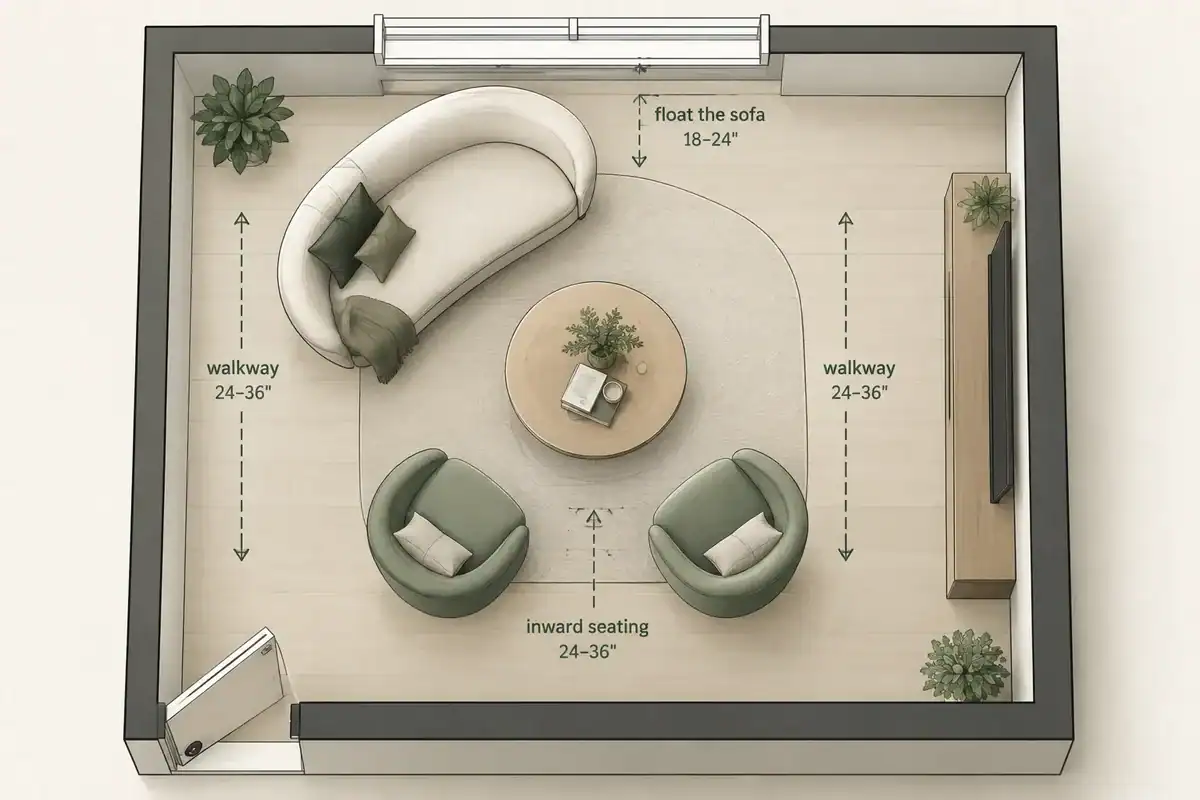
Edge case: if your TV wall is the focal point, a curved sofa can feel like it’s turning away from it. Angle the arc so the center seat faces the screen squarely, and keep the TV wall styling simple so the sofa stays the sculptural element.
How do you keep curved furniture from looking cluttered?
Limit yourself to one dominant curve, two supporting curves, and nothing else rounded. Too many arcs in one room creates visual noise that reads as clutter even when surfaces are clean.
Practical guardrails:
- The 1-2-stop rule: one curved sofa (dominant), one round table plus one rounded chair or ottoman (supporting), then switch to straight lines for shelving, consoles, and art.
- Keep tabletops to three objects max in varied heights.
- Hide the everyday mess. A closed-door console beats an open basket pile; see minimalist decor ideas that hide everyday clutter.
- Leave one empty corner. Negative space is what makes curves look deliberate.
Clutter-free styling is less about owning less and more about giving each shape room to breathe.
What colors and materials work best for curved minimalist living rooms?
Textured neutrals win. Cream, oatmeal, beige, warm greige, and soft gray in tactile fabrics pair best with rounded forms because they add warmth without visual heaviness, which is why bouclé, velvet, and chenille dominate curved sofa listings.
Fabric quick guide:
| Fabric | Feel | Best for |
|---|---|---|
| Bouclé | Nubby, cloud-like | The signature curved look; hides light wear |
| Linen | Crisp, airy, relaxed | Japandi and Scandinavian rooms |
| Cotton canvas | Casual, breathable | Families, slipcovered pieces |
| Velvet | Plush, slightly formal | Adding depth to a pale neutral room |
| Performance weave | Tight, wipeable | Kids, pets, light upholstery |
Balance the softness with warm wood. Living room trend coverage notes growing use of deeper espresso and mahogany tones that read elegant rather than loud. A walnut oval table or oak-legged chair grounds all that pale upholstery.
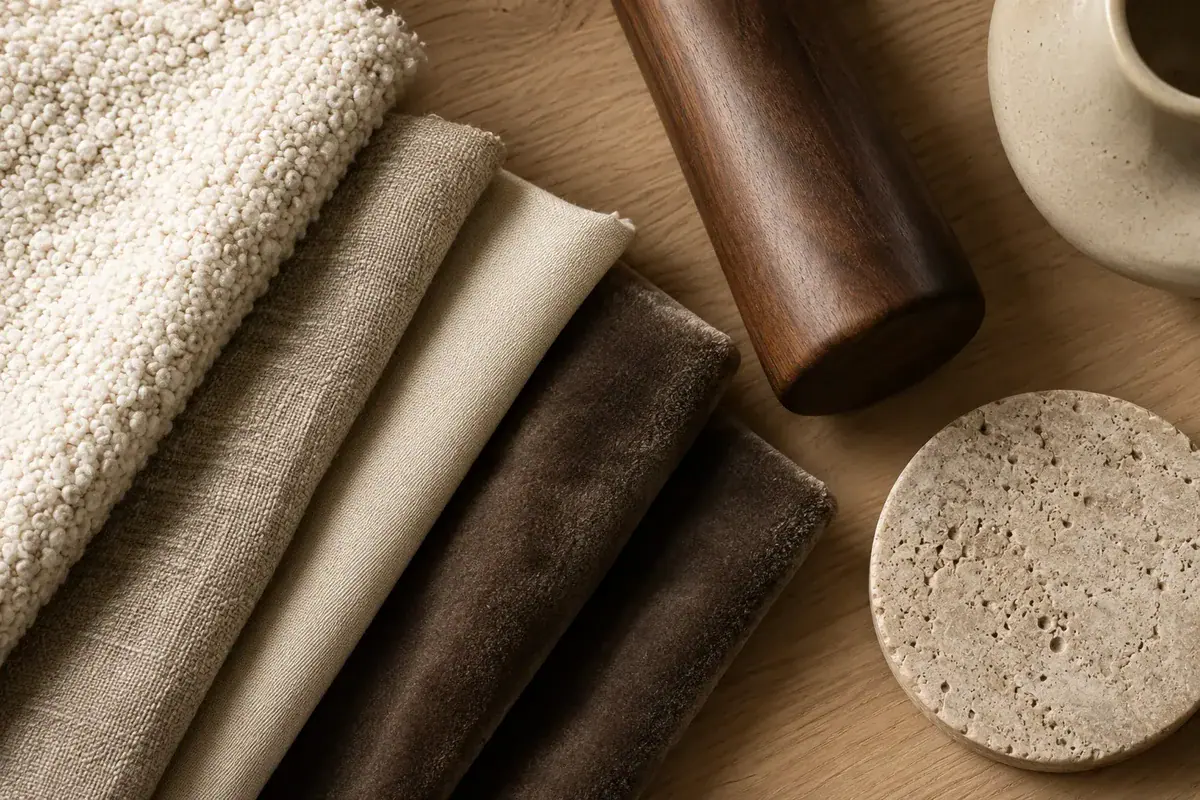
If you’re building the palette from scratch, start with a neutral palette living room base and layer in texture rather than extra color. For depth without drama, add one muted accent: olive, clay, or a dusty blue cushion.
What should you look for in curved minimalist coffee tables and side tables?
Pick round or oval over rectangular whenever a walkway is tight, and keep the table height within 2 inches of your seat height. A 36 to 42 inch round table suits most curved sofas; smaller rooms do better with a 30 to 34 inch round or two nesting rounds.
- Oval stretches a narrow room visually and seats more people around it.
- Round is the safest pick for traffic flow and families with toddlers.
- Nesting rounds split apart when guests arrive, tuck away when they don’t.
- Sculptural side tables (a drum, a pedestal, an arch-base pillar) carry the curve without taking floor space.
Material pairing rule: if the sofa is soft and pale, make the table hard and warm (travertine, walnut, oak). If the sofa is dark, go pale stone or light wood. Matching soft-on-soft flattens the room.
Are there affordable curved minimalist pieces and sets, including chairs and ottomans under $500?
Yes. The most affordable entry points are rounded accent chairs, barrel chairs, round ottomans, and arched side tables, which commonly fall under $500 at mainstream retailers. Curved sofas themselves span a wide range, from budget cloud-style couches at big-box stores up through designer serpentine pieces, with curved sofa options at Target sitting at the accessible end.
Budget-smart sequence, cheapest first:
- Round ottoman or pouf (often under $150), instant soft shape, doubles as seating.
- One barrel accent chair, the highest impact per dollar.
- Arched or drum side table, small footprint, sculptural payoff.
- Round coffee table, replaces the boxiest piece in most rooms.
- Curved loveseat or sofa, the last and largest investment.
Skip the matching set. Full curved “sets” often create the exact bulk you’re trying to avoid. Buying pieces individually keeps proportions under your control and spreads the cost. More ways to refresh without replacing everything: a minimalist home look without getting rid of everything.
Can a curved sectional work in minimalist style without overwhelming the room?
A curved sectional works in minimalist rooms only when the room is at least about 12 by 14 feet and the sectional is low-backed, modular, and floated to define a zone rather than fill a corner. Retailers note curved sofas can be surprisingly space-efficient in open layouts because the shape defines and softens the floor plan while naturally pulling seating inward.
Make it work:
- Choose modular so you can shrink the configuration later.
- Keep the back under 30 inches and the arms nearly flush.
- Use it as a room divider in open-plan spaces, with the curve facing in.
- Pair with a single round table and nothing else. No extra chairs, no ottoman.
Overwhelm warning sign: if the sectional touches two walls and you’re stepping sideways to reach the window, it’s too big. Size down to a curved sofa plus one chair.
What are the most common mistakes when decorating with curved minimalist furniture?
The biggest mistake is pushing a curved sofa flat against a wall, which hides the shape and creates unusable triangles of dead space behind the arms.

Others to avoid:
- Too many curves. Round sofa, round rug, round table, round mirror, round lamp, the room starts to feel like a bubble.
- Oversized scale. A 110-inch curved sofa in a 10-foot room, bought because it looked airy in a showroom three times the size.
- Blocked walkways. Losing the 30-inch path is the fastest way to make a soft room feel cramped.
- All-white, no texture. Stark white curves without bouclé, wood, or linen read cold, the exact problem curves were meant to solve.
- Ignoring door swings. Measure the arc of your entry door against the arc of the sofa.
- Forgetting the light. Hard overhead lighting flattens curves; layered lamps reveal them. See cozy living room lighting ideas.
Is curved minimalist furniture good for modern homes, and will it last?
Yes. Curved pieces suit modern homes especially well because contemporary architecture is full of straight lines (large windows, flat ceilings, rectangular rooms) that benefit from a softening counterweight. Designers quoted in House Beautiful’s living room trend coverage point to sculptural, rounded, pillowy seating as defining current interiors.
On longevity: curved roundups and trend reports describe curved styles as here to stay rather than a passing fad, and the steady expansion of low-profile and small-space curved categories across major retailers supports that. Design reports also list curved shapes as clearly “in” while boxy silhouettes trend out.
Buy for proportion and material quality, and the piece outlives the trend conversation entirely.
FAQ
Do curved sofas take up more space than straight sofas?
Usually yes, in floor area. A curved sofa’s arc pushes its ends forward, so a 3-seat curved sofa can occupy the depth of a 4-seat straight one. Compensate by choosing a low back and exposed legs.
Can a curved sofa go against a wall?
It can, but it’s not ideal. The arc leaves dead triangles behind the arms. Float it 4 to 10 inches off the wall or angle it across a corner so the shape reads properly.
What size coffee table goes with a curved sofa?
A round table 36 to 42 inches across works for most full-size curved sofas; go 30 to 34 inches for a loveseat. Keep it 16 to 18 inches from the seat front and within 2 inches of seat height.
Is bouclé practical for families with kids or pets?
Moderately. Bouclé hides light wear and crumbs well, but loose loops can snag on claws. Choose a tight-weave bouclé or a performance version if pets share the sofa.
How much walkway space do I need around curved furniture?
Keep 30 to 36 inches for main traffic paths and at least 24 inches for secondary routes between pieces.
Can I mix curved and straight-lined furniture?
Yes, and you should. Curves look deliberate only when straight lines surround them. Keep consoles, shelving, and frames rectangular while seating and tables carry the curves.
What’s the cheapest way to get the curved look?
A round ottoman or pouf, then a single barrel accent chair. Both commonly sit under $500 and deliver the soft silhouette without a sofa-sized commitment.
Does curved furniture work with Japandi or Scandinavian style?
Very well. Both styles favor simple forms and natural materials, so a gently curved linen sofa with light oak legs fits naturally.
Conclusion
Curved minimalist living room furniture solves a real problem: modern rooms that look right but feel stiff. The fix isn’t more furniture. It’s softer shapes in smaller, lower profiles, with open floor left around them.
Your next three steps:
- Measure before you browse. Note your seating wall length, room depth, and door swings, then shop only within those numbers.
- Start with one curve. A barrel chair or round ottoman tells you quickly whether the softer look suits your space, at a fraction of the sofa cost.
- Add texture before adding pieces. Swap in a bouclé cushion, a linen throw, and a warm wood table. Often that alone fixes the coldness.
Keep it simple, keep it low, and leave the floor space. That’s where style meets comfort.