
Greenery bathroom decor works best when the plants feel like part of the room rather than an extra layer placed at the end. One tall plant beside the vanity, a trailing vine on a pale oak shelf, or a few eucalyptus stems in a stone vase can bring softness without covering every surface.
You do not need a large renovation to create this mood. These renter friendly bathroom updates that look more expensive show how plants, towels, trays, and small accessories can change a bathroom while the main finishes stay in place.
The goal is a bathroom that feels fresh, calm, and polished without looking like a greenhouse. Soft leaves, warm light, natural texture, and clear surfaces can give the room a relaxed hotel mood that still feels practical for daily use.
Table of Contents
Greenery Bathroom Decor That Feels Fresh and Luxe
The room starts to feel more polished when the greenery has a clear role.
Architectural Digest notes that green works well in bathrooms because of its calm, spa like quality. Pairing it with clean white surfaces and warm finishes helps the room feel polished rather than themed. Green bathrooms can feel calm and spa inspired, especially when the color appears through leaves, towels, and a few well placed accents.

Use Fewer Plants With Stronger Placement
A bathroom rarely needs plants in every corner.
One tall plant beside the vanity can have more impact than six small pots spread across the counter, shelf, window ledge, and toilet tank. The room feels calmer because the eye has one clear place to land.
Good places for a larger plant include:
- Beside a floating vanity
- Near a bright window
- At the end of a long counter
- Near a freestanding tub
- In an open corner outside the shower
- Beside a pale wood stool
Leave about 6 to 10 inches of open space around a counter plant. For a floor plant, keep at least 12 inches between the planter and any cabinet door or shower opening.
A tall plant around 3 to 5 feet works well in a larger bathroom. In a smaller room, a plant around 12 to 20 inches tall may be enough.
Pair Greenery With Clean White Finishes
Green leaves look strongest against calm surfaces.
Warm white walls, white quartz, pale stone, and cream towels give the plants room to stand out. The contrast feels fresh without becoming too bright or cold.
A simple vanity scene could include:
- Charcoal cabinet
- White quartz counter
- Black framed mirror
- Brass sconces
- Cream hand towel
- One ceramic planter
- One sculptural plant
Keep the counter mostly open.
A plant around 6 to 10 inches tall can sit at one end of a 36 inch vanity without blocking the mirror. Place it at least 4 inches away from the faucet so leaves stay clear of splashes.
Add One Warm Luxe Finish
Greenery feels richer beside one warm material.
Brushed brass, pale oak, walnut, woven fiber, and cream linen all work well. Pick one main finish and repeat it lightly.
For example:
- Brass sconces and brass drawer pulls
- Pale oak stool and pale oak shelf
- Woven basket and woven planter sleeve
- Cream towels and cream shower curtain
- Walnut mirror frame and walnut tray
Two repeats are usually enough.
Give Each Plant a Clear Purpose
Every piece of greenery should help the room.
A tall floor plant can soften an empty corner. A trailing plant can add movement to a shelf. A small vase can bring color to the vanity. A single branch can make a narrow ledge feel finished.
Think about what the room is missing.
If the bathroom feels too sharp, use broad soft leaves.
If the shelf feels flat, use a trailing vine.
If the counter feels cold, use a ribbed ceramic pot with one small plant.
If the room feels crowded, remove plants rather than adding more.
Keep Planters Calm and Simple
The planter matters almost as much as the plant.
Good planter choices include:
- Matte warm white ceramic
- Soft black stone look
- Ribbed cream ceramic
- Pale gray cement
- Woven cover over a basic pot
- Smooth taupe planter
- Slim black metal stand
Match the planter to one finish already in the room.
A black planter can connect with the mirror frame. A cream planter can connect with the towels. A woven planter sleeve can connect with a storage basket.
Avoid using several unrelated planter styles in one small bathroom.
Use One Plant as the Main Color Accent
Green can carry the color in the room.
Keep the rest of the palette quiet with black, white, cream, brass, wood, and stone. The leaves will look brighter and more deliberate.
A strong room may include:
- Warm white walls
- Charcoal vanity
- White quartz counter
- Matte black mirror
- Brass sconces
- Cream towels
- Pale oak stool
- One large green plant
This keeps the bathroom fresh without adding sage towels, emerald art, green tile, and several different plants at the same time.
Let Natural Light Work With the Greenery
Place real plants where they can use the available daylight.
A plant near a window can bring movement into the room as the light changes. Morning light can make the leaves look bright and soft against white walls.
Do not place a large plant directly in front of the window. It can block light and make the bathroom feel smaller.
For a windowless bathroom, faux greenery may be the safer choice. Use one realistic leaf type and place it in a matte ceramic or stone planter.
Build a Simple Fresh Luxe Formula
A balanced greenery bathroom can follow this mix:
- One main plant
- One smaller green detail
- One warm metal finish
- One natural wood piece
- Cream or white towels
- Clear counter space
- Warm light around the mirror
This keeps the room fresh and polished without making the greenery feel like a separate theme.
Effortless greenery bathroom decor works best when the plants are fewer, the placement is clear, and the finishes around them stay calm.
Choose Bathroom Plants That Suit the Light and Humidity
Humidity helps some leaves stay soft, but light and airflow still matter. A plant placed in the wrong corner may struggle even if the room feels warm and damp after every shower.
Beyti Studio recommends plants such as snake plants, pothos, and ferns for humid bathroom settings. Their guide on bathroom plants that suit humidity and indoor light also pairs greenery with brass, matte black, and simple white finishes, which fits the fresh luxe mood well.

Match the Plant to the Window
Start with the actual daylight in the room.
A bright bathroom with a large window gives you more plant choices. A shaded bathroom with a small frosted window needs plants that can handle lower light. A windowless bathroom may be better suited to faux greenery.
Look at the room during the brightest part of the day.
Ask:
- Does direct sun reach the floor?
- Does the window face north, south, east, or west?
- Does the glass have privacy film?
- Are blinds closed most of the day?
- Does another building block the light?
- Does the plant sit more than 6 feet from the window?
A plant near an east facing window may receive gentle morning light. One near a south facing window may need more distance from the glass so the leaves do not scorch.
Use Humidity Friendly Plants
Some plants handle bathroom conditions better than others.
Pothos, ferns, and snake plants are common choices because they can work in warm rooms with changing moisture levels. Each still needs suitable light and care.
A simple placement plan could look like this:
- Fern near a filtered window
- Pothos on a high shelf
- Snake plant beside a vanity
- Small philodendron on a bath ledge
- Eucalyptus stems in a vase on the counter
Keep the plant label or care notes nearby until you know how the plant reacts to the room.
A fern may enjoy humidity but still struggle in a dark corner. A snake plant may handle lower light, but it should not sit in standing water.
The bathroom should support the plant rather than just look good for a photo.
Check Airflow After Showers
Humidity can help some plants, but trapped moisture may also cause problems.
A bathroom with weak airflow can stay damp for hours. This may lead to mold on soil, standing water in saucers, or leaves that never dry.
Run the bathroom fan after showers and keep the plant away from areas where water collects.
Useful placement gaps include:
- 4 to 6 inches from a shower opening
- 6 inches from a frequently wet counter edge
- 12 inches from a swinging cabinet door
- 18 inches from a floor vent
- Clear space around the planter base
Do not let a planter sit directly in a puddle near the shower. Use a tray beneath the pot and empty any water that collects.
Keep Plants Away From Harsh Heat
Bathrooms can have sudden temperature changes.
Warm steam, cold window glass, heated floors, and ceiling vents may all affect the plant.
Avoid placing leaves directly beneath a heating vent or beside a radiator. Keep tropical plants away from cold glass during winter, especially in Canadian homes where window temperatures can drop sharply.
A plant stand can help lift the pot away from a heated floor. A small shelf can keep trailing greenery above damp surfaces.
Use the Right Planter and Drainage
The outer planter may look polished, but the inner pot still needs to work.
Keep the plant in a nursery pot with drainage holes, then place that pot inside a ceramic, stone, or woven cover. This makes watering easier and protects the bathroom surface.
A useful setup includes:
- Inner pot with drainage
- Outer planter without leaks
- Small tray beneath the inner pot
- Space between the pot and planter wall
- Room to lift the plant out for watering
For a counter plant, choose a pot around 4 to 6 inches wide. A shelf plant may need a smaller 3 to 5 inch pot. A floor plant can use a planter around 10 to 14 inches wide, depending on the plant size.
Avoid oversized pots in narrow rooms because they can make the floor feel crowded.
Know When Faux Greenery Makes More Sense
A windowless bathroom may not support a real plant.
Faux greenery can still soften the room if the leaves look realistic and the placement feels natural.
Choose one leaf type rather than mixing several plastic plants. Pothos, olive branches, eucalyptus, and simple fern shapes often read more naturally than bright glossy leaves.
Make faux greenery look better by:
- Using a ceramic or stone planter
- Bending stems into a loose shape
- Keeping the plant slightly imperfect
- Dusting the leaves often
- Avoiding oversized plastic vines
- Placing it where a real plant could plausibly grow
A faux plant beside a mirror or on a shelf can still bring color and softness. Keep it away from the hottest part of the shower where water spots may collect on the leaves.
Group Plants Only When the Room Can Handle It
A larger bathroom may support two or three plants in one area.
Group them near a window or tub rather than spreading them across the whole room. Use different heights but similar planter finishes.
A simple group could include:
- One floor plant around 3 feet tall
- One medium pot around 12 inches tall
- One trailing plant on a shelf
Keep at least one third of the nearby floor or shelf open.
In a small bathroom, use one main plant and stop there. The room will feel calmer, and the plant shape will stand out more clearly.
Build a Simple Plant Placement Plan
A practical bathroom plant plan could look like this:
| Bathroom Condition | Best Placement | Greenery Choice |
|---|---|---|
| Bright filtered window | Near the window | Fern or pothos |
| Medium light | Vanity edge or shelf | Snake plant or philodendron |
| Low light | Closest bright corner | Low light tolerant plant |
| No natural light | Shelf or vanity | Realistic faux greenery |
| Small bathroom | One raised spot | Small pothos or stem vase |
| Large bathroom | One grouped zone | Floor plant plus shelf plant |
Greenery Bathroom Decor Around the Vanity
The vanity is one of the easiest places to add greenery because it is already part of the main bathroom view.
Houzz shows how bathrooms made more beautiful with plants often use greenery beside mirrors, counters, tubs, and windows. The plant works best when it supports the room rather than taking over the vanity.

Keep the Counter Mostly Clear
A bathroom vanity needs room for washing, grooming, and cleaning.
Place the plant at one end of the counter rather than directly beside the sink. Leave at least 4 to 6 inches between the planter and faucet so the leaves stay away from splashes.
For a 30 inch vanity, one small plant and one soap pump may be enough.
For a 36 to 48 inch vanity, try:
- One planter at the far end
- One low tray near the faucet
- One folded hand towel
- Clear space around the sink
For a double vanity, place one low arrangement between the sinks or one plant at the outer edge. Avoid matching plants at every corner because the counter can start to feel crowded.
Leave about 8 to 12 inches of open surface where possible. Open counter space makes the quartz or stone more visible and gives the plant a clean background.
Choose the Right Planter Finish
The planter should connect with something already in the bathroom.
A matte white planter can echo white tile. A black planter can connect with the mirror frame. Pale stone works well beside quartz. A woven sleeve can soften a modern vanity.
Useful planter finishes include:
- Warm white ceramic
- Matte black stone look
- Ribbed cream ceramic
- Pale gray cement
- Taupe clay
- Woven fiber
- Clear glass for cut stems
Keep the planter simple if the bathroom already has strong tile or metal details.
A bathroom with checkerboard flooring may need a plain cream planter. A room with white walls and quiet stone can handle a black ribbed pot or darker ceramic shape.
Avoid using several planter colors on the same counter. One finish will look calmer.
Match the Planter Size to the Vanity
Scale matters more than plant count.
A planter that is too small can look lost beside a large mirror. A planter that is too wide can block daily items and make the counter feel cramped.
Useful starting sizes include:
- 3 to 4 inch planter for a narrow vanity
- 4 to 6 inch planter for a 30 to 36 inch vanity
- 6 to 8 inch planter for a wide single vanity
- 8 to 10 inch planter for a double vanity corner
Keep the full plant height around 6 to 12 inches for most counters. A taller arrangement can work at the far end of a long vanity, but it should not block the mirror or sconce.
For a small bathroom, choose a narrow plant with an upright shape. Broad leaves can extend into the sink or doorway if the counter is shallow.
Balance the Mirror, Light, and Plant Height
The plant should sit below the main mirror view.
A counter plant around 8 to 12 inches tall usually leaves enough mirror space above it. If the mirror begins close to the counter, use shorter stems or a low planter.
Keep leaves clear of the sconces.
Warm light can make foliage look richer, but leaves placed directly against a bulb or shade may cast awkward shadows. Leave around 8 to 12 inches between the tallest leaf and the nearest fixture.
A simple vanity wall might use:
- Arched black mirror
- Brass sconces
- Charcoal vanity
- White quartz counter
- One 10 inch fern
- One cream towel
- One pale wood tray
The plant softens the straight cabinet lines without hiding the mirror shape.
Use Greenery as the Main Accent Color
The vanity does not need green towels, green soap bottles, green trays, green art, and several plants.
Let the leaves carry most of the color.
Keep the surrounding pieces within:
- Warm white
- Cream
- Charcoal
- Black
- Brass
- Pale oak
- Soft gray stone
One small green repeat can help. A muted botanical print or a second eucalyptus stem near the shower may be enough.
Too many green accessories can make the vanity look themed. One strong plant will usually feel fresher.
Use Cut Stems on Narrow Vanities
A slim vase may work better than a potted plant on a shallow counter.
Use two or three eucalyptus, olive, or leafy stems in a narrow glass or ceramic vase. Keep the base around 2 to 4 inches wide.
Place the vase at the far end of the counter.
For a 24 inch vanity, a stem arrangement around 8 to 10 inches tall gives color without taking up much room. Keep the stems loose rather than packing the vase tightly.
Cut stems also work well in guest bathrooms where daily plant care may be less practical.
Keep Leaves Away From Water and Daily Items
Greenery should not interfere with the faucet, mirror, toothbrushes, or cabinet doors.
Place the planter where leaves cannot fall into the sink. Keep it away from electric grooming tools and cords.
Useful spacing includes:
- 4 to 6 inches from the faucet
- 6 inches from the sink edge
- 8 inches below a wall sconce
- 10 to 12 inches from a swinging cabinet door
- Clear space around the planter base
A shallow tray beneath the planter can protect the counter from water rings.
Lift the inner nursery pot out for watering rather than pouring water directly into a decorative planter on the vanity.
Style a Double Vanity Without Making It Busy
A double vanity already has more visual weight.
Use one central plant or one plant at the outer edge. Do not place matching plants beside both sinks unless the counter is very wide.
A double vanity around 60 to 72 inches could use:
- One plant between the sinks
- One soap pump at each sink
- One folded towel near each outer edge
- Clear space below each mirror
If two separate mirrors divide the wall, place a low plant between them. Keep it below the mirror line so it does not interrupt the view.
For a long shared mirror, move the plant to one side and use a low vase at the other end only if the counter still feels balanced.
Add Greenery to a Vanity Shelf
A floating vanity with an open lower shelf gives you another place for plant styling.
Keep the counter clear and place a small plant below with folded towels or a basket.
A lower shelf group could include:
- Two folded cream towels
- One small plant
- One woven basket
Keep at least one third of the shelf open.
Use a low light tolerant plant only if the shelf receives enough daylight. A realistic faux plant may look better in a dark lower area.
Common Vanity Styling Mistake
The most common mistake is spreading several small objects evenly across the full counter.
A plant, candle, perfume bottle, jar, tray, soap pump, tissue box, and folded towel can leave no open surface.
Group useful items on one tray. Place one plant at the far end. Move backup products into a drawer.
The vanity will feel calmer, and the greenery will look more polished.
Greenery bathroom decor around the vanity feels strongest when the plant has enough room, the planter fits the counter, and daily items stay grouped. The sink area remains useful while the leaves add the fresh luxe detail promised by the room.
Style Bathroom Shelves With Greenery Without Clutter
Bathroom shelves can look polished with very little on them.
The Coolist notes that grouping a few plants can create stronger impact than spreading them around the room. On shelves, the same rule works well. Keep one main plant group, then use towels or one ceramic piece to support it.

Build a Simple Group of Three
A shelf often looks calmer with three visual groups.
Try:
- One plant
- One towel stack
- One ceramic jar
The towel stack counts as one group, even if it includes two or three towels.
Place the plant at one end, the towels near the middle, and the jar at the opposite side. Keep a little space between each group so the shelf does not look packed.
For a shelf around 24 to 30 inches wide, three groups are usually enough.
For a smaller shelf around 16 to 20 inches wide, use:
- One plant
- One towel stack
Stop there if the shelf already feels full.
Leave One Third of the Shelf Open
Open space helps the plant shape stand out.
A useful rule is to leave about one third of the shelf empty. This gives the eye a break and makes the styled items easier to see.
Do not place decor from edge to edge.
A 30 inch shelf may use around 18 to 20 inches for objects and leave the rest open. A 24 inch shelf may need only 14 to 16 inches of styling.
Keep the emptier area beside the trailing vine or towel stack. The open wall around the plant can make the shelf feel lighter.
Use Trailing Plants Carefully
Trailing greenery can soften a plain wall, but the vine length matters.
Keep the drop around 8 to 18 inches for most bathroom shelves. Longer vines may catch on towels, doors, or cabinet handles.
Trim uneven growth that makes the shelf look messy.
Good places for trailing plants include:
- Upper shelf above the toilet
- Shelf beside the mirror
- Ledge near a bright window
- High shelf above a towel rail
- Open storage niche beside the vanity
Keep the leaves away from direct shower spray and wet towels. Damp fabric pressed against the plant may trap moisture.
If the vine hangs near a cabinet door, leave at least 6 inches of clear space so it does not get caught.
Match the Shelf Material to the Bathroom Style
The shelf finish can guide the mood of the room.
Use pale oak for:
- Modern rustic bathrooms
- Zen styling
- Biophilic rooms
- Warm minimalist spaces
Use black metal for:
- Industrial bathrooms
- Modern black and white rooms
- Strong geometric styling
Use warm white painted wood for:
- Farmhouse bathrooms
- Traditional rooms
- Shabby chic styling
Use dark walnut for:
- Art Deco bathrooms
- Traditional rooms
- Hollywood Regency styling
Repeat the shelf material once somewhere else. A pale oak shelf can connect with a stool. A black shelf can connect with the mirror frame. A walnut shelf can connect with a tray or frame.
Keep Towels as One Visual Block
Fold towels so they read as one calm shape.
Use two or three towels in the same color. Cream, white, oatmeal, and pale taupe work well beside green leaves.
Fold each towel in thirds and place the smooth edge toward the room.
Avoid mixing many towel colors on one shelf. White, gray, beige, green, and patterned towels can make the shelf feel busy.
A strong shelf pairing could include:
- Two cream towels
- One trailing pothos
- One ribbed ceramic jar
That is enough for a 24 inch shelf.
Keep Decor Away From the Toilet Lid and Tank
Shelves above the toilet need extra care.
Place the lowest shelf at least 10 to 12 inches above the tank so the lid can open and the area remains easy to clean.
Use lightweight decor on higher shelves. Avoid placing a heavy stone planter where it could fall.
A shelf above the toilet can hold:
- One trailing plant
- Two folded towels
- One small ceramic jar
Keep the center of the shelf clear enough to reach items without knocking over the plant.
Use One Shelf as the Main Feature
Two or three shelves do not need identical styling.
Let one shelf carry the plant and the other carry towels or storage.
For example:
Upper shelf
- One trailing plant
- One small ceramic jar
- Open space
Lower shelf
- Two folded towels
- One woven basket
This feels calmer than repeating the same plant, jar, and towel group on every level.
Keep the Shelf Useful
Bathroom shelves should still help with storage.
Use decorative pieces that do more than fill space:
- Ceramic jar for cotton pads
- Woven basket for extra towels
- Glass container for bath salts
- Tray for daily items
- Small plant for color and softness
Keep backup bottles and cleaning items behind closed doors when possible.
Open shelves look better when the visible items have simple shapes and similar colors.
Simple Shelf Styling Formula
A balanced shelf can follow this mix:
- One plant
- One towel stack
- One ceramic or woven container
- One third of the shelf left open
- One repeated material
- One clear color direction
Greenery bathroom decor on shelves feels more polished when the plant has space, the towel colors stay calm, and the shelf still works for daily storage.
Greenery Bathroom Decor for Small Bathrooms
Small bathrooms need greenery with a light touch.
The Spruce shows how green bathrooms can work across many home styles, from bright modern rooms to darker traditional spaces. In a compact bathroom, the most useful lesson is to keep the greenery clear, scaled correctly, and easy to see from the doorway.
Before adding any plant, look at the room layout. These small bathroom layouts that protect open walking space can help you judge where a planter, shelf, or hanging vine will fit without blocking daily movement.

Use One Plant as the Main Accent
A small room rarely needs more than one main plant.
Place it where it can change the whole view:
- At one end of the vanity
- On a shelf beside the mirror
- Near a bright window
- On a shower ledge
- In one clear corner
- Inside a wall mounted planter
The plant should be easy to notice, but it should not sit in the middle of the room.
For a 24 to 30 inch vanity, use one plant around 6 to 10 inches tall. For a narrow ledge, use a slim vase with two or three stems.
One clear plant shape will often look richer than several tiny pots.
Keep the Floor Clear
Floor space matters in a compact bathroom.
A large planter beside the toilet or shower may narrow the walking path and make cleaning harder. Use raised placement instead.
Good small space options include:
- Floating shelf
- Shower niche
- Wall mounted planter
- Window ledge
- Vanity corner
- Hanging planter near a bright window
Keep the main walking route around 30 to 36 inches wide where the room allows.
Avoid placing a floor planter near a swinging door. Leave at least 12 inches between the planter and the door edge so the pot does not get hit.
A floating vanity also helps because the visible floor continues beneath it. The plant can sit on the counter or shelf while the lower half of the room remains open.
Use Mirrors to Double the Greenery Visually
A mirror can make one plant feel like two.
Place the plant where its reflection appears beside the faucet or along the outer edge of the mirror. This adds color across the vanity wall without adding another pot.
Do not place the plant directly in front of the mirror.
Move it 4 to 8 inches to one side so the reflection feels natural and the sink stays clear.
A large mirror that nearly matches the vanity width can also make the room look broader. A thin black frame gives the plant a clean outline without adding visual weight.
Use One Raised Plant Instead of Several Counter Pots
A raised plant can add height without using the sink area.
Place one small plant on a shelf above the toilet, beside the mirror, or near the window. Keep the shelf around 6 to 8 inches deep.
A simple shelf group could include:
- One small plant
- Two folded towels
- One ceramic jar
Leave about one third of the shelf open.
Do not fill the shelf with several small pots. One plant with enough open wall around it will look cleaner.
Choose a Light Planter Near Dark Fixtures
A black planter can disappear beside a charcoal vanity or dark wall.
Use warm white, cream, pale stone, or soft taupe when the room already has several black details.
A lighter planter can stand out against:
- Matte black faucet
- Charcoal vanity
- Black framed mirror
- Dark shower trim
- Deep green wall
A black planter works better against white tile or a pale wood shelf.
Match the planter to the room rather than choosing it separately.
Keep Greenery Away From the Toilet Tank
The toilet tank may look like an easy styling surface, but it is rarely the best place for a plant.
The pot can interfere with cleaning, lid access, and daily use. It may also make the area look crowded when there is already a shelf above it.
Use a shelf 10 to 12 inches above the tank instead.
Place one plant at one end and keep the center open. This leaves room for towels or one useful container.
Use Hanging Plants Only Near Safe Open Space
A hanging plant can work well when the floor and counter are full.
Place it near a window or in an unused upper corner. Keep the vine short enough that it does not brush against faces, doors, or the shower opening.
Useful spacing includes:
- 8 inches from a wall
- 12 inches from a cabinet door
- 18 inches above head height
- Clear distance from hot lights
- No contact with wet towels
A small hanging planter around 5 to 7 inches wide is usually enough.
Keep the hanger simple. Black metal, pale wood, or natural fiber can connect with the mirror, shelf, or basket.
Use Faux Greenery in Windowless Small Bathrooms
A tiny windowless bathroom may not support real plants.
One realistic faux plant can still soften the room. Choose a matte ceramic pot and keep the leaves simple.
Good faux options include:
- Small pothos
- Eucalyptus stems
- Olive branches
- Compact fern
- One broad leaf stem
Dust the leaves often because small bathrooms collect moisture and lint quickly.
Avoid bright glossy plastic foliage. It can look harsh beside polished stone and warm lighting.
Add a Small Plant to the Shower Niche
A shower niche can hold one small plant if the spot has enough light.
Keep the pot beside, not in front of, daily bottles. Use a container that does not rust or stain the tile.
A niche around 12 to 18 inches wide may hold:
- One small plant
- Two or three shower bottles
- Open space between them
Do not fill the full niche. Open space keeps the plant visible and makes the shower easier to clean.
Small Bathroom Greenery Plan
| Small Bathroom Issue | Why It Feels Crowded | Simple Fix |
|---|---|---|
| Too many small pots | Every surface looks occupied | Keep one main plant |
| Large floor planter | Walking space gets tight | Move greenery to a shelf |
| Long trailing vine | The wall looks messy | Trim it to an 8 to 14 inch drop |
| Dark pot on a dark wall | The plant disappears | Use a cream or pale stone planter |
| Plant blocks the mirror | The vanity feels smaller | Move it 4 to 8 inches to one side |
| Greenery fills the shower ledge | Daily items feel cramped | Keep one small pot and open space |
Common Small Space Mistake
The most common mistake is treating every empty ledge as a plant spot.
One pot on the vanity, one on the toilet tank, one in the shower, and one on the window can make a small bathroom feel packed.
Choose the strongest location from the doorway.
Use one plant there, then stop. Add a second piece only if the room still feels balanced after the first one is in place.
Greenery bathroom decor for small bathrooms feels more polished when the plant is scaled to the room, the floor stays open, and the mirror helps spread the color without adding more objects.
Add Green Without Painting or Changing Tile
You can add green without touching the walls or tile.
Fabric, artwork, plants, and a few small accessories can change the room in one afternoon. These pieces are also easier to move, replace, or remove than paint and permanent finishes.
The room will feel calmer when you choose one main green shade and repeat it in a few spaced places.

Start With Towels and a Shower Curtain
Textiles give you the largest color change for the least work.
A shower curtain covers a wide part of the room, while towels add smaller repeats near the vanity and hooks. Use one green family so the room does not look mixed.
Good pairings include:
- Sage towels with a cream curtain
- Olive hand towels with warm white walls
- Deep green curtain with white towels
- Muted eucalyptus bath mat with cream fabric
- Soft fern green towels with pale gray tile
If the bathroom already has dark fixtures, choose a lighter green.
Sage and muted olive work well beside black frames and charcoal vanities. Emerald can feel richer, but it usually needs more white around it.
For a 72 inch shower curtain, keep the pattern simple. A thin green border, narrow stripe, or soft botanical print will feel calmer than a large busy pattern.
Add Botanical Artwork
Artwork is an easy way to add green above a towel bar, beside the mirror, or near the toilet.
Use one medium print rather than several tiny frames.
Good choices include:
- Simple leaf sketch
- Soft botanical photograph
- Green abstract print
- Fern illustration
- Olive branch drawing
- Vintage floral study with muted green
For a narrow wall, use a vertical frame around 16 by 20 inches.
For a wider wall, a 20 by 24 inch frame can work, but keep it smaller than the mirror so the vanity remains the main feature.
Hang the frame around 6 to 8 inches above a towel bar or shelf. Keep it away from direct shower spray.
Match the frame to one nearby finish:
- Black frame with black mirror
- Brass frame with brass sconces
- Pale wood frame with wood stool
- White frame on a darker wall
Use Green Through Small Accessories
A few small pieces can add color without filling the room.
Useful options include:
- Green glass soap bottle
- Sage ceramic tray
- Olive bath mat
- Small plant in a cream pot
- Botanical print
- Green edged hand towel
- Soft eucalyptus stems
- Muted green storage jar
Keep daily items grouped.
Place the soap pump and one small jar on a low tray. Add one plant at the far end of the vanity. Leave open counter space between them.
The common mistake is adding many green pieces because each one feels inexpensive. Several jars, towels, candles, vases, and planters can make the room feel busy.
Choose three visible green repeats and stop.
Repeat Green Three Times
Three spaced repeats can connect the room.
A simple mix could include:
- One green towel near the vanity
- One plant beside the mirror
- One green detail in the artwork
Another could use:
- Olive bath mat
- Eucalyptus stems
- Sage shower curtain border
Keep the repeats in different parts of the room.
One near the vanity, one near the shower, and one on the wall can guide the eye without making the bathroom look themed.
Use Removable Wall Decor
Rental bathrooms may have limits on drilling and paint.
Use lightweight framed art, removable hooks, or a leaning print on a shelf where suitable.
A narrow botanical print can sit on a pale oak ledge beside one small plant. Keep the frame stable and away from water.
For a temporary wall accent, use one removable botanical decal in a dry area. Keep the design simple and small so it does not compete with the mirror or shower tile.
Add a Green Bath Mat Carefully
A bath mat can add color near the floor, but scale matters.
Choose a mat wide enough to sit in front of the vanity or shower without blocking a door.
Leave around 1 to 2 inches of clearance from a swinging door. Keep the mat flat and away from floor vents.
A muted green mat works well with:
- White vanity
- Pale stone floor
- Black faucet
- Cream towels
- Brass lighting
- Wood stool
Avoid adding a green mat if the floor already has strong pattern. In that case, keep the mat cream or taupe and use green higher in the room.
Use a Shower Curtain as the Main Green Feature
A shower curtain can carry the color when the rest of the room is quiet.
Choose one of these directions:
- Warm white with a sage border
- Cream with narrow olive stripes
- Soft green with no pattern
- Botanical print with plenty of white space
- Deep green lower band with a white upper section
Hang the curtain close to the ceiling to make the wall feel taller.
Let it fall close to the floor without pooling. A curtain that is too short can make the shower wall look chopped.
Keep towels and artwork quieter if the curtain has a strong print.
Add Green to a Shelf Without Filling It
A shelf can hold one small green piece.
Use:
- One plant
- Two folded cream towels
- One ceramic jar
Leave about one third of the shelf open.
If the shelf already has a trailing plant, skip green jars and green towels there. Let the leaves provide the color.
Choose Faux Greenery for Easy Color
Faux greenery can work well for a low care update.
Use one realistic plant or a few stems. Place them where a real plant could plausibly sit, such as near a window, on a shelf, or at one end of the vanity.
Choose matte leaves rather than glossy plastic. Use a ceramic, stone, or glass container.
Dust the leaves often so they do not collect lint or water spots.
Greenery bathroom decor can feel fresh and polished without paint or new tile. Use fabric, artwork, and one or two plant details to add color while the larger surfaces stay calm.
Pair Greenery With Black, Brass, Wood, or Chrome
Greenery can work with several bathroom finishes, but each one gives the room a different mood.
Matte black feels bold and clean. Brass adds warmth. Pale wood softens hard surfaces. Chrome keeps the room bright and polished.
Victoria Plumbing presents green bathroom ideas with a serene and polished mood through rich green tones, lighter finishes, and calm material pairings. At home, the easiest way to use this idea is to choose one main fixture finish, then add greenery and one warm material around it.

Use Matte Black for Bold Contrast
Matte black gives green leaves a sharp outline.
It works well on mirror frames, faucets, shower trim, towel hooks, and cabinet pulls. The contrast looks strongest against warm white walls, white quartz, and pale stone.
A balanced black and green bathroom could include:
- Black framed mirror
- Matte black faucet
- Charcoal vanity
- White quartz counter
- One cream planter
- One leafy plant
- Cream towels
- Pale oak stool
Keep the planter light if the vanity and fixtures are dark. A cream or pale stone pot will keep the plant visible.
A black planter can disappear against a charcoal cabinet or dark wall. Use it only when the background is light.
Use Brass for a Warmer Luxe Mood
Brass works well with olive, fern green, eucalyptus, and deep emerald.
It brings warmth to white tile and makes natural greenery feel richer. Use brushed or aged brass if you want a softer finish with less shine.
Good places for brass include:
- Vanity sconces
- Cabinet pulls
- Faucet
- Towel hooks
- Mirror frame
- Small tray
Choose two or three brass details.
A black mirror with brass sconces can feel balanced. A brass faucet with brass drawer pulls can connect the vanity without covering the room in metal.
Keep the bulbs warm so the brass looks soft rather than yellow.
Use Pale Wood for a Soft Natural Look
Pale oak is one of the easiest materials to pair with plants.
It works well on shelves, stools, trays, mirror frames, and open vanity storage. The wood adds warmth beside white tile, black metal, and clear glass.
A simple pale wood repeat could include:
- Pale oak stool
- Pale oak shelf
- Small wood tray
Use one or two pieces in a small bathroom.
Too much wood can pull the room toward a rustic mood. If you want a cleaner modern look, keep the vanity painted and use wood only through one stool or shelf.
Use Walnut for a Richer Traditional Mood
Walnut feels deeper and more formal than pale oak.
It works well in Traditional, Art Deco, Hollywood Regency, and Mid century modern bathrooms. Pair it with cream walls, brass lighting, and deep green foliage.
Good walnut placements include:
- Mirror frame
- Vanity cabinet
- Small tray
- Wall shelf
- Stool
Use walnut with soft white rather than bright blue white. The warmer wall color will sit more comfortably beside the wood.
A walnut vanity may need a white countertop and clear glass shower to keep the room from feeling heavy.
Use Chrome for a Bright Hotel Mood
Chrome reflects light and keeps the bathroom feeling bright.
It works well with crisp white tile, clear glass, pale gray stone, and green leaves. The finish can feel cooler than brass, so add cream towels or pale wood nearby.
A bright chrome bathroom could include:
- Chrome faucet
- Chrome shower fixture
- Frameless mirror
- White vanity
- Clear glass shower
- Pale stone floor
- One leafy plant
- Cream towels
Keep the plant planter simple.
A warm white ceramic pot can soften the polished chrome without changing the clean hotel mood.
Use Brushed Nickel for a Quieter Finish
Brushed nickel feels softer than chrome and less bold than matte black.
It works well with sage, muted olive, warm gray stone, and linen. The finish suits calm modern, traditional, and Zen bathrooms.
Use brushed nickel on:
- Faucet
- Towel bar
- Cabinet pulls
- Shower fixture
- Sconces
Pair it with a pale stone planter or soft taupe pot. The room will feel calm without losing the fresh green accent.
Choose One Main Finish
A bathroom can support more than one metal, but one should lead.
Choose the main finish for the faucet, sconces, and shower hardware. Use a second finish once or twice in smaller details.
For example:
- Main finish: matte black
- Secondary finish: brushed brass
Or:
- Main finish: chrome
- Secondary finish: pale wood
Avoid mixing matte black, brass, chrome, nickel, and copper across every fixture. The room may feel scattered.
Match the Green Tone to the Finish
Different green shades can feel better with different materials.
| Fixture Finish | Green Pairing | Supporting Materials |
|---|---|---|
| Matte black | Sage or emerald | White quartz and cream towels |
| Brushed brass | Olive or fern green | Charcoal and pale oak |
| Chrome | Crisp leaf green | White tile and clear glass |
| Brushed nickel | Muted sage | Warm gray stone and linen |
| Walnut | Deep green | Cream walls and brass |
| Pale oak | Soft eucalyptus green | White plaster and woven fiber |
Sage works well with softer finishes. Emerald looks stronger beside black or brass. Olive pairs naturally with wood and stone.
Use Clear Glass to Balance Strong Finishes
Clear glass can keep the room from feeling heavy.
A black vanity, brass lighting, and large plant may already bring strong visual weight. A clear shower enclosure keeps the back wall visible and lets light move through the room.
Keep the shower frame slim.
Thick black grid lines may compete with the mirror, faucet, and plant stems. A thin frame will give enough contrast without adding another busy pattern.
Simple Finish Pairing Formula
A polished bathroom can follow this mix:
- One main metal finish
- One warm natural material
- One repeated planter finish
- One or two plants
- Clear glass
- Cream or white towels
- Warm light
Greenery bathroom decor feels more polished when the leaves connect with the fixtures, wood, stone, and fabric already in the room. The finish choice can change the mood, but the room stays calm when each material has a clear place.
Budget Greenery Bathroom Decor That Still Looks Polished
A bathroom can feel fresher without new tile, a new vanity, or a full renovation.
Start with the view from the doorway.
Look for the first area that feels plain, crowded, or disconnected. That spot may need one plant, but it may also need fewer bottles, a lighter planter, or a cleaner towel arrangement.
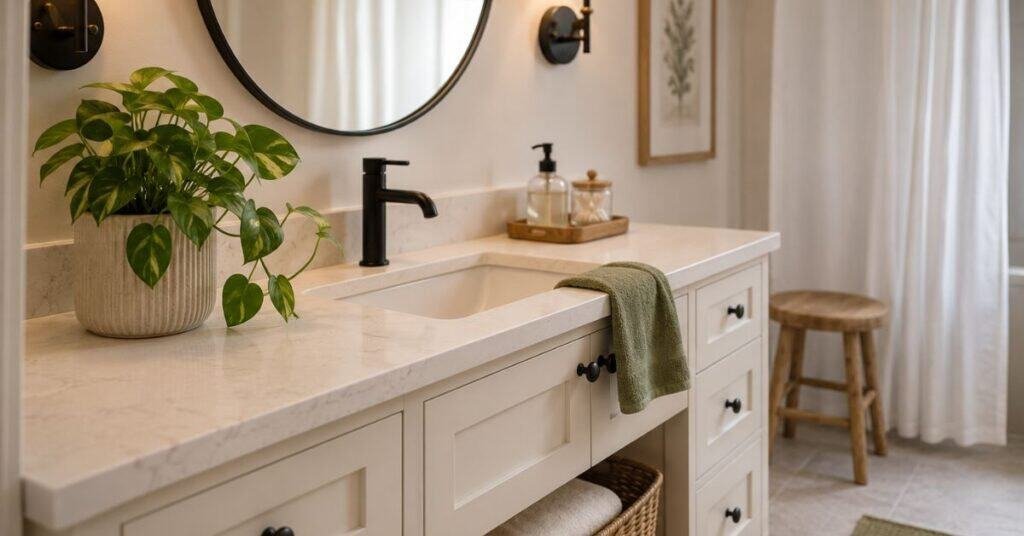
Start With One Plant or Stem Arrangement
One plant can be enough for a budget refresh.
Choose the strongest location:
- Far end of the vanity
- Shelf beside the mirror
- Window ledge
- Pale wood stool near the shower
- Open corner beside a freestanding tub
- Narrow ledge above the toilet
For a small vanity, use a plant around 6 to 10 inches tall.
For a larger bathroom, use one floor plant around 3 to 4 feet tall. Keep at least 12 inches of clear space around the planter so cabinet doors and shower panels can move freely.
A few eucalyptus or olive stems in a slim vase can also work. Use a vase around 3 to 5 inches wide so the counter stays open.
Refresh Existing Planters
A basic plant pot can look more polished with a simple outer cover.
Place it inside:
- Woven basket
- Warm white ceramic planter
- Pale stone pot
- Matte black container
- Ribbed cream vessel
- Soft taupe planter
The outer planter should connect with one finish already in the room.
A black planter can connect with the mirror frame. A cream planter can connect with the towels. A woven cover can connect with a basket or wood stool.
Keep the plant in its original nursery pot with drainage. Lift it out for watering so the bathroom surface stays dry.
Restyle What You Already Own
A fresh room often comes from moving pieces rather than buying new ones.
Try these changes:
- Remove half the items from the counter
- Group soap and one jar on a tray
- Fold towels in thirds
- Move the plant closer to natural light
- Place the planter at one end of the vanity
- Hide backup bottles inside a drawer
- Leave one third of each shelf open
- Repeat one planter finish
Take a photo from the doorway after each change.
The photo can reveal crowded areas, uneven spacing, or too many colors more clearly than standing inside the room.
Use Towels as a Low Cost Color Layer
Towels can add green without changing permanent finishes.
Use one main shade:
- Sage
- Olive
- Eucalyptus
- Fern green
- Muted emerald
Pair green towels with cream, white, taupe, or pale gray.
A simple set could include:
- Two cream bath towels
- Two sage hand towels
- One pale taupe bath mat
Avoid mixing several green shades in one small room. One main tone will feel calmer.
Fold open shelf towels with the smooth edge facing outward. Keep the stack low enough that the shelf still has open space.
Add One Botanical Print
Artwork can fill a blank wall at a low cost.
Use one medium print instead of several tiny frames. A leaf sketch, fern photograph, olive branch drawing, or soft green abstract can work beside the mirror.
Keep the frame connected to the room:
- Black frame with black mirror
- Pale wood frame with wood stool
- Brass frame with brass sconces
- White frame on a deeper wall
Hang the art around 6 to 8 inches above a towel bar or shelf.
Keep it away from direct shower spray and strong steam where possible.
Add a Woven Basket for Warmth
A woven basket can soften tile, quartz, and metal.
Use one basket under a floating vanity, beside the cabinet, or near the shower. A basket around 14 to 18 inches wide can hold towels or paper goods without taking over the floor.
For a narrow bathroom, use a taller basket with a smaller footprint.
Keep the contents tidy. Fold or roll towels in the same direction and keep them below the top edge.
One larger basket usually looks calmer than several small containers.
Use Removable Green Accents
Removable pieces work well for renters and quick updates.
Good options include:
- Towels
- Shower curtain
- Bath mat
- Artwork
- Small plant
- Faux stems
- Ceramic tray
- Planter cover
These pieces can change with the season or move to another room later.
Keep the large surfaces neutral so the green accents stay easy to change.
Work With Existing Tile
Older tile does not always need to be replaced.
If the tile is white, beige, gray, or soft cream, greenery can bring it back to life.
Pair older tile with:
- Warm white towels
- One green plant
- Matte black mirror
- Pale wood stool
- Woven basket
- Soft warm bulbs
If the tile already has strong color or pattern, keep the plant and accessories simple.
Use one cream planter, one towel shade, and one black or brass finish.
Improve the Lighting Before Buying More Decor
Cool light can make green leaves look dull and white walls look blue.
Try warm white bulbs around 2700K to 3000K. Keep the same bulb color in the sconces and ceiling fixture.
View the room after sunset.
Look at the plant, towels, tile, and planter. Warm light may make the room feel softer before you add anything else.
Budget Refresh Order
| Update Order | What to Change | Why It Helps |
|---|---|---|
| 1 | Clear the counter | Makes the room feel calmer |
| 2 | Add one plant | Brings color and softness |
| 3 | Restyle towels | Adds a clean fabric layer |
| 4 | Group items on a tray | Keeps daily pieces together |
| 5 | Add one basket | Brings storage and texture |
| 6 | Change the bulb color | Softens tile and foliage |
| 7 | Add one botanical print | Finishes an empty wall |
Budget greenery bathroom decor looks strongest when the room is edited before new pieces are added. One healthy plant, calm towels, warm light, and clear surfaces can give the bathroom a fresher mood without a major project.
Frequently Asked Questions
What color plants or decor make a bathroom feel fresh but still luxe?
Deep green leaves, soft sage, olive, and eucalyptus tones work well with warm white, cream, black, brass, and pale wood. Keep the green as the main accent and let the larger surfaces stay calm.
What are the best plants for bathrooms with humidity?
Pothos, ferns, snake plants, and some philodendrons can work well in humid bathrooms when the light level also suits them. Humidity helps, but the plant still needs enough daylight, drainage, and airflow.
How do you decorate a small bathroom with greenery without making it feel crowded?
Use one main plant instead of placing several small pots around the room. Put it on a vanity corner, shelf, window ledge, or shower niche, then keep the floor and mirror area open.
Can you make a bathroom look high end on a budget?
Yes. Start with one healthy plant, warm bulbs, folded cream towels, a simple tray, and a planter that matches the mirror or faucet finish.
These spa bathroom accessories for a polished hotel inspired look can help you add calm texture without filling the room with small decor.
What bathroom fixtures work best with green decor?
Matte black gives green leaves bold contrast, while brushed brass adds warmth. Chrome feels bright and clean, and pale wood helps soften stone, tile, and glass.
Is sage green better than emerald green for a bathroom?
Sage feels lighter and calmer, so it often works well in small bathrooms or rooms with dark fixtures. Emerald feels richer and more dramatic, but it usually needs white, cream, or pale stone nearby.
How do you style bathroom shelves with plants?
Use one plant, one towel stack, and one useful jar or basket. Leave about one third of the shelf open so the plant shape stays clear.
What are the easiest ways to add green without painting?
Use towels, a shower curtain, botanical artwork, a bath mat, or one potted plant. Repeat the same green family two or three times across the room rather than using several unrelated shades.
How many plants are too many in a bathroom?
The room has too many plants when pots block the mirror, counter, doors, or walking path. One or two plants are enough for many bathrooms, while a larger room may support a small grouped area near a window.
What accessories help a green bathroom feel connected?
Choose a calm planter, cream towels, one tray, a woven basket, and one repeated metal or wood finish. The greenery should carry most of the color while the other accessories support it.
Conclusion
Greenery bathroom decor feels most polished when the plants support the room instead of filling every open surface.
Start with one healthy plant in a strong location. Give it a calm planter, warm light, soft towels, and enough open space around it. Add a second green detail only when the room still feels balanced.
Keep the main surfaces quiet, repeat one or two finishes, and let the greenery provide the strongest color. This works especially well with minimalist decorating ideas that still feel warm, where fewer pieces have more space to stand out.
For more bathroom styling ideas, visit Bathroom Decor Ideas: The Surprising Before and After I Didn’t Expect.