
Quick Answer
The most durable outdoor patio rug ideas start with one decision: a tightly woven, UV-stabilized polypropylene or recycled PET rug in a flatweave (under about ¼ inch pile). These fibers shed water instead of soaking it up, dry fast after rain, and resist fading in direct sun.
Expect roughly 3-7 years of life with proper care, and expect a covered patio to be gentler on any rug than a fully exposed deck. Style still matters, so choose calming neutral tones or a UV-stable printed pattern that hides dust between cleanings.
Table of Contents
Key Takeaways
- Polypropylene is the durability benchmark for exposed patios: water-resistant, quick-drying, and commonly UV-treated against fading.
- Recycled PET and polyester sit just behind polypropylene on weather resistance, with better sustainability credentials.
- Flatweave beats plush outdoors. Low pile dries quickly and gives mold and mildew fewer places to settle.
- Water-resistant is not waterproof. Most flatweaves let water pass through; rubber-backed or reversible plastic-straw rugs block it.
- Size rule: leave 18-24 inches of rug behind dining chairs, and keep at least the front legs of seating on the rug.
- Budget bands: roughly $25, $30 for a small budget polypropylene rug, $60, $80 for a mid-tier 8×10, and about $125, $200 for branded outdoor lines.
- Winter storage extends life. Clean, dry, roll, and store rather than leaving a rug frozen under snow.
- A pad helps in wind-prone or slick spots, but only an open-mesh, outdoor-rated pad that lets water drain.
- Mid-tone patterns hide dirt best. Pure white shows every leaf; solid black shows every speck of pollen.
What Makes A Patio Rug Weather Resistant
A patio rug is weather resistant when its fibers repel moisture, its weave dries fast, its dyes are UV-stabilized, and its edges are bound tightly enough not to unravel. Those four traits matter more than brand or price.
Here’s what to look for on the label and in your hands:
- Non-absorbent synthetic fiber. Polypropylene stores almost no moisture, which is why it’s widely treated as the gold standard for real outdoor exposure.
- UV stabilization. Untreated dyes chalk and fade within a season of full sun. Treated fibers hold color much longer.
- Low profile. Anything under about ¼ inch dries quickly and traps less grit.
- Tight weave and bound edges. Loose weaves fray at corners first, especially where chairs drag.
- Mold and mildew resistance. Forbes’ outdoor rug testing highlights mold, stain, and fade resistance as the three features that separate rugs that survive from rugs that stain.
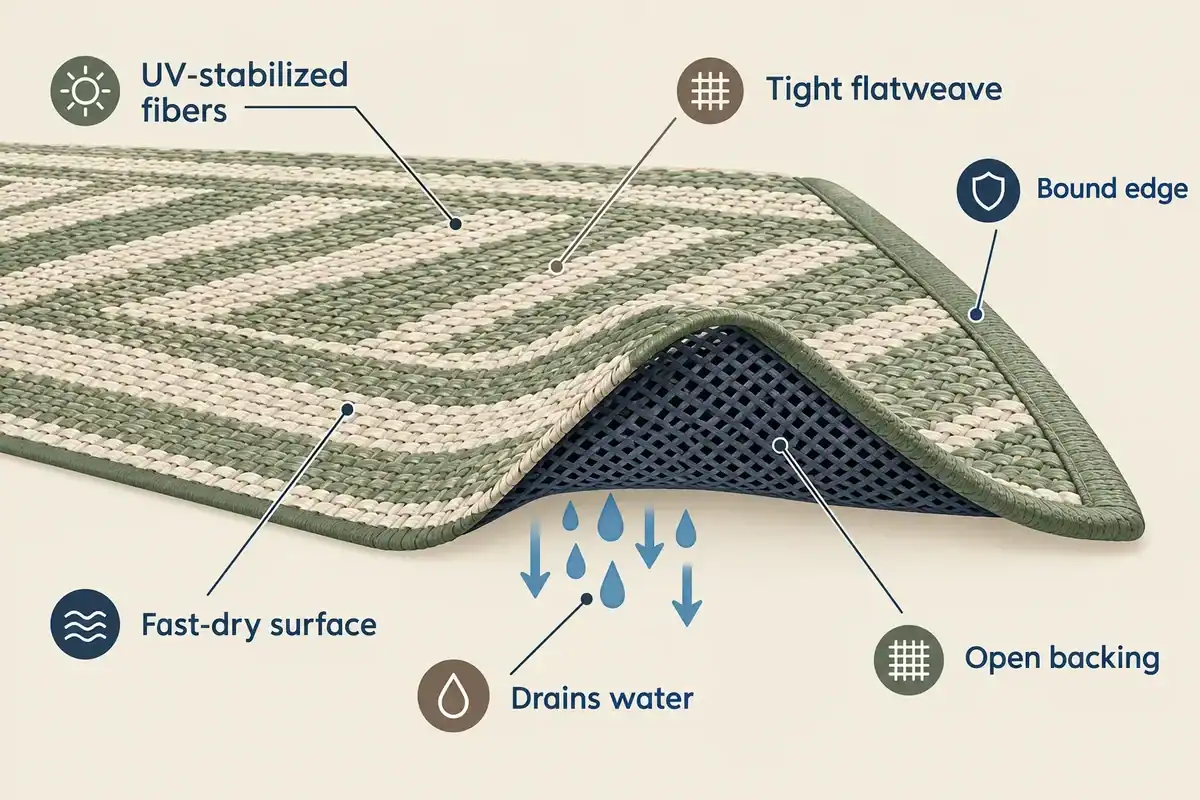
Decision rule: If a rug feels thick and spongy and soaks up water from a spray bottle, it belongs on a covered porch at most, not an open patio.
Common mistake: assuming “indoor/outdoor” on the tag means fully weatherproof. It usually means the fiber can handle moisture, not that the rug should live through a January storm.
Best Outdoor Rug Materials That Last
Polypropylene leads for durability, recycled PET and polyester follow closely, and natural fibers like jute and sisal belong only in sheltered spots. Material choice does more for lifespan than anything else you can control.
| Material | Weather resistance | Dry speed | UV resistance | Best for |
|---|---|---|---|---|
| Polypropylene | Very high | Fast | High (when treated) | Exposed patios, decks, poolside |
| Recycled PET | High | Fast | Medium, high | Eco-minded shoppers, high traffic |
| Polyester | High | Fast | Medium, high | Covered patios, softer feel |
| Nylon | High | Medium | Medium | Heavy foot traffic, entries |
| Jute / sisal | Low | Slow | Low | Covered porches, sunrooms only |
Recycled PET has become a real contender, and sustainability-focused outdoor rug roundups note these rugs are often marketed as nontoxic with long-lasting weaves built for heavy wear. Meanwhile, material comparisons for summer patios consistently rate natural fibers as unsuitable for rain and direct sun because they dry slowly and mildew.
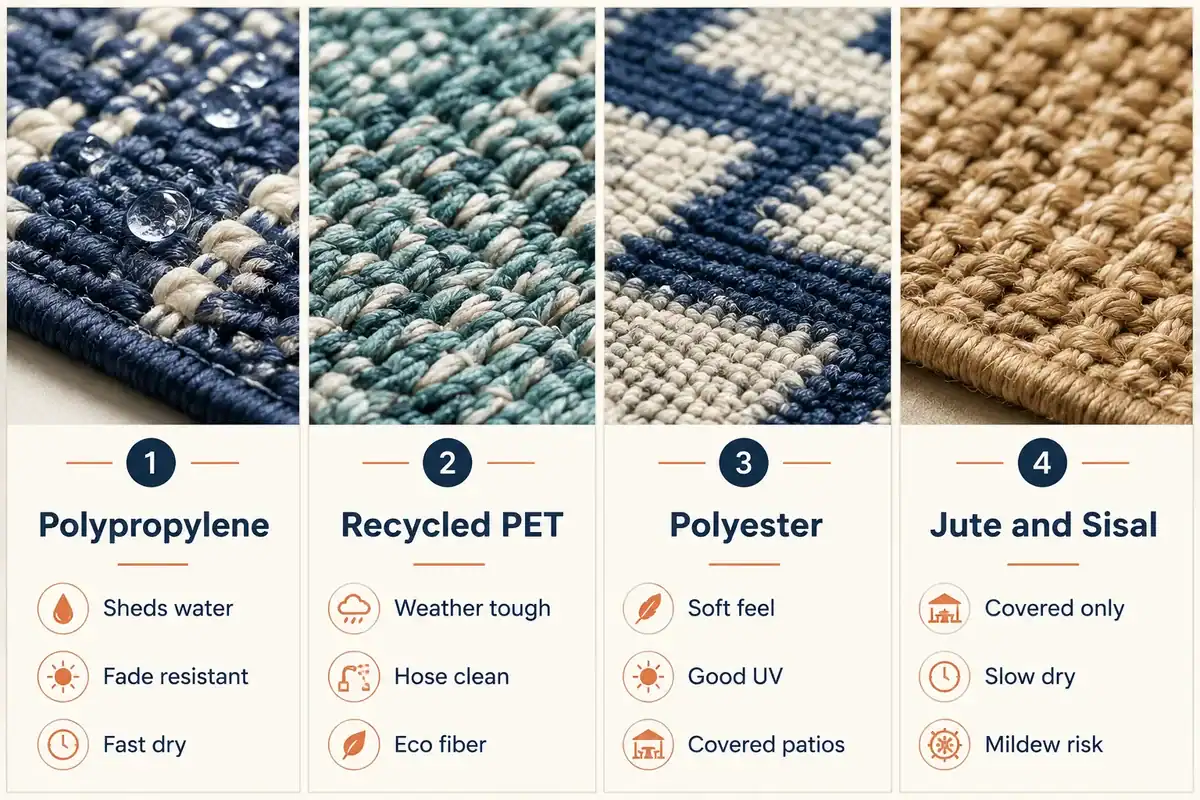
Edge case: a jute-look rug can absolutely work outside, as long as it’s a polypropylene rug printed or woven to look like jute. You get the warm, textured look without the mildew risk.
Outdoor Rug Vs Indoor Rug: What Actually Differs
Outdoor rugs use non-absorbent synthetic fibers, UV-treated dyes, and open or breathable backings. Indoor rugs use absorbent fibers, standard dyes, and often a latex or canvas backing that holds moisture against the floor.
The practical differences:
- Fiber: wool and cotton hold water; polypropylene sheds it.
- Dye: indoor rugs fade fast in unfiltered sun.
- Backing: an indoor latex backing traps water and can leave a permanent shadow on wood decking or stone.
- Cleaning: an outdoor rug can be hosed, scrubbed, and left in the sun. An indoor rug usually can’t.
- Feel: indoor rugs win on softness, which is why some people layer a small indoor-style rug over an outdoor base under a covered roof.
Choose an indoor rug outside only if the space is fully covered, screened, and never gets blowing rain, and you’re willing to bring it in for winter.
How To Choose The Right Size Patio Rug
Measure your furniture zone first, then add 18-24 inches on each side for dining sets and keep the front legs of all seating on the rug for lounge layouts. A rug that’s too small makes even a beautiful patio look unfinished.
Quick sizing checklist:
- Tape it out. Use painter’s tape or a garden hose to outline the rug footprint before buying.
- Dining sets: chairs should stay fully on the rug when pulled out. A 60-inch round table usually needs at least an 8×10.
- Sofa and chairs: front legs on the rug, back legs off is fine and often looks more relaxed.
- Leave a border. Show 12-18 inches of hard surface around the rug so the patio still reads as a floor.
- Center on the seating, not the walls or railing.
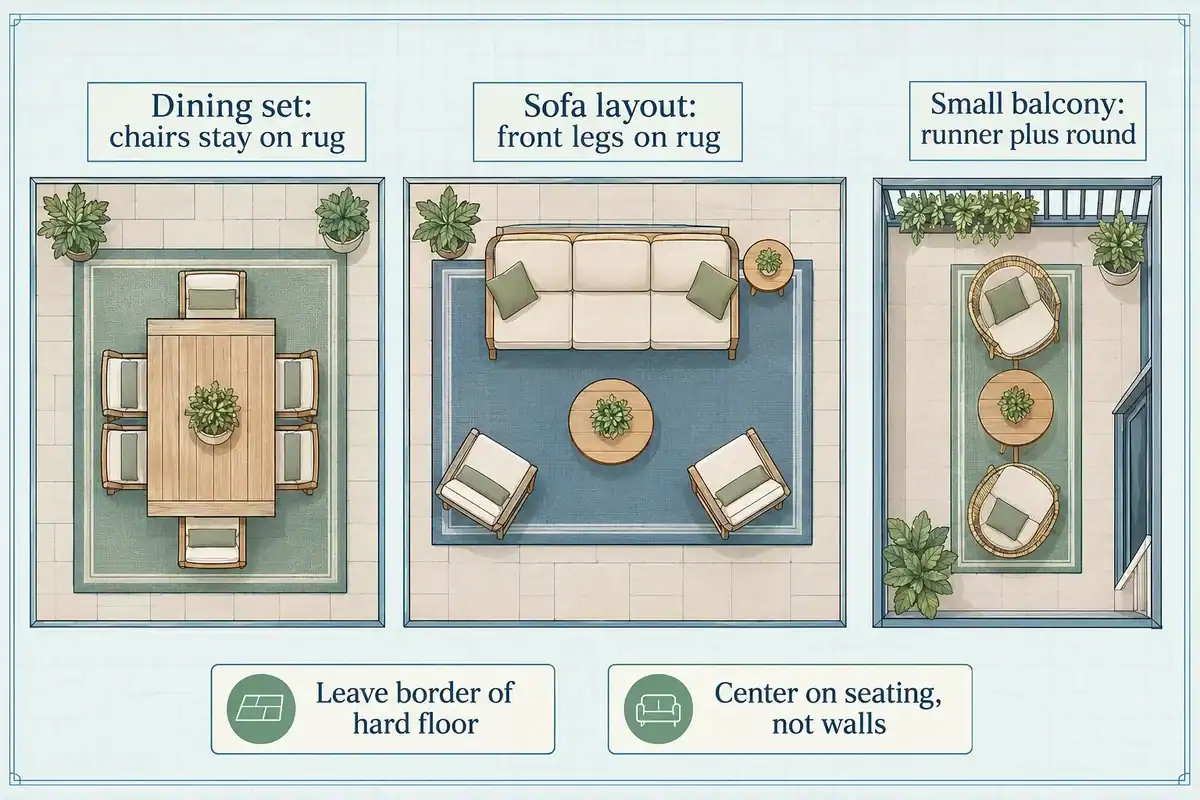
Common mistake: buying a 5×7 for a full seating group. It ends up looking like a bath mat under a sofa. If the budget is tight, a smaller furniture arrangement on a right-sized rug looks better than oversized furniture on an undersized rug. For layout help, see these outdoor seating arrangement ideas.
Outdoor Patio Rug Ideas For Small Patios And Balconies
On a small patio or balcony, use one rug that reaches close to the edges of the usable floor, in a light neutral or a small-scale pattern. Small spaces feel larger with fewer, larger elements, not more little ones.
Ideas that work in tight square footage:
- A single 5×7 flatweave in a soft ivory, greige, or pale sage to visually stretch the floor.
- A runner along a narrow balcony, paired with one round rug under a bistro table.
- Vertical stripes running away from the door to make a shallow patio feel deeper.
- Tone-on-tone texture instead of high-contrast pattern, so the eye keeps moving.
- Interlocking deck tiles plus a small rug for a layered, finished look on concrete.
For more ways to stretch a compact footprint, these genius small outdoor space ideas pair well with a right-sized rug, and balcony dwellers can borrow from these spring balcony decor ideas.
Edge case for renters: on a balcony with a drain, skip solid rubber backings entirely. Choose a reversible open-weave rug so water reaches the drain instead of pooling.
Best Colors And Patterns For Outdoor Rugs (And What Won’t Fade)
Mid-tone neutrals and UV-stable printed patterns hold up best visually. Very light rugs show leaves and mud; very dark rugs show pollen, dust, and salt. Something in between stays looking clean the longest.
Style directions that balance beauty with practicality:
- Calming neutral tones: warm sand, greige, soft charcoal. Elegant modern style that hides everyday grit.
- Classic stripes: timeless, and they camouflage traffic patterns.
- Faded vintage medallions: the pattern is supposed to look sun-washed, so real fading blends in.
- Terracotta, olive, and rust: earthy shades that pair with brick, wood, and greenery.
- Geometric flatweaves: clean lines that suit modern minimalist living.
For fade resistance, look for UV-stabilized fibers and solution-dyed color rather than surface-printed dye alone. HGTV’s outdoor rug guidance recommends low-profile synthetics treated for UV exposure specifically for areas that see rain and direct sun.
Still deciding between quiet and bold? This guide to neutral or colorful outdoor rug patio ideas walks through both directions.
Pull quote: The rug that still looks good in year three is usually the one whose pattern was never trying to look brand new.
How Much Does A Good Outdoor Patio Rug Cost?
Plan on about $25, $30 for a budget 5×7 polypropylene rug, $60, $80 for a mid-tier 8×10, and roughly $125, $200 for branded outdoor lines. The price gap mostly reflects UV treatment, backing quality, and edge construction.
What each tier realistically gets you:
- Budget ($25, $40): thin, lightweight, often untreated dyes. Deck-focused reviews report these last about 1-2 seasons before fading or fraying.
- Mid-tier ($60, $100): tighter weave, better bound edges, usually UV-treated. Good value for most patios.
- Premium ($125, $200+): heavier weight, stronger warranties, better color retention. Some high-end recycled plastic rugs are reported to approach a decade of normal use.
Decision rule: if your patio is covered and low traffic, mid-tier is plenty. If it’s a fully exposed south-facing deck, the extra spend on UV treatment and a bound edge pays for itself in about two seasons.
Can You Leave Outdoor Rugs Out In Winter?
You can, but you shouldn’t if you want maximum lifespan. Freeze-thaw cycles, trapped snowmelt, and months of dampness under a rug are the fastest way to cause mildew, stiffness, and staining on the surface below.
Winter care steps:
- Rinse and scrub with mild soap and water at the end of the season.
- Dry completely on both sides, ideally hanging over a railing in sun.
- Roll, never fold. Folding creates permanent creases in synthetic fibers.
- Store upright in a dry garage, shed, or closet, off the concrete floor.
- If you must leave it out, choose a reversible open-weave polypropylene rug, and lift it periodically to let the surface underneath dry.
Edge case: in mild-winter regions (coastal California, the Gulf South, southern BC), a quality polypropylene rug can often stay out year-round with occasional lifting and rinsing. In the Prairies, Northeast, or Midwest, storage is the better call. Pair the seasonal swap with your other seasonal home decor ideas so it becomes routine.
Outdoor Rugs For Wet Climates And Rainy Areas
In rainy regions, prioritize drainage over water repellency. A reversible, loose-weave polypropylene rug that lets rain pass through to the surface below dries faster than a rubber-backed rug that holds a puddle.
Match the rug to the exposure:
- Fully exposed deck (Pacific Northwest, coastal Atlantic): open-weave or reversible plastic-straw rug that drains through the boards.
- Covered patio with blowing rain: tightly woven polypropylene that resists mold and dries quickly.
- Screened porch: more freedom, including polyester or soft-feel indoor/outdoor blends.
- Poolside: quick-dry flatweave with a non-slip weave rather than a solid backing.
HGTV’s waterproof outdoor rug coverage notes that truly waterproof options generally rely on impermeable backings or reversible plastic-straw construction, while most everyday outdoor rugs are water-resistant and let moisture pass through.
Common mistake in wet climates: placing a solid-backed rug directly on wood decking. Trapped moisture can discolor boards and shorten the life of the deck itself, a point worth remembering alongside these backyard patio design mistakes.
Do Outdoor Rugs Need A Pad Underneath?
Usually optional, sometimes essential. Use an outdoor-rated, open-mesh pad if your rug slides, curls at the corners, or sits in a windy spot. Skip solid or closed-cell pads, which trap water.
Use a pad when:
- The rug is lightweight and lifts in wind.
- The patio surface is smooth concrete, tile, or composite decking.
- The rug is on a balcony where sliding is a trip hazard.
- Corners curl and won’t relax after a few sunny days.
Skip a pad when the rug is heavy, already reversible with grip, or sits on textured stone or wood where friction is high.
Non-negotiable: the pad must be open-mesh and labeled for outdoor use. An indoor felt or latex pad will hold water like a sponge and mark the surface underneath.
Outdoor Rug Cleaning And Maintenance Tips
Sweep weekly, hose monthly, deep clean twice a season, and always let both sides dry fully. That simple rhythm is the difference between a rug that lasts two years and one that lasts six.
A realistic maintenance routine:
- Weekly: shake or sweep off leaves, pollen, and grit. Grit is what abrades fibers.
- Monthly: hose down and let it dry in the sun.
- Twice a season: scrub with mild dish soap and a soft-bristle brush, rinse thoroughly, dry flat or hanging.
- Spot treatment: blot spills immediately. For mildew spots, a diluted vinegar solution and a soft brush usually works on polypropylene.
- Lift and rotate: move the rug every few weeks so the surface beneath dries and the rug wears evenly.
- Avoid: pressure washers on high settings, bleach, and steam cleaners, all of which can distort synthetic fibers.
Living Spaces’ outdoor rug guidance reinforces that tight weaves and tightly bound edges handle high foot traffic best, which also means they survive repeated hosing better than loose weaves.
Outdoor Rug Alternatives If You Don’t Want A Traditional Rug
If a rug feels like too much upkeep, define your patio zone with hard surfacing or plantings instead. Interlocking deck tiles, stenciled concrete, or a gravel border can give the same “finished floor” effect without anything to dry out.
Alternatives worth considering:
- Interlocking wood or composite deck tiles for warmth over concrete.
- Stenciled or painted concrete using exterior porch paint for a tile-look pattern.
- Outdoor floor tiles, though quality matters a lot; see these outdoor décor tile choices to avoid.
- Gravel or pea-stone borders around a paved seating pad.
- A pair of large planters plus a bench to define the zone visually with no floor covering at all.
- Curated décor ideas overhead instead: lighting and wall interest can anchor a space just as well as a rug. Browse more outdoor decor ideas for inspiration.
Common Mistakes When Buying Outdoor Rugs
The most expensive mistake is buying for looks alone and discovering the rug holds water. The second is buying too small. Both are avoidable in five minutes of checking.
Avoid these:
- Choosing thick pile because it feels nicer in the store. It stays damp outside.
- Ignoring pile height and weave on the product spec page.
- Skipping the exposure question. Covered and uncovered patios need different rugs.
- Buying pure white or jet black for a high-traffic, tree-shaded patio.
- Using a solid rubber backing on wood decking.
- Assuming a warranty covers fading. Read whether UV fade is included.
- Forgetting the border. A rug that runs wall to wall makes a patio feel smaller, not bigger.

Frequently Asked Questions
Are outdoor rugs waterproof?
Most are water-resistant, not waterproof. Polypropylene fibers shed water, but flatweave constructions typically let moisture pass through to the surface below. Truly waterproof rugs use rubber or impermeable backings or reversible plastic-straw weaves.
How long should an outdoor patio rug last?
Quality synthetic outdoor rugs generally last about 3-7 years with proper care. Polypropylene tends toward 5-7 years on covered patios and 3-5 years on fully exposed decks. Budget rugs often last only 1-2 seasons.
Will an outdoor rug damage my wood deck?
It can, if it traps moisture. Solid-backed rugs on wood decking hold water and can discolor boards. Use an open-weave or reversible rug, and lift it every few weeks to let the deck dry.
Can outdoor rugs get moldy?
Yes, especially thick-pile or natural-fiber rugs that stay damp. Flatweave synthetics resist mold far better because they dry quickly. Regular rinsing and full drying on both sides prevents most mildew problems.
What size rug do I need under a patio dining table?
Add at least 18-24 inches on every side of the table so chairs stay on the rug when pulled out. A 60-inch round table usually needs an 8×10 rug or larger.
Do outdoor rugs fade in the sun?
Untreated dyes fade quickly. Look for UV-stabilized or solution-dyed synthetic fibers, which hold color across multiple sun seasons. Faded-vintage patterns also disguise gradual fading better than solid saturated colors.
Can I pressure wash an outdoor rug?
Use caution. High-pressure settings can fray or distort synthetic fibers. A garden hose plus mild soap and a soft-bristle brush is safer and works just as well.
Are recycled PET outdoor rugs as durable as polypropylene?
Nearly. Recycled PET rates high for weather resistance, dries fast, and cleans with a hose. It usually sits slightly behind polypropylene on UV resistance but ahead on sustainability.
Should I put a pad under an outdoor rug?
Only if the rug slides, curls, or lifts in wind, and only an open-mesh outdoor-rated pad. Indoor felt or latex pads trap water and can stain the surface beneath.
What’s the best outdoor rug color for hiding dirt?
Mid-tone neutrals like greige, taupe, soft charcoal, and terracotta. Pure white shows leaves and mud, while jet black shows pollen, dust, and salt residue.
Conclusion: Style That Survives The Seasons
The best outdoor patio rug ideas come down to a short, honest checklist. Pick a UV-treated polypropylene or recycled PET flatweave, size it generously to your furniture, choose a mid-tone neutral or forgiving pattern, and commit to a light cleaning rhythm. That combination delivers both the cozy textures you want underfoot and the weather resistance your patio demands.
Your next steps:
- Measure and tape out your rug footprint this weekend before shopping.
- Identify your exposure: covered, partly shaded, or fully open. This decides your weave.
- Set your budget band using the price tiers above, and skip the cheapest option if your patio faces full sun.
- Check three specs on any rug page: fiber, pile height, and whether the edges are bound.
- Plan your seasonal swap now, so cleaning and storage don’t become an afterthought in November.
Then finish the space. A right-sized rug pairs beautifully with layered lighting, greenery, and a few personal touches, and this collection of patio wall decor ideas can complete the look. Where style meets comfort, the details that last are the ones worth choosing carefully.