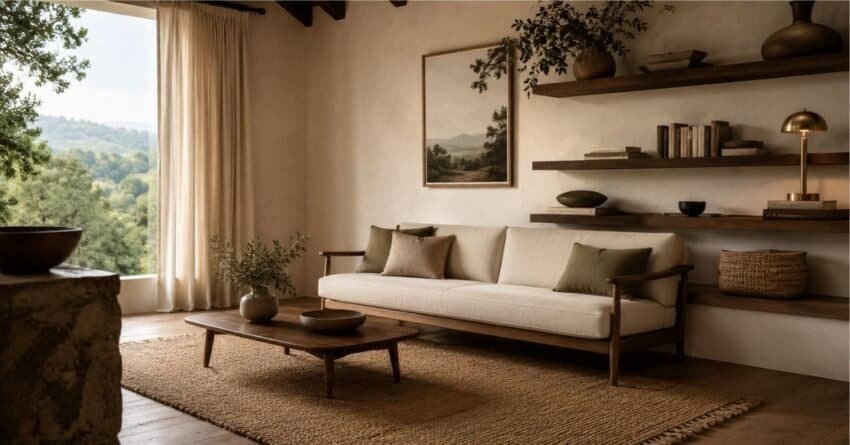
A shelf can look clean and still feel unfinished.
Maybe the books are lined up, the baskets are in place, and the wall looks neat. But something still feels flat. The shelf does not look messy, yet it does not make the room feel warm or styled either.
That is where minimalist shelf decor can help.
The goal is not to fill every inch. The goal is to use fewer pieces with better spacing, softer texture, and a clear reason for being there. Books, baskets, ceramics, framed art, and open space can make shelves feel calm without looking bare.
If you already like minimalist home styling accessories that look calm, shelf styling is one of the easiest places to use that same idea. A few strong pieces can change how the whole room feels.
Think of a light oak shelf with three stacked books, a soft beige ceramic bowl, one framed print, and several inches of open space around them. The shelf feels styled, but it still lets the wall breathe.
That balance is what makes minimalist shelves work.
In the sections below, you will see how to style shelves with books, baskets, art, ceramics, floating shelves, small spaces, and budget friendly pieces. You will also see the common shelf styling mistakes that make a room feel cluttered instead of stunning.
Table of Contents
Minimalist Shelf Decor That Makes Rooms Feel Stunning Without Clutter
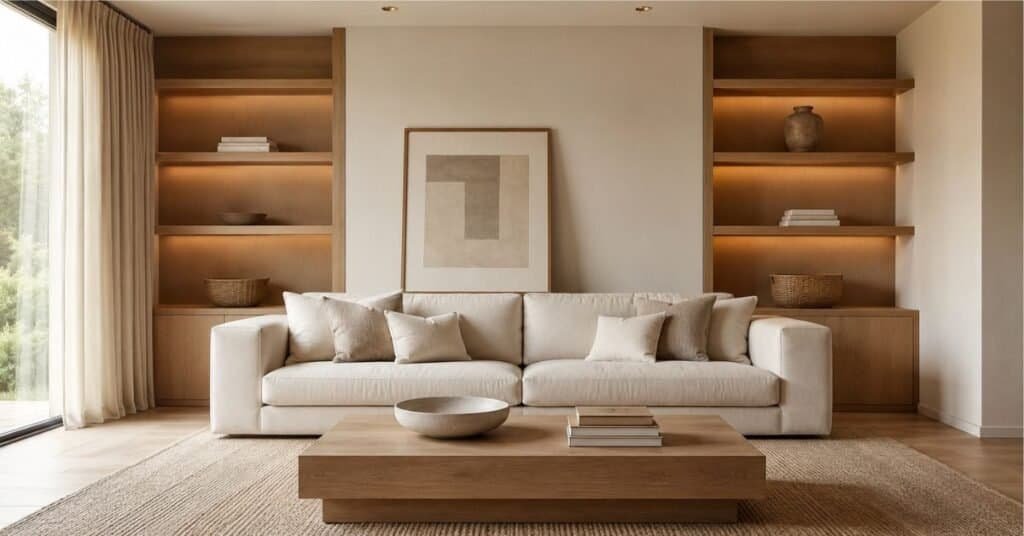
Minimalist shelf decor works best when the shelf has room to breathe.
A shelf filled from end to end can make the whole room feel crowded, even if every item is beautiful. A shelf with fewer pieces, better spacing, and one clear focal point usually feels calmer and more expensive.
Martha Stewart recommends clearing the shelves before restyling, which is a helpful first move. When you remove everything first, you can see the shelf shape, wall color, and empty space before deciding what belongs there.
Start With Empty Shelves First
Before styling, take every item off the shelf.
This may feel like extra work, but it helps you avoid decorating around clutter. Once the shelf is empty, group your pieces on the floor or table.
Sort them into simple groups:
- Books
- Baskets
- Framed art
- Ceramic vases
- Sculptural bowls
- Small plants
- Everyday items that need hiding
Then choose only the pieces that match the room.
For a warm minimalist room, you might keep cream books, a light oak frame, a beige stoneware vase, and a woven basket. Bright packaging, random papers, and tiny decor pieces can move somewhere else.
A good starting point is to return half of what was there before. Style the shelf, step back, then add one more piece only if the shelf feels too empty.
Give Every Shelf a Main Moment
Every shelf needs one main moment.
That does not mean every shelf needs a large object. It means each shelf should have one area that feels clear and easy to notice.
For example:
- A tall ceramic vase on the left
- A book stack with a bowl in the middle
- A framed art piece leaning on the right
- A woven basket on the lower shelf
- A small plant beside open space
Avoid placing the same size items in a straight row. Five tiny objects lined up across a shelf can feel busy and flat.
Try mixing height instead. Pair a taller vase with a low bowl. Stack books under a small object. Lean a frame behind a shorter piece.
Here is a simple way to fix common shelf problems:
| Shelf Issue | Why It Happens | Simple Fix |
|---|---|---|
| Shelf looks busy | Too many small items | Remove the smallest pieces first |
| Shelf looks empty | No focal point | Add one vase, frame, or bowl |
| Shelf looks flat | Everything is the same height | Mix tall, medium, and low pieces |
| Shelf feels random | Too many colors | Use one soft color family |
| Shelf feels heavy | No open space | Leave 30 to 40 percent clear |
For most shelves, keep about 30 to 40 percent of the space open when possible. On a 36 inch shelf, that means leaving roughly 10 to 14 inches clear across the full shelf.
That open space is not wasted. It is what makes the decor stand out.
Minimalist Shelf Styling With Books, Baskets, and Art
Books, baskets, and art are the easiest pieces to use in minimalist shelf styling.
They look natural in a real home, and they also give shelves a job. Books add height and color. Baskets hide things you do not want to see. Art makes the shelf feel more personal without adding clutter.
The trick is not to use all of them everywhere.
Mix Vertical and Horizontal Books
Books can make shelves feel warm, but long rows of books can feel heavy.
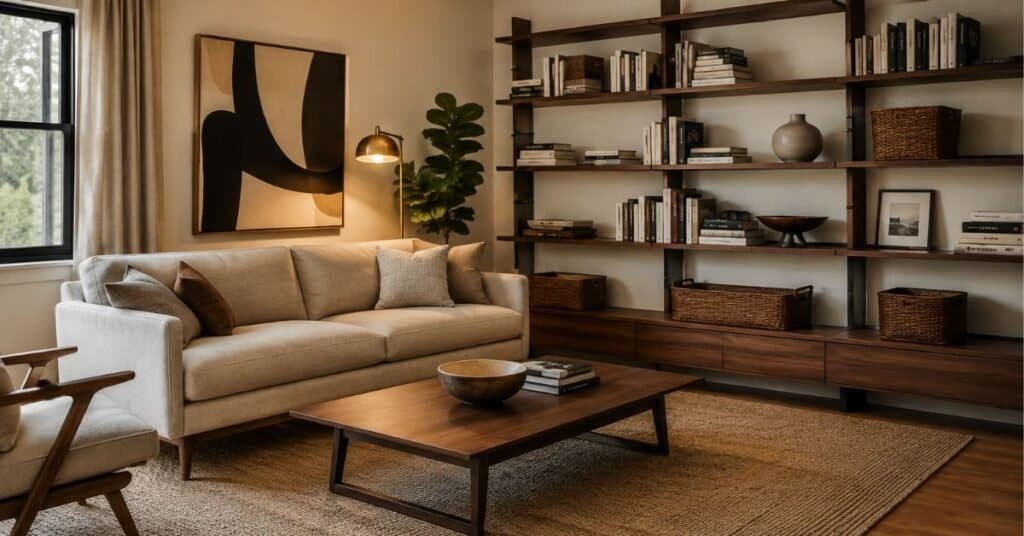
Martha Stewart shares ideas for mixing vertical and horizontal book placement, and this works well for minimalist shelf decor. The mix breaks up the shelf so it feels styled instead of packed.
Try this:
- Place 5 to 8 books upright on one side.
- Stack 3 to 5 books flat in another area.
- Add one small bowl or object on top of the flat stack.
- Leave a few inches of space between each grouping.
If your book spines are very bright, spread them out instead of placing all the strong colors in one spot. You can also turn a few books so the softer page edges show, but keep the shelf easy to use.
For a living room shelf, place your tallest books toward the outer edge. Then use lower pieces near the center so the shelf does not feel blocked.
Use Baskets to Hide Everyday Clutter
Baskets are one of the most useful minimalist shelf accessories.
They soften the shelf, add texture, and hide small items that make a room look messy. Use them for remotes, cords, extra candles, small toys, pet items, or loose papers.
A basket works best on a lower shelf or near the end of a bookcase. It gives weight to the bottom and keeps the upper shelves lighter.
Try this basket setup:
| Shelf Area | What to Place There | Why It Works |
|---|---|---|
| Bottom shelf | Woven basket | Grounds the shelf |
| Middle shelf | Books and ceramic bowl | Adds warmth and shape |
| Eye level shelf | Framed art and vase | Creates a calm focal point |
| Top shelf | One light object or open space | Keeps the shelf airy |
If clutter keeps returning to the same shelf, use minimalist decor ideas that hide everyday clutter to give those items a better home.
Add Art Without Filling Every Gap
Framed art can make shelves feel finished fast.
Use one small frame leaning against the back of the shelf, then place a shorter object in front of it. This gives depth without using too many pieces.
For a 10 inch deep shelf, choose a frame that is around 7 to 9 inches tall. For a deeper bookcase, you can use a larger frame, but leave space around it so it does not feel squeezed.
A simple shelf mix could look like this:
- One framed art piece
- One short stack of books
- One ceramic bowl
- Open space on one side
That is enough for one shelf zone.
When in doubt, remove one piece and step back. Shelves usually look better when the eye has a clear place to rest.
Minimalist Floating Shelf Decor for Calm Walls
Floating shelves need more space than a bookcase.
Because they sit directly on the wall, every item feels more visible. A crowded floating shelf can make the whole wall feel busy, even when the rest of the room is simple.
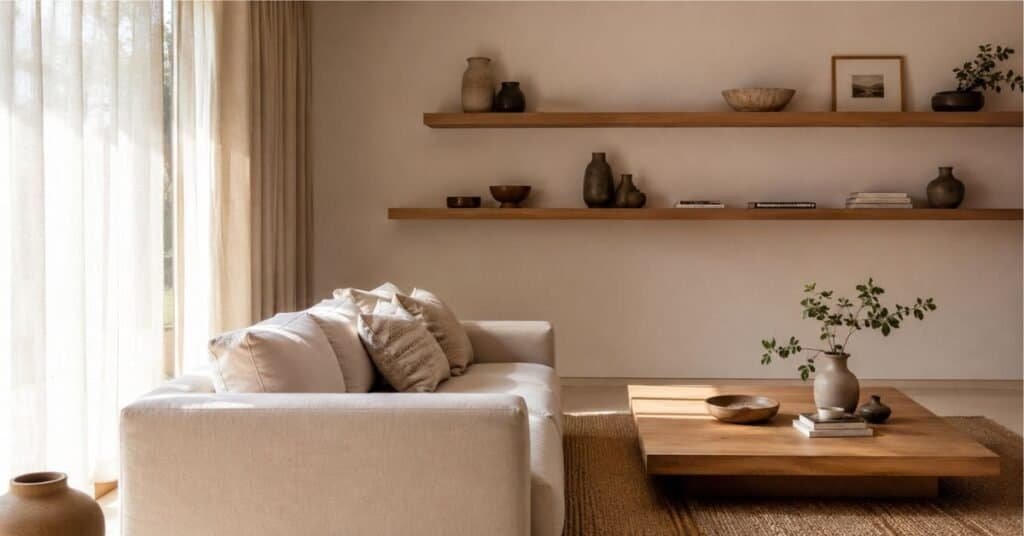
ELLE Decor shares open shelving ideas that focus on clean lines on open shelves. That same idea works in living rooms, bedrooms, and small apartments. Keep the lines clear, then let a few pieces carry the look.
Keep Floating Shelves Light and Airy
A floating shelf should not look like a storage ledge.
Use fewer items than you would on a deep bookcase. If the shelf is narrow, choose slim pieces that do not hang over the edge.
Try this simple floating shelf mix:
- One small framed art piece
- One short stack of books
- One ceramic vase
- One low bowl
- Open space at both ends
For a 24 inch floating shelf, use 2 to 3 pieces. For a 36 inch shelf, 3 to 4 pieces may work if the shapes are simple.
Keep at least 2 inches of space between the decor and the shelf edge. This small gap helps the shelf feel calm instead of packed.
If you have two floating shelves stacked above each other, avoid placing decor in the exact same spot on both shelves. Put a vase on the left side of the top shelf, then place books on the right side of the lower shelf. This creates a softer visual flow.
Match Shelf Decor to the Wall Around It
The wall behind your shelves matters.
Warm white walls, soft beige walls, pale gray walls, and light wood shelves can make minimalist shelf decor feel quiet and clean. If the wall color is dark, use lighter decor so the pieces do not disappear.
A calm color mix could include:
| Wall or Shelf Color | Decor That Works Well |
|---|---|
| Warm white wall | Light oak, cream ceramics, beige books |
| Soft beige wall | White frames, stoneware, woven baskets |
| Pale gray wall | Warm wood, black frame, cream vase |
| Dark accent wall | Light books, brass detail, pale ceramic |
| Brick wall | Wood shelves, clay vase, black metal |
Small contrast can help. A thin matte black frame, a small brass object, or a dark book spine can give the shelf shape without making the wall feel heavy.
For a living room with open shelves, use minimalist living room styling with airy space as a guide. The same breathing room that helps a sofa wall also helps shelves look more balanced.
A floating shelf looks best when the decor feels like part of the wall, not something fighting against it.
Modern Minimalist Shelf Decor for Living Rooms
Living room shelves are usually one of the first things people notice.
They sit near the sofa, TV, fireplace, or main walkway, so they can shape the whole room. When shelves look calm, the living room feels more polished. When shelves look crowded, the room can feel busy even if the sofa and coffee table are simple.
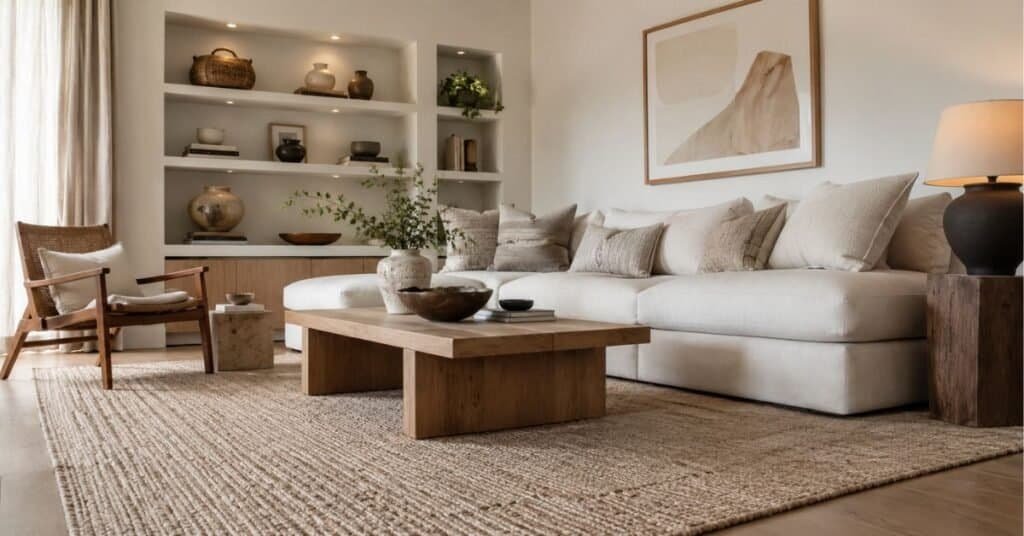
Style Living Room Shelves Around One Color Family
Before placing anything, choose one soft color family.
This keeps the shelf from looking random. You do not need every item to match, but the colors should feel related.
Good color mixes include:
- Cream, beige, oak, and stone
- Warm white, taupe, black, and wood
- Soft gray, cream, glass, and brass
- Beige, clay, woven texture, and white
- Walnut, ivory, matte black, and tan
Good Housekeeping UK shares that small groups of art, ceramics, textured bowls, photos, candles, and greenery can create lovely focal points in minimalist interiors. Their guide to small groups of art, ceramics, bowls, and greenery is a good reminder that shelf decor does not need to be loud to feel finished.
A simple living room shelf can use cream books, one beige ceramic vase, a black frame, and a woven basket. The colors stay quiet, but the materials keep the shelf from feeling flat.
Try repeating one material at least twice. If you use light oak shelves, add a wood frame or small wood bowl. If you use black picture frames, repeat black with a thin lamp base or book spine nearby.
Add Height Without Crowding the Shelf
A shelf needs height changes to feel natural.
If every piece is the same height, the shelf can look stiff. If every piece is tall, it can feel heavy. The easiest fix is to pair tall, medium, and low items together.
Try this shelf grouping:
- Tall item: ceramic vase or framed art
- Medium item: stacked books or small plant
- Low item: bowl, tray, or candle holder
- Open area: empty shelf space beside the group
Here is a quick guide:
| Decor Piece | Best Shelf Use | Styling Tip |
|---|---|---|
| Tall vase | Adds height | Place near one side, not always in the center |
| Framed art | Adds depth | Lean it behind a lower item |
| Book stack | Adds structure | Use 3 to 5 books only |
| Bowl | Adds softness | Place it on books or beside a vase |
| Basket | Adds storage | Use lower shelves for heavier baskets |
| Small plant | Adds life | Keep it simple and avoid too many plants |
For a 12 inch deep shelf, avoid tiny objects that get lost. A 7 to 10 inch vase, an 8 by 10 frame, or a medium bowl will usually look stronger than several small trinkets.
The shelf should feel full enough to be interesting, but open enough for the eye to rest.
Minimalist Bookshelf Decor That Looks Warm and High End
A bookshelf can feel warm without looking packed.
The mistake is treating every shelf like it needs to hold as much as possible. Bookshelves look better when they have a mix of books, objects, baskets, and open areas.
Good Housekeeping shares bookshelf decor ideas for every style, which supports a simple idea: bookshelves can be useful and beautiful at the same time. You do not need to choose between storage and style.
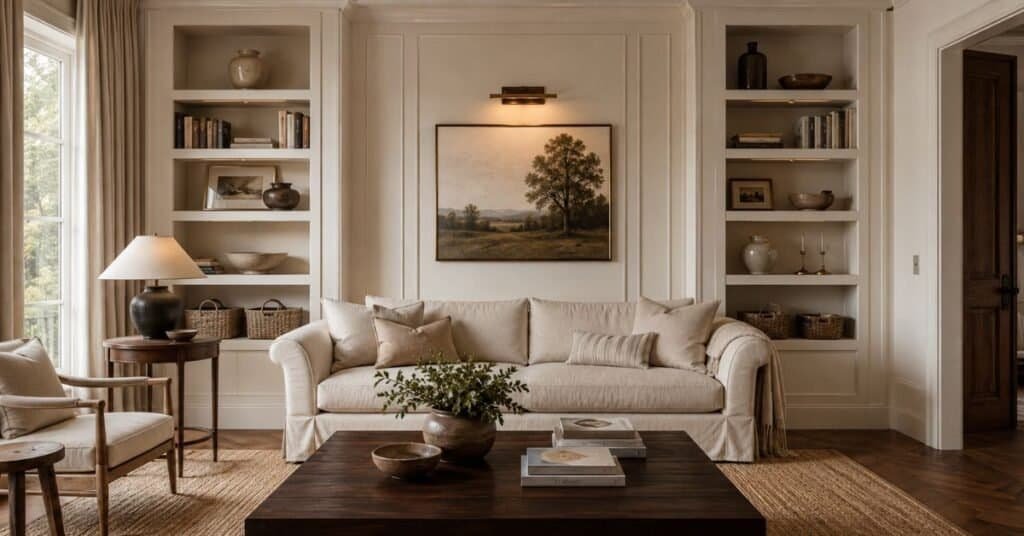
Break Up Rows of Books With Simple Objects
Long rows of books can feel heavy, especially in a small living room.
Break up the rows with one simple object every so often. A ceramic vase, small framed photo, sculptural bowl, or empty gap can give the shelf a softer rhythm.
Try this bookshelf layout:
- One shelf with mostly books
- One shelf with books and a bowl
- One shelf with framed art and open space
- One lower shelf with a woven basket
- One shelf with a vase and short book stack
This keeps the bookshelf useful without making it feel like a wall of storage.
For a 30 inch wide shelf, try 12 to 18 inches of books and leave the rest for one decor grouping or open space. On a taller bookcase, keep heavier baskets and darker books near the bottom so the shelf feels grounded.
Use Negative Space So Decor Can Stand Out
Open space is what makes shelf decor easier to see.
If every inch is filled, your best pieces get lost. A beautiful stoneware vase will stand out more with space around it than it will when squeezed between books and tiny objects.
Try leaving 4 to 6 inches beside a main object. On a wider shelf, leave one full zone mostly open.
This works especially well with:
| Shelf Item | Space to Leave Around It | Why It Helps |
|---|---|---|
| Ceramic vase | 4 to 6 inches | Gives the shape room to show |
| Framed art | 2 to 4 inches on each side | Keeps it from feeling squeezed |
| Woven basket | 1 to 2 inches at each side | Makes storage look neater |
| Book stack | 2 to 3 inches above it | Leaves room for a bowl or object |
| Sculptural bowl | 3 to 5 inches | Lets the shape feel clear |
A high end bookshelf does not need expensive pieces. It needs scale, spacing, and fewer items fighting for attention.
If one shelf looks wrong, remove two small pieces and step back. Most of the time, the fix is more space, not more decor.
Minimalist Shelf Decor for Small Spaces
Small rooms need shelves that look good and work hard.
In a tight living room, bedroom, or studio apartment, shelves can hold decor, books, storage baskets, and daily items without taking up floor space. The problem starts when shelves become the place where everything lands.
Minimalist shelf decor for small spaces should feel light, useful, and easy to keep tidy.
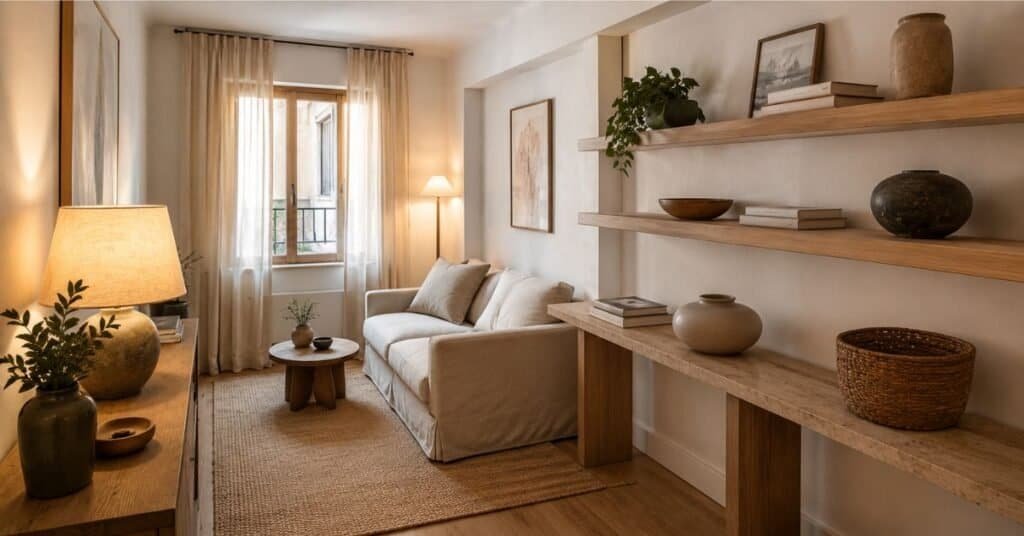
Use Shelves for Storage and Beauty
Small spaces need storage, but that storage does not need to look messy.
Use baskets, boxes, trays, and book stacks to give everyday items a home. Keep the prettiest pieces at eye level, then place heavier storage lower so the shelf does not feel top heavy.
Try this small shelf setup:
- Eye level: framed art, small vase, or books
- Middle shelf: books and one bowl
- Lower shelf: woven basket or lidded box
- Top shelf: one light object or open space
If you live in an apartment, shelves can help you use the wall instead of adding more furniture. For more layout ideas, these small space apartment ideas that make rooms bigger can help you keep a compact room feeling open.
A small room usually looks better with fewer shelf objects in larger shapes. One medium ceramic vase can look cleaner than three tiny pieces lined up together.
Keep Small Shelf Decor Narrow and Useful
Small shelves do not have much depth, so every item needs to fit well.
Avoid decor that hangs over the edge. It can make the shelf feel unsafe, crowded, and poorly sized.
Better choices include:
- Slim framed art
- Small ceramic bowls
- Short book stacks
- Narrow baskets
- One small plant
- Glass candle holders
- Low stoneware pieces
For an 8 inch deep floating shelf, keep most decor under 6 inches deep. This leaves a small safety gap and keeps the shelf from looking stuffed.
Here is a simple guide:
| Small Shelf Problem | Better Choice | Why It Works |
|---|---|---|
| Shelf feels crowded | One vase and one book stack | Fewer pieces look cleaner |
| Shelf looks too flat | Add one taller frame | Gives height without bulk |
| Shelf feels messy | Use one small basket | Hides loose items |
| Shelf feels dark | Use light ceramics | Brightens the wall |
| Shelf feels random | Repeat one color | Makes items feel connected |
For a tiny apartment, use one shelf for display and one shelf for hidden storage. That way, the room still feels pretty, but daily clutter has a place to go.
Minimalist Shelf Decorating Mistakes That Ruin the Look
Minimalist shelves can go from calm to messy faster than most people expect.
The shelf may start with a few books and one vase. Then a candle gets added. Then a small frame, a plant, a bowl, a souvenir, and another stack of books. Before long, the shelf feels crowded even though each piece looks nice on its own.
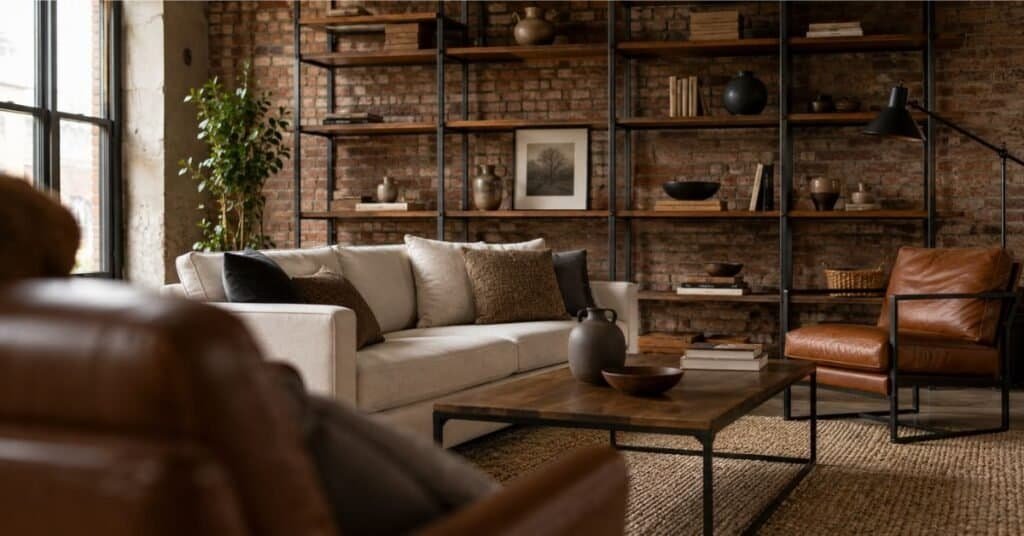
Over Styling Every Shelf
The most common mistake is filling every open spot.
House Beautiful UK warns to beware of over styling, and that is one of the easiest shelf styling problems to spot. When every inch has decor, nothing gets noticed.
A cleaner fix is to remove the smallest pieces first.
Tiny objects are often the reason shelves feel busy. Small candles, mini vases, small signs, little bowls, and tiny plants can blend into visual clutter.
Try this quick edit:
- Remove anything smaller than your palm.
- Keep one main item per shelf zone.
- Leave one open area on each shelf.
- Repeat only one or two colors.
- Step back from the room before adding more.
If the shelf still feels crowded, remove one more piece. Minimalist shelf decor usually looks stronger after editing, not adding.
Ignoring Scale and Proportion
A shelf can also feel wrong when the decor size does not match the shelf.
A tiny bowl can disappear on a deep bookcase. A huge vase can overwhelm a narrow floating shelf. A small frame can look lost on a long wall shelf.
Martha Stewart points to scale and proportion on living room shelves as part of making shelves look balanced. The idea is simple: match the size of your decor to the size of your shelf.
Use this guide:
| Shelf Type | Better Decor Size | What to Avoid |
|---|---|---|
| Narrow floating shelf | Slim frame, small vase, short books | Oversized bowls |
| Deep bookcase | Medium vase, larger frame, basket | Tiny scattered objects |
| Tall built in shelves | Larger books, art, baskets | Decor that is all one height |
| Short wall shelf | Low bowl, small stack, one frame | Too many tall pieces |
| Open kitchen shelf | Useful pieces with clean lines | Random decorative fillers |
For a 10 inch deep shelf, choose decor that is about 6 to 8 inches deep or less. For a tall bookcase, use larger pieces that can be seen from across the room.
The goal is simple: each item should look like it belongs on that shelf, not like it was squeezed in at the last minute.
Budget Friendly Minimalist Shelf Decor That Still Looks Stunning
Minimalist shelves do not need expensive decor.
In fact, budget pieces can look better than costly ones when the spacing, color, and scale are right. A thrifted vase, a stack of books, a simple basket, and one framed print can make a shelf feel warm and polished.
The key is to avoid buying small filler pieces just because the shelf has empty space.
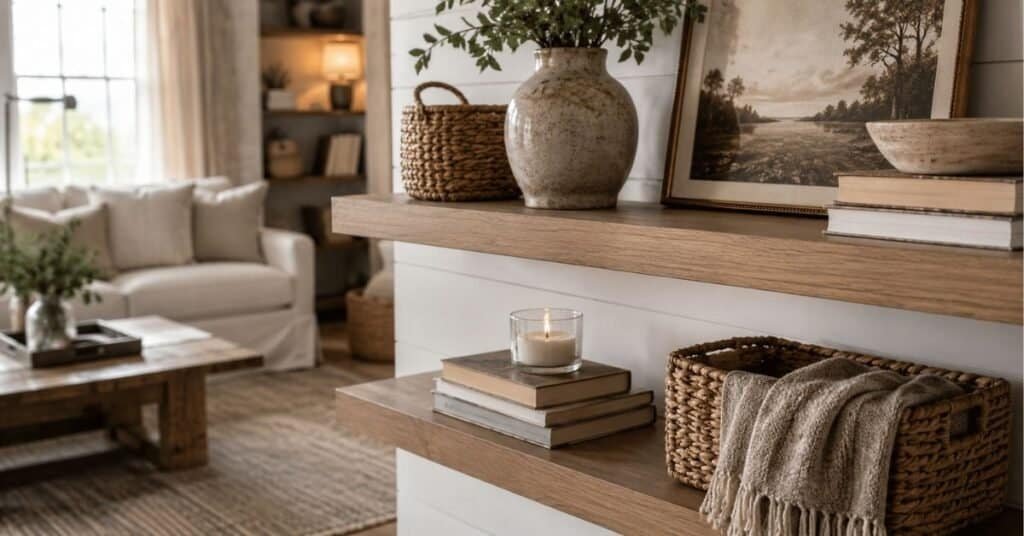
Use What You Already Own First
Before buying anything new, shop your own home.
Walk through the rooms and look for items that already fit your shelf style. You may already have books, bowls, baskets, frames, vases, jars, candle holders, or small plants that can work.
Good pieces to reuse include:
- Hardcover books
- Simple bowls
- Neutral baskets
- Ceramic pitchers
- Small framed prints
- Glass jars
- Wood trays
- Stoneware mugs
- Linen covered books
- Clay pots
Remove labels, bright packaging, and random items that do not match the shelf. A plain glass jar can look beautiful, but a jar with a busy label may make the shelf feel less calm.
Try placing your largest piece first. Then add one book stack and one smaller object. Stop there, step back, and see if the shelf already feels finished.
A budget shelf often looks better with three strong pieces than with ten small ones.
Shop for Texture, Not More Decor
If you do buy something, look for texture first.
Texture helps a simple shelf feel rich without needing many objects. Look for ceramic, wood, woven fibers, stoneware, glass, linen, or aged metal.
House Beautiful shares bookshelf ideas that combine chic organization with a pleasing shelf layout. For a budget shelf, that means the layout matters just as much as the pieces themselves.
A thrifted ceramic vase can look stunning when it has space around it. A plain basket can feel high end when it sits on a lower shelf with books above it. A simple frame can look beautiful when the colors match the rest of the room.
Try this budget mix:
| Budget Item | How to Use It | Why It Works |
|---|---|---|
| Thrifted vase | Place alone beside open space | Adds height and shape |
| Old books | Stack 3 to 5 together | Adds structure |
| Woven basket | Use on lower shelf | Hides small clutter |
| Simple frame | Lean against shelf back | Adds depth |
| Glass holder | Pair with ceramics | Adds light texture |
| Clay pot | Add one small plant | Adds a natural touch |
Avoid buying tiny filler pieces. They may seem helpful in the store, but they can make shelves feel scattered at home.
For a stunning shelf on a small budget, choose fewer pieces with better shape, warmer texture, and enough open space around them.
A Simple Minimalist Shelf Decor Formula You Can Copy
A shelf is easier to style when you follow a simple pattern.
You do not need to guess where every item should go. Start with a few basic pieces, place them with breathing room, then repeat the idea in small ways across the shelf.
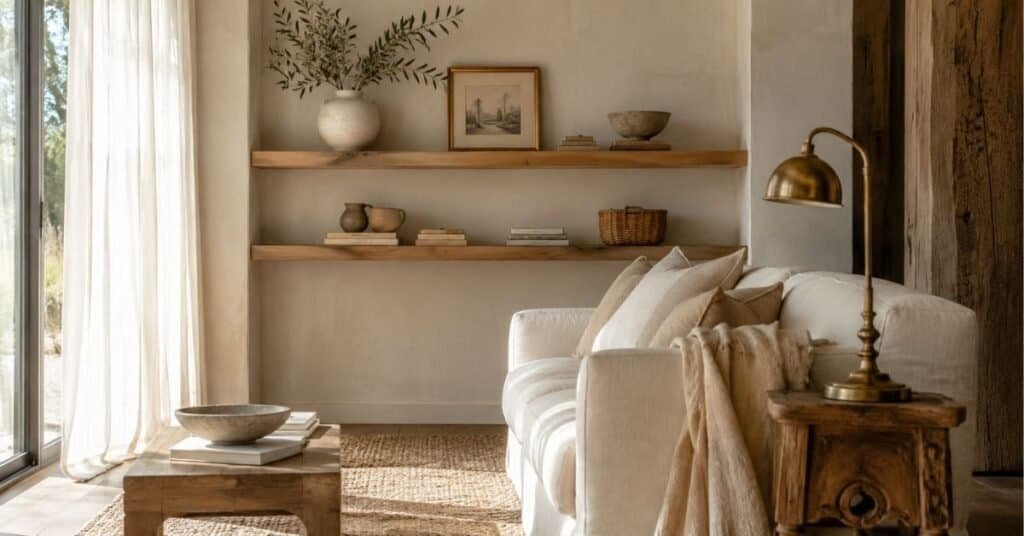
Use the Book, Basket, Object, Space Formula
This formula works for most shelves:
- Books
- Basket
- Object
- Space
Start with books because they give the shelf structure. Add a basket if you need hidden storage. Place one object, like a vase or bowl, to add shape. Then leave open space so the shelf does not feel crowded.
Here is what it can look like:
| Shelf Zone | What to Use | Simple Placement |
|---|---|---|
| Left side | Vertical books | Keep them near the edge |
| Middle | Ceramic vase or framed art | Let it be the main piece |
| Right side | Open space | Leave room for the eye to rest |
| Lower shelf | Woven basket | Use it for hidden storage |
| Small shelf | Books and one bowl | Keep the grouping tight |
The open space matters as much as the objects. If you remove the empty area, the shelf loses its calm feeling.
For a 36 inch shelf, try using about 20 to 24 inches for decor and leaving the rest open. For a smaller 24 inch shelf, two pieces may be enough.
Try the Rule of Three Without Making It Rigid
The rule of three can help shelf decor feel balanced.
House Beautiful recommends restraint when styling a bookcase, which is important here. A group of three can look beautiful, but only when the pieces have enough space around them.
Try these shelf groupings:
- Books, vase, bowl
- Basket, framed art, small plant
- Vertical books, low bowl, open space
- Book stack, candle holder, ceramic object
- Frame, vase, woven texture
The pieces should not all be the same height. Use one tall piece, one medium piece, and one low piece.
A simple grouping could be a 9 inch vase, a 6 inch stack of books, and a 3 inch bowl. That small height change keeps the shelf from looking flat.
Here is a quick guide:
| Shelf Type | Simple Formula | What to Avoid |
|---|---|---|
| Floating shelf | Frame, books, vase | Filling both ends |
| Bookcase | Books, basket, bowl | Long rows with no breaks |
| Kitchen shelf | Plates, bowl, glass piece | Too many random extras |
| Small apartment shelf | Basket, frame, open space | Bulky decor |
| Living room shelf | Books, art, ceramic vase | Tiny scattered objects |
You can repeat the formula, but do not make every shelf look identical. Change the height, side, and spacing so the shelves feel natural.
Frequently Asked Questions
How do you decorate shelves without making them look busy?
Use fewer pieces and leave open space between each group.
Start with books, one basket, one ceramic piece, and one framed item. If the shelf still feels crowded, remove the smallest decor first because tiny pieces can make shelves look messy fast.
What is the rule of three in shelf styling?
The rule of three means grouping three items together so the shelf feels balanced.
For example, you can use a book stack, a ceramic vase, and a small bowl. Vary the height so the grouping feels natural instead of stiff.
How many items should go on a minimalist shelf?
It depends on the shelf width, but most minimalist shelves look good with 2 to 4 pieces.
A 24 inch floating shelf may only need two items. A 36 inch shelf can usually hold three or four items if there is still open space around them.
How do you make shelves look styled instead of cluttered?
Choose a small color family, repeat materials, and avoid filling every gap.
Books, baskets, ceramics, and framed art work well when they have space around them. A planned shelf usually has one main focal point, one support piece, and one open area.
What colors work best for minimalist shelf decor?
Warm white, beige, cream, taupe, light gray, soft brown, matte black, and light oak work well.
These colors feel calm and easy to mix. You can add a small accent color through art, a clay vase, or a book spine, but keep it repeated in one or two places only.
Should books be stacked vertically or horizontally?
Use both.
Vertical books add height, while horizontal stacks create a base for a small bowl, frame, or ceramic piece. Mixing both keeps shelves from looking like plain storage.
How do you style shelves in a small apartment?
Use shelves for both display and hidden storage.
Place pretty pieces at eye level, then use baskets or boxes on lower shelves for everyday items. These kitchen shelf styling ideas for open storage can also help if your apartment has open shelving in the kitchen or dining area.
What items make shelves look expensive on a budget?
Larger pieces usually look better than many tiny ones.
Try thrifted ceramic vases, simple framed art, woven baskets, neutral books, stoneware bowls, and glass candle holders. Good spacing can make budget pieces look more high end.
How much empty space should you leave on shelves?
Leave about 30 to 40 percent of the shelf open when possible.
On a 36 inch shelf, that could mean 10 to 14 inches of open space across the full shelf. If that feels too bare, add one larger piece instead of several small ones.
How do you mix books and decor without crowding the shelf?
Use books as anchors, then add one decor piece nearby.
For example, place 5 to 8 books upright on one side, then add a bowl or vase beside them. On another shelf, use a short book stack with one small object on top and leave the rest open.
Conclusion
Minimalist shelf decor does not mean bare shelves.
It means choosing fewer pieces and giving them room to stand out. Books, baskets, ceramics, framed art, and open space can make a shelf feel calm, warm, and stunning without making the room feel crowded.
Start with one shelf first.
Clear it, choose a soft color family, add books, place one basket if you need hidden storage, then finish with one strong object like a ceramic vase or sculptural bowl. Step back before adding more.
Most shelves do not need more decor. They need better spacing, better scale, and a few pieces that feel right for the room.
For more calm home ideas, visit Minimalist Home Ideas: I Tried Simplifying My Space… Here’s What Actually Happened.