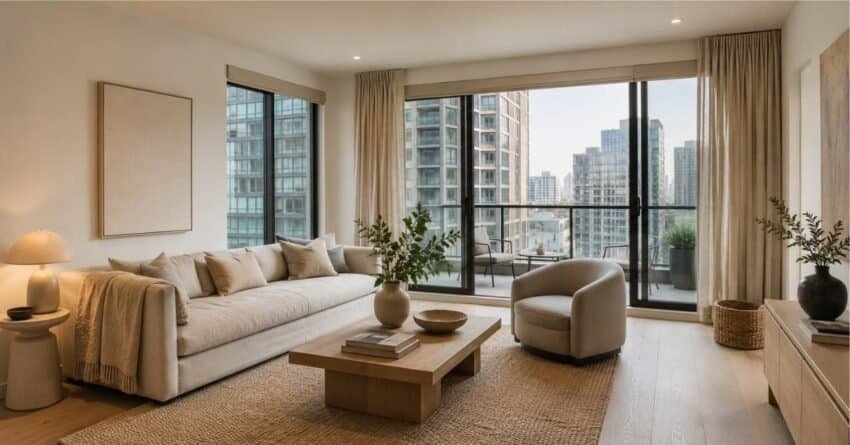
Small homes can feel crowded fast.
Sometimes the furniture is not the problem. The room may have enough storage, a decent layout, and simple decor, but the colors still make everything feel tight, cold, or unfinished.
A harsh white wall can feel flat at night. Too many accent colors can make a small living room feel busy. Dark curtains, bold rugs, and mixed wood tones can break the room into little pieces.
A minimalist color palette helps small homes feel calmer and more open without making the rooms look plain.
The right colors do not have to be plain. Warm white walls, soft beige tones, natural wood, light greige, muted olive, clay accents, and soft black details can all work together without making the room feel crowded.
If your rooms feel smaller than they should, these small space apartment ideas that make rooms feel bigger can also help with layout and spacing. Color works best when the room has a little breathing room too.
Picture a small living room with cream walls, linen curtains, a pale oak coffee table, a soft beige rug, and one muted green pillow. Nothing feels loud, but the room still feels warm.
That is the goal.
In this article, you will see simple ways to build a minimalist color palette for small homes using warm neutrals, soft contrast, wood tones, texture, and tiny accents that make a room feel stunning without feeling packed.
Table of Contents
Minimalist Color Palette Hacks That Make Small Homes Feel Stunning
A small home needs a calm color base before anything else.
If the walls, sofa, curtains, rug, and decor all compete, the room can feel busy before you even add furniture. A minimalist color palette gives the eye fewer stops, which helps the room feel more open.
Benjamin Moore suggests using white, greige, gray, and black hues for a calm look. For a small home, that idea works best when the colors are softened with warm wood, cream fabric, and natural texture.
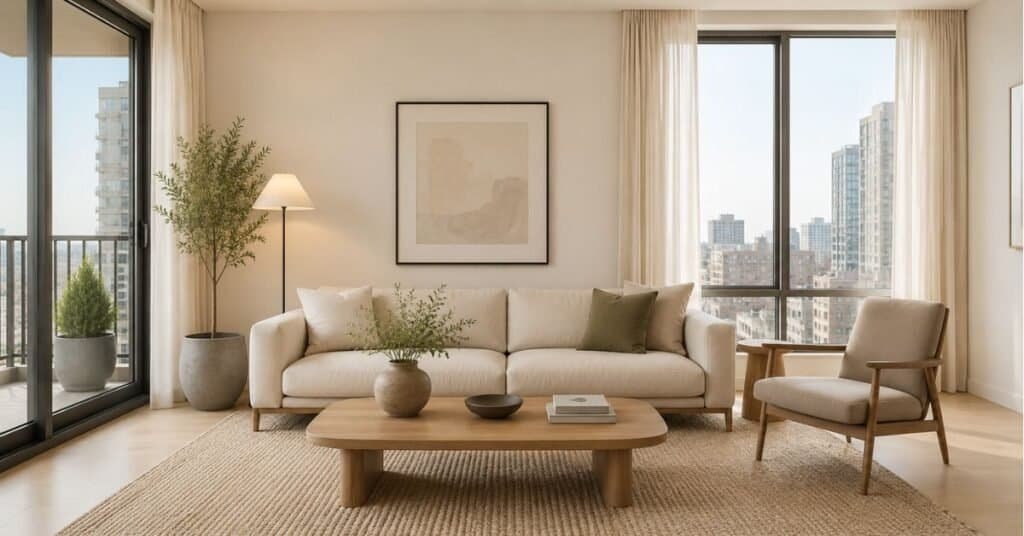
Start With One Soft Base Color
Start with one main color for the largest surfaces.
This could be warm white, cream, soft beige, pale greige, or light taupe. These shades work well because they reflect light without feeling stark.
Use your base color on:
- Main walls
- Large curtains
- Large rugs
- Sofa or bedding
- Built in shelves
- Main hallway or shared walls
In a small home, connected spaces often touch each other visually. The living room, dining nook, entry, and kitchen may all be seen from one spot. One soft base color helps those areas feel connected.
For example, warm white walls can carry through the living room and entry. Then you can add beige textiles, pale oak furniture, and one muted accent color.
A good small home base might look like this:
| Area | Color Choice | Why It Works |
|---|---|---|
| Walls | Warm white | Keeps the room bright |
| Sofa | Cream or beige | Softens the room |
| Rug | Pale beige | Makes the floor feel lighter |
| Wood | Pale oak | Adds warmth |
| Accent | Muted olive or clay | Adds interest without noise |
Try to avoid changing wall colors in every small zone. Too many wall colors can make a small home feel chopped up.
Keep Contrast Soft, Not Harsh
Contrast gives a room shape, but too much contrast can make a small room feel smaller.
Strong black curtains, a dark rug, black shelves, and bold wall art can break the room into heavy blocks. The space may still look modern, but it can feel tight.
Use contrast in smaller places instead:
- Thin black picture frames
- Chair legs
- Lamp bases
- Small bowls
- Cabinet pulls
- One side table
- One muted accent pillow
Soft black, walnut, clay, and muted olive are easier to live with than sharp black everywhere. They give the room depth without making the walls close in.
Here is a simple color fix guide:
| Small Home Color Problem | Why It Happens | Simple Color Fix |
|---|---|---|
| Room feels cold | Too much bright white | Add cream, wood, and warm lighting |
| Room feels busy | Too many accent colors | Choose one muted accent |
| Room feels chopped up | Harsh contrast in every corner | Use dark details in small doses |
| Room feels flat | All colors are too similar | Add texture and one deeper tone |
| Room feels smaller | Dark colors on large surfaces | Keep large pieces light |
A small home does not need to be all white to feel bigger. It needs color choices that work together quietly.
Warm Minimalist Color Palette Ideas for Small Rooms
A warm minimalist color palette can make a small room feel softer right away.
This is helpful when a room looks clean but still feels cold. The fix is usually not more decor. It is warmer undertones, softer texture, and colors that sit close together.
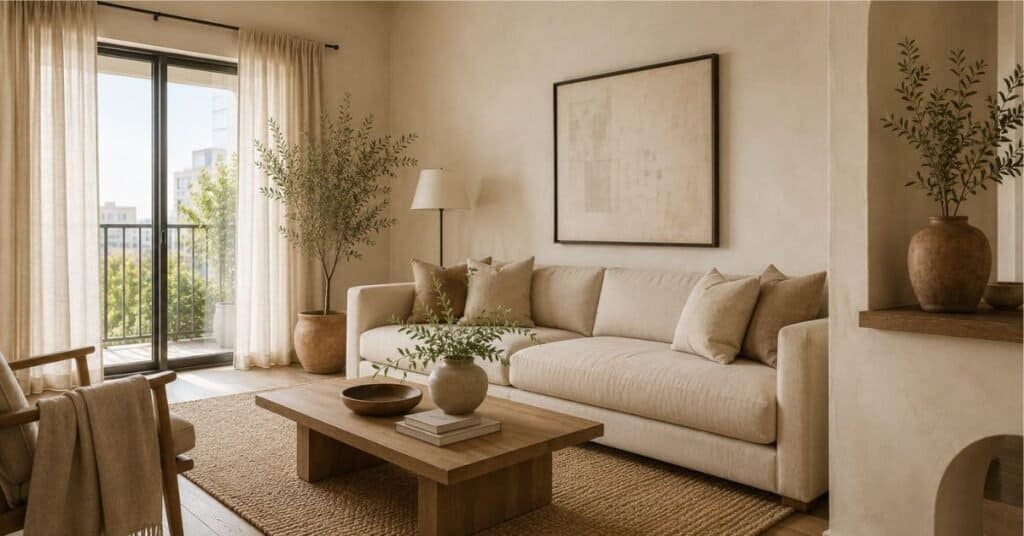
Use Cream, Beige, Taupe, and Wood Together
Cream, beige, taupe, and wood tones work well in small homes because they feel calm without looking flat.
The trick is to keep the undertones close. A warm cream wall usually works better with pale oak, beige linen, clay decor, and soft brass. A cool gray wall works better with cleaner white, black, glass, and cooler wood tones.
For a cozy small living room, try this mix:
- Warm cream walls
- Beige or ivory sofa
- Pale oak coffee table
- Taupe pillows
- Woven rug
- Clay vase
- Muted olive branches
This gives the room warmth without adding too much color.
If your room already has dark flooring, use lighter pieces above it. Cream curtains, a pale rug, and beige upholstery can balance the dark floor so the room does not feel heavy.
A simple rule: keep the biggest pieces soft, then use deeper colors only in small details.
Add Texture Instead of Extra Color
Texture can do a lot of the work that color usually does.
A room with cream walls, beige curtains, and a soft rug can still feel rich when the textures are different. Linen, woven fibers, ceramic, wood grain, boucle, cotton, and stoneware all add depth without making the room look crowded.
For more ideas, these layered living room textures that look good can help you build warmth without adding more color.
Try pairing:
| Neutral Base | Texture to Add | Small Detail |
|---|---|---|
| Warm white wall | Linen curtains | Soft black frame |
| Beige sofa | Boucle pillow | Clay vase |
| Pale oak table | Ceramic bowl | Brass lamp |
| Cream bedding | Cotton throw | Wood nightstand |
| Greige wall | Woven basket | Olive branch |
A small home can feel warm with only a few colors if the textures are strong.
Think of a cream sofa beside linen curtains, a pale oak table, and one ceramic vase. The colors stay quiet, but the room still feels finished.
Neutral Minimalist Color Palette for Small Apartments
Apartments can feel busy because several areas are often visible at once.
The living room, dining nook, kitchen, and entry may all share one view. If each area has a different color mood, the apartment can feel smaller than it is.
A neutral minimalist color palette helps those areas feel connected.
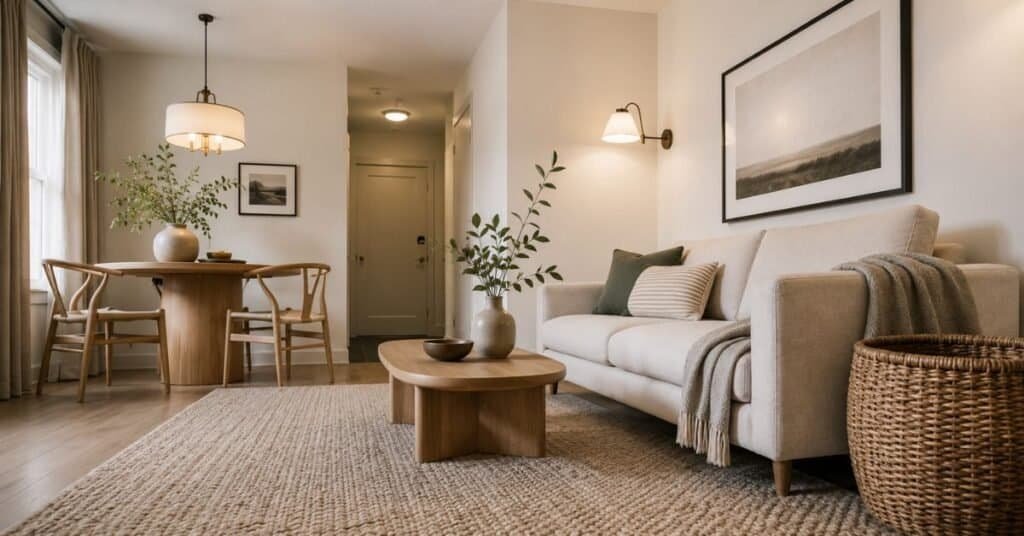
Choose a Base, Support Color, and Tiny Accent
The easiest way to plan apartment color is to choose three levels.
Start with one base color. Add one support color. Then use one tiny accent.
The KariGhars describes minimalist interiors as using neutral bases with a single muted accent. That works well in small apartments because it keeps the room from feeling visually crowded.
Try this simple ratio:
- 80 percent warm white, cream, or soft greige
- 15 percent beige, pale oak, taupe, or walnut
- 5 percent soft black, muted olive, clay, or brass
This does not need to be exact. It is just a helpful way to avoid adding too many colors.
For example, use warm white walls, beige curtains, a pale oak table, a cream sofa, and small olive accents in art or pillows. The room still has personality, but the colors stay quiet.
Make Connected Rooms Feel Like One Space
Small apartments feel calmer when the colors repeat.
Use the same wall color through the main living area if possible. Then repeat one wood tone and one accent color in each zone.
A small apartment could use:
| Area | Base Color | Support Color | Small Accent |
|---|---|---|---|
| Living room | Warm white | Beige and pale oak | Muted olive |
| Dining nook | Warm white | Pale oak | Soft black frame |
| Entry | Warm white | Woven texture | Clay bowl |
| Kitchen | Cream or greige | Light wood | Matte black hardware |
This helps the apartment feel like one home instead of several small corners fighting each other.
Rugs, lamps, and art can still define each area. You do not need a new color theme for every spot.
For more help with keeping a room calm, use minimalist living room styling with fewer elements beside your color plan. Fewer pieces make the palette easier to notice.
A small apartment color plan should feel easy to follow. Once you know your base, support color, and tiny accent, shopping and styling become much simpler.
Minimalist Colors for Small Spaces That Feel Bigger
Color can make a small space feel wider, softer, and less crowded.
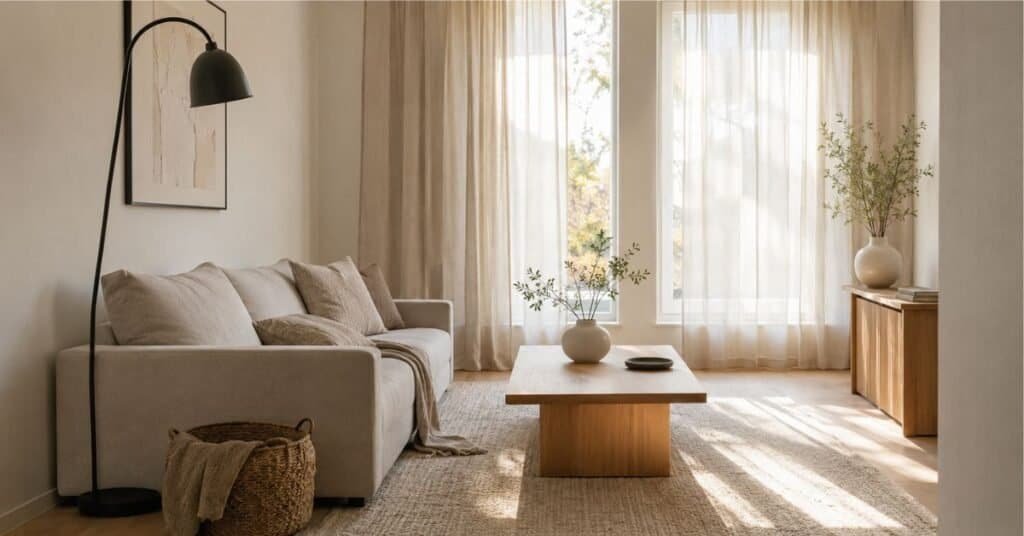
The biggest color impact comes from large surfaces: walls, curtains, rugs, sofas, bedding, and cabinets. If those areas are too dark or too busy, the room can feel smaller right away.
Apartment Therapy shares ideas for using a minimalist color palette in compact spaces, which fits small homes well. The fewer colors the eye has to jump between, the calmer the room feels.
Use Light Reflecting Colors on Large Surfaces
Light colors work best when they are soft, not harsh.
Warm white, cream, pale beige, soft greige, and light taupe can reflect daylight while still feeling warm. These colors are especially useful on walls, curtains, and large rugs because they cover so much visual space.
Use lighter colors on:
- Main walls
- Curtain panels
- Large rugs
- Sofa covers
- Bedding
- Cabinet fronts
- Large storage pieces
A small living room with cream walls, linen curtains, and a pale rug will usually feel more open than the same room with dark curtains and a heavy patterned rug.
If the room has only one window, keep the window area light. Cream or warm white curtains can let the window feel larger. Dark panels can frame the window too strongly and make the wall feel smaller.
Use Dark Accents Only Where They Help
A small room still needs a little depth.
Dark accents can help define the space, but they should be used in small doses. Think thin picture frames, lamp bases, chair legs, cabinet pulls, or a small side table.
Avoid using dark colors on every large piece in a tiny room. A black sofa, dark rug, black curtains, and dark shelves can make the room feel closed in.
Here is an easy guide:
| Color Area | Safer Small Space Choice | What to Avoid |
|---|---|---|
| Walls | Warm white or pale greige | Dark walls in every room |
| Curtains | Cream or linen tone | Heavy dark panels |
| Rug | Soft beige or light woven texture | Busy dark patterns |
| Sofa | Cream, beige, or taupe | Very dark bulky fabric |
| Accent | Thin black frame or lamp | Black on every surface |
| Wood | Pale oak or warm walnut | Too many mixed wood tones |
Use dark details where they give shape. A slim black frame above a cream sofa can look sharp without making the wall feel heavy.
The room should still feel light first. The darker pieces should act like small punctuation marks, not the main color story.
Modern Minimalist Color Palette Combinations You Can Copy
A minimalist color palette is easier to use when you can picture the full mix.
Instead of choosing one wall color and hoping it works, build a small palette with a base, wood tone, textile color, and accent. This makes the room feel planned without making it feel stiff.
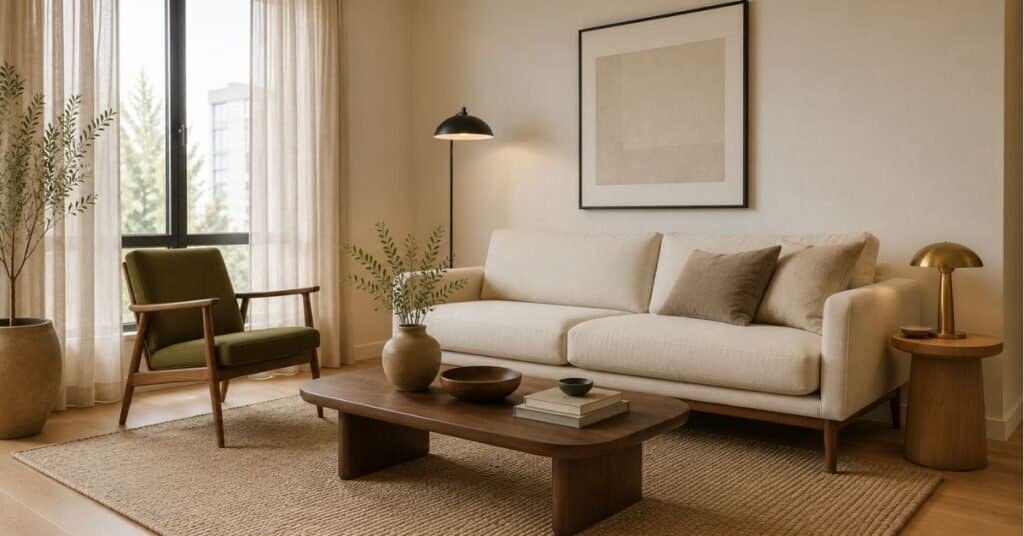
Homes & Gardens shares ideas around warm neutrals and pops of green in minimalist schemes. That is useful for small homes because a tiny green or clay accent can warm up a neutral room without making it feel busy.
Warm White, Pale Oak, and Soft Beige
This is one of the easiest palettes for small homes.
It works well in living rooms, studio apartments, bedrooms, and open layouts because it feels light and warm at the same time.
Use:
- Warm white walls
- Pale oak furniture
- Soft beige rug
- Cream sofa or bedding
- Linen curtains
- One small clay or brass accent
This palette is calm, but it still has warmth. Pale oak keeps the room from feeling too white. Beige textiles soften the floor and seating.
For a small living room, try warm white walls, a pale oak coffee table, cream curtains, and a beige rug. Then add one clay vase or muted olive pillow for a small color moment.
Greige, Cream, Walnut, and Matte Black
Greige is helpful when you want something warmer than gray but cooler than beige.
It can work well with cream fabric, walnut furniture, and small matte black details. This palette feels a little more modern and grounded.
Use:
- Greige walls
- Cream sofa
- Walnut side table
- Warm beige rug
- Matte black frame or lamp
- Soft white curtains
The key is to keep black small. A thin frame, lamp base, or chair leg is enough.
If the room is very small, keep the walls lighter and use walnut only on one or two furniture pieces. Too much dark wood can make the room feel heavy.
Taupe, Linen, Clay, and Muted Green
This palette works well for bedrooms, reading corners, and calm small homes.
Taupe and linen create a soft base. Clay adds warmth. Muted green brings in a natural feel without becoming loud.
Use:
- Taupe pillows
- Linen curtains
- Clay ceramic decor
- Muted green art or pillow
- Warm white walls
- Light wood or walnut accents
A small bedroom could use warm white walls, cream bedding, taupe pillows, a clay vase on the nightstand, and one muted green print above the bed.
Here is a simple palette guide:
| Palette | Best Room | How to Use It |
|---|---|---|
| Warm white, pale oak, beige | Living room or studio | Keep large pieces light and warm |
| Greige, cream, walnut, black | Modern apartment | Use black in thin details only |
| Taupe, linen, clay, green | Bedroom or reading corner | Keep the accent soft and repeated |
| Cream, brass, beige, wood | Entryway or dining nook | Add brass in one or two small places |
| Warm white, olive, clay, oak | Small open layout | Repeat olive in art or textiles |
A good palette does not need many colors. It needs the right colors repeated in the right places.
Minimalist Paint Colors and Wall Color Tips
Paint color can change a small room more than almost anything else.
The same room can feel open in the morning and dull at night if the wall color does not work with the light. That is why minimalist paint colors need to be tested in the real room before you commit.
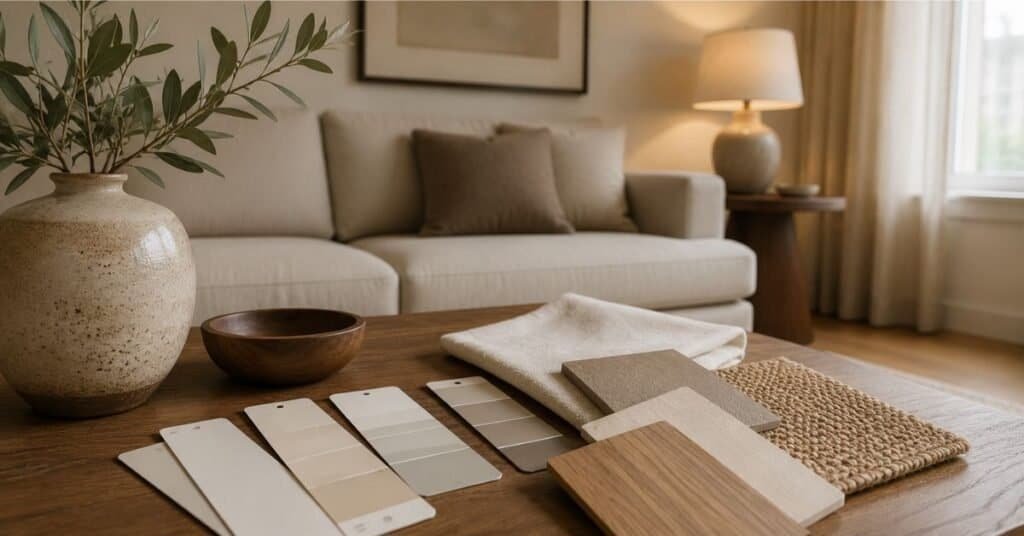
Minimal and Modern shares ideas for minimalist color palettes that can be used across interiors. The helpful part for small homes is that a simple palette should work from room to room, not just on one pretty wall.
Test Paint in Morning and Evening Light
Paint changes throughout the day.
A warm white can look creamy in the morning and yellow at night. A soft greige can look calm in daylight and muddy under a warm bulb. A pale beige can look perfect on one wall and darker on another.
Before painting a whole room, test a large sample.
Try this:
- Paint or place a large sample on two walls.
- Check it in morning light.
- Check it again in evening lamp light.
- Look at it beside your sofa, floor, rug, and curtains.
- Keep the sample up for at least two days.
Small rooms can make paint look darker because there is less wall distance and less light bounce. A color that looks soft in a store can feel heavier once it wraps around a tiny room.
For a small home, safer wall colors usually include:
| Paint Color Type | Best Use | Watch Out For |
|---|---|---|
| Warm white | Main walls and hallways | Can look yellow with warm bulbs |
| Cream | Bedrooms and cozy living rooms | Can feel too rich in dark rooms |
| Pale greige | Apartments and shared spaces | Can look muddy with beige floors |
| Soft beige | Warm rooms with wood tones | Can feel flat without texture |
| Light taupe | Bedrooms and reading corners | Can darken in low light |
A large sample helps you see the color clearly before making a bigger change.
Avoid Mixing Too Many Undertones
Undertones are the quiet colors under the main color.
A wall may look white, but it can lean yellow, pink, gray, blue, or green. A beige sofa may lean warm, while a gray rug may lean cool. When too many undertones mix, the room can feel off even if every piece looks nice on its own.
For a warm minimalist color palette, keep warm tones together.
Use:
- Warm white walls
- Cream fabric
- Beige rugs
- Pale oak
- Walnut
- Clay
- Brass
- Muted olive
For a cooler minimalist palette, use:
- Soft gray walls
- Clean white fabric
- Black frames
- Glass
- Cooler wood
- Slate or charcoal accents
Greige can help bridge the gap because it sits between gray and beige. It works well in small homes where you have warm wood floors but still want a clean, modern feel.
A simple test helps. Place your paint sample beside your main fabric and flooring. If one looks yellow, one looks blue, and one looks pink, the palette may feel busy once the room is finished.
Minimalist Color Mistakes That Make Small Homes Look Cold
A minimalist color palette can feel cold when it loses warmth.
This usually happens when the room has too much plain white, too many cool grays, or too many sharp accent colors. The room may look clean, but it can feel stiff instead of cozy.
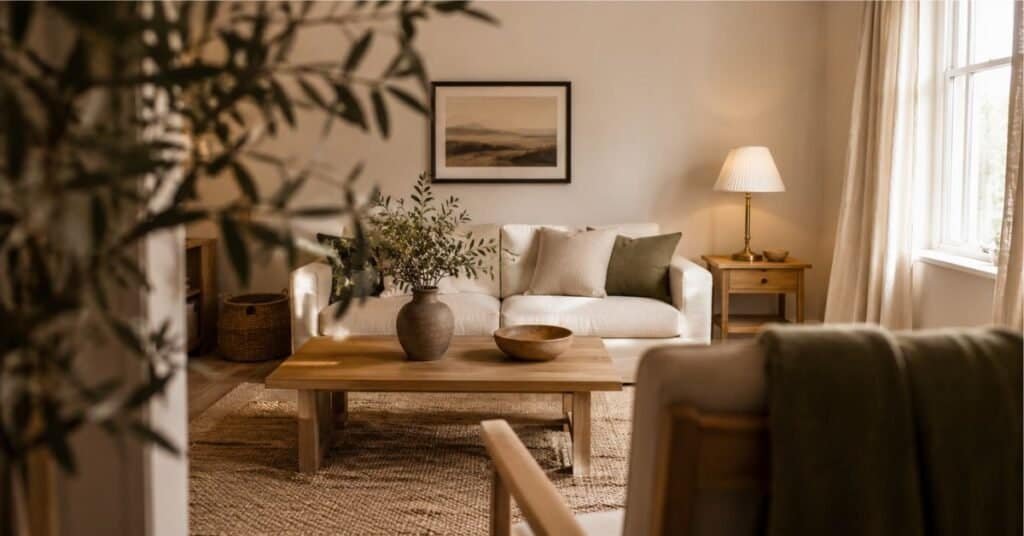
Homes & Gardens shares ideas around colors that keep minimalist rooms from feeling bland, including warm neutrals and soft green accents. For small homes, that is a helpful reminder that minimal color does not mean lifeless color.
Using Too Much Plain White
White can help a small home feel open, but too much flat white can feel harsh.
A room with white walls, white sofa, white curtains, white rug, and no texture can look bright during the day, then cold at night. The fix is to warm up the white with cream, beige, wood, and soft lighting.
Try adding:
- Cream curtains
- Pale oak furniture
- Beige rug
- Woven basket
- Clay ceramic vase
- Warm brass lamp
- Soft 2700K bulbs
- Muted olive branches or art
You do not need to repaint everything. Even one beige rug and one warm wood table can soften a plain white room.
If your walls are already bright white, avoid adding more bright white in every layer. Choose cream, ivory, oatmeal, or warm beige instead.
Adding Too Many Accent Colors
Accent colors can make a minimalist room feel personal.
The problem starts when every corner has a different accent. A blue pillow, red art, green vase, yellow throw, and black rug can make a small room feel loud.
Choose one main accent and repeat it in small ways.
For example:
| Accent Color | Where to Repeat It | Keep It Calm With |
|---|---|---|
| Muted olive | Pillow, art, plant leaves | Cream and pale oak |
| Clay | Vase, bowl, small print | Beige and warm white |
| Soft black | Frame, lamp, chair legs | Linen and wood |
| Dusty blue | Art, pillow, book spine | Greige and cream |
| Warm brass | Lamp, frame, small tray | Taupe and ivory |
Keep accents small. A muted olive pillow, a small print, and plant leaves are enough. You do not need matching curtains, pillows, art, and decor in the same accent.
Too many visible everyday items can also break a calm color plan. These minimalist decor ideas that hide everyday clutter can help keep bright packaging, cords, papers, and random pieces from taking over the room.
A small home feels calmer when accent colors are used with restraint and repeated lightly.
Budget Friendly Minimalist Color Palette Hacks
You do not need to repaint the whole home to change the color mood.
A small room can feel warmer with a few color swaps in the right places. Textiles, lamps, baskets, art, and small decor can shift the palette without a big project.
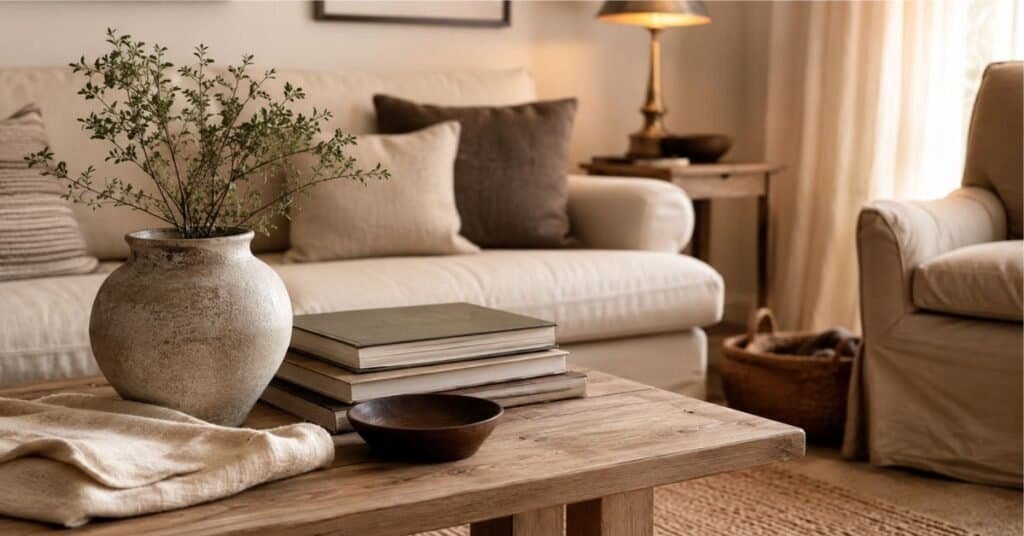
Change Textiles Before Paint
Textiles cover a lot of space, so they can change a room fast.
Curtains, rugs, pillow covers, throws, and bedding often make a bigger difference than small decor. If your room feels cold, start there before buying more objects.
Try these budget swaps:
- Replace stark white curtains with cream linen look curtains.
- Add a soft beige rug over dark flooring.
- Use taupe pillow covers instead of bright accent colors.
- Fold a warm neutral throw over a chair or sofa.
- Choose bedding in cream, oatmeal, or soft greige.
A small living room can look calmer when the rug and curtains are close in tone. For example, cream curtains with a pale beige rug can help the floor and wall feel connected.
If your rental walls are cool gray, warm textiles can soften them. Try ivory curtains, walnut wood, clay ceramics, or a muted olive pillow.
Use What You Already Own in One Color Family
Before buying anything, gather your decor by color.
Place cream books, beige bowls, wood trays, black frames, woven baskets, and clay pieces together. Then remove anything that fights the palette.
You may already have enough pieces for a calm minimalist color palette.
Try this quick home edit:
| What You Have | How to Use It |
|---|---|
| Neutral books | Stack them on a coffee table or shelf |
| Black frames | Repeat them in two small places |
| Wood tray | Use it to group small items |
| Woven basket | Hide colorful everyday clutter |
| Beige throw | Soften a chair or sofa |
| Clay vase | Add a warm accent |
This is also a smart way to test a color palette before spending money. If the colors feel calm together on a table, they will likely feel calm in the room.
The goal is not to buy more. It is to make the colors you already own work harder.
A Simple Minimalist Color Palette Plan for Every Room
A small home feels calmer when the rooms share a color plan.
The living room does not need one palette, the bedroom another, and the entry another. A few repeated colors can help the whole home feel more open and connected.
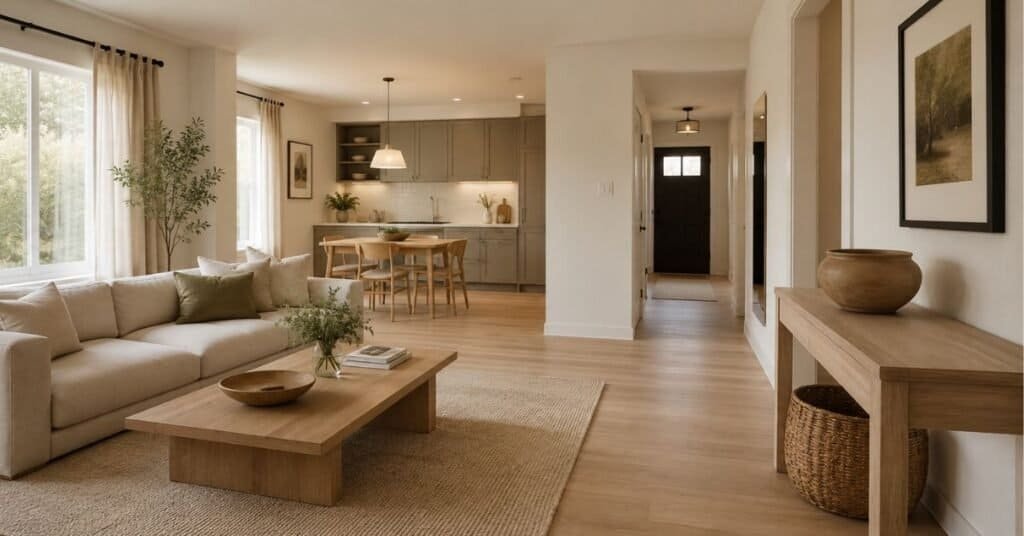
Living Room
The living room usually needs the clearest palette because it holds the largest pieces.
Start with the wall color, sofa, rug, and curtains. These four areas shape the room more than small decor.
A simple living room palette could be:
- Warm white walls
- Cream sofa
- Beige rug
- Pale oak coffee table
- Soft black frames
- One muted olive or clay accent
If your living room feels busy, reduce the number of visible accent colors first. Then repeat one accent in two or three small places.
For more ideas, these neutral palette living room ideas with warm details can help you keep the room soft without making it feel plain.
Bedroom
A bedroom should feel restful, especially in a small home.
Use warmer colors near the bed so the room feels softer at night. Cream bedding, taupe pillows, beige throws, and wood nightstands can make a minimalist bedroom feel calm without using many colors.
Try this bedroom palette:
| Bedroom Area | Color Idea |
|---|---|
| Walls | Warm white or soft beige |
| Bedding | Cream or ivory |
| Pillows | Taupe or greige |
| Nightstand | Pale oak or walnut |
| Accent | Clay, olive, or soft brass |
Avoid high contrast right beside the bed if the room is tiny. A bold black headboard, dark bedding, and bright art can feel heavy in a small bedroom.
A softer mix can still feel beautiful. Use texture through cotton, linen, wool, and wood instead of adding more colors.
Kitchen
A minimalist kitchen palette should feel clean but not cold.
Warm white, light wood, soft gray, greige, and cream work well because they keep the room bright. Then use small accents through hardware, stools, lighting, or one ceramic bowl.
Try this kitchen palette:
- Warm white walls
- Greige or cream cabinets
- Light wood stools
- Soft black or brass hardware
- White or beige counter decor
- One clay or wood bowl
If your kitchen opens into the living room, keep the same base wall color. This helps both spaces feel connected.
Keep counters visually quiet. Too many bright appliances, labels, and towels can break the color plan fast.
Entryway
The entryway should feel connected to the main room.
Use the same base color from the living room, then add one small color moment through art, a bowl, or a vase. This keeps the entry from feeling like a separate tiny box.
Try this entry palette:
- Warm white wall
- Light wood console
- Woven basket
- Soft black mirror or frame
- Clay catchall bowl
- Cream runner rug
A mirror can help bounce light, especially in a narrow entry. A basket can hide shoes, bags, or bright everyday items that do not match the palette.
Here is a simple room by room color plan:
| Room | Base Color | Accent | Texture to Add |
|---|---|---|---|
| Living room | Warm white | Olive or clay | Linen and woven rug |
| Bedroom | Cream | Taupe or brass | Cotton and wood |
| Kitchen | Greige or warm white | Soft black | Wood and ceramic |
| Entryway | Warm white | Clay | Woven basket |
| Dining nook | Beige or cream | Walnut | Linen and cane |
Repeat your base color in every room if possible. Then repeat one accent lightly so the home feels connected from one space to the next.
Frequently Asked Questions
What colors work best in a minimalist color palette?
Warm white, cream, soft beige, greige, taupe, light gray, natural wood, and small black accents work well.
These colors are calm enough for small homes, but they still leave room for warmth. Add one muted accent, like olive, clay, brass, or dusty blue, if the room feels too plain.
How many colors should a minimalist room use?
Most minimalist rooms work well with 2 to 3 main colors and one small accent.
For example, use warm white walls, beige textiles, pale oak furniture, and a small clay accent. This keeps the room simple without making it feel empty.
Is a minimalist palette always white or gray?
No, a minimalist palette does not have to be only white or gray.
Warm neutrals, wood tones, taupe, clay, beige, greige, and muted green can all work beautifully. The main idea is to keep the colors calm, repeated, and easy on the eye.
How do you keep a minimalist space from feeling cold?
Use warm undertones, natural texture, and soft lighting.
Linen curtains, woven rugs, ceramic decor, wood furniture, cotton pillows, and 2700K bulbs can make a clean room feel much warmer. These minimalist home ideas that still feel warm can also help if your room feels too plain.
Can a minimalist palette work in a small apartment?
Yes, a minimalist color palette works very well in a small apartment.
Repeat the same base color through the living area, entry, and kitchen. Then use one accent color in small places so the apartment feels connected instead of broken into separate corners.
What is the best neutral paint for minimalist interiors?
The best neutral paint depends on your light, flooring, and furniture.
Warm white, cream, pale beige, and soft greige are safe places to start. Test large samples on two walls and check them in daylight and evening light before choosing.
Should minimalist rooms use accent colors?
Yes, but accent colors should stay small and calm.
Muted olive, clay, soft black, warm brass, dusty blue, or a gentle taupe can add depth. Use one accent in two or three small places, such as a pillow, frame, vase, or art print.
How do you add texture without adding visual clutter?
Choose textures in close colors.
For example, pair cream linen curtains with a beige woven rug, pale oak furniture, and a white ceramic vase. The textures add depth, but the close colors keep the room calm.
Is greige a good minimalist color?
Yes, greige is a strong choice for minimalist interiors.
It sits between gray and beige, so it can work with both warm and cool pieces. In a small room, pale greige walls can feel softer than gray and cleaner than deeper beige.
What is the 60 30 10 rule for minimalist decorating?
The 60 30 10 rule means using one main color for about 60 percent of the room, one support color for about 30 percent, and one accent for about 10 percent.
For a small minimalist home, you can make it even quieter. Try mostly warm white or cream, some beige and wood, then a tiny accent like olive, clay, or soft black.
Conclusion
A minimalist color palette can make a small home feel calmer, warmer, and more open.
You do not need a full makeover to get that feeling. Start with one soft base color, add warm neutrals, repeat natural wood tones, and use one small accent color with care.
The best palettes are simple, but they are not boring.
Warm white walls, cream textiles, pale oak, soft beige, greige, clay, muted olive, and soft black details can all work together beautifully. The key is repetition. When colors repeat from room to room, the whole home feels more connected.
Start with one corner first.
Try cream curtains, a beige rug, a pale wood table, and one muted accent. Step back and see how the room feels before adding more.
A small home does not need louder color to feel stunning. It needs calmer color, warmer texture, and fewer pieces fighting for attention.
For more calm room ideas, visit Minimalist Home Ideas: I Tried Simplifying My Space… Here’s What Actually Happened.