Quick Answer
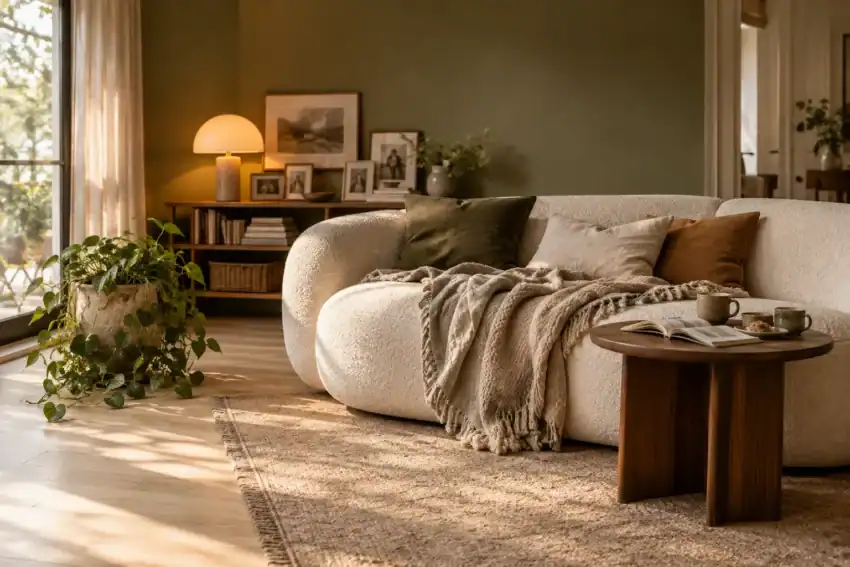
Minimalist Nordic home decor only feels cold when it’s styled for a camera instead of a life. The fix is simple: keep the clean lines and clear surfaces, but warm them with layered textiles, mixed wood tones, soft lamplight at 2700K, and a handful of objects that actually mean something to you.
Nordic design was never all-white, trend reporting now describes classic white-and-grey Scandi as feeling impersonal, with warm browns, olive greens, and clay tones taking over. You don’t need new furniture to get there.
Table of Contents
Key Takeaways
- White walls are optional. Warm beige, muted green, dusty blue, clay, and brown are all authentically Nordic.
- Texture beats quantity. Wool, linen, boucle, and handmade ceramics add warmth without adding clutter.
- Lighting is the biggest lever. Swap cool LEDs for warm, dimmable bulbs and use three light sources per room.
- Keep your stuff. Books, photos, and everyday objects are what separate a home from a showroom.
- Mix wood tones on purpose. Pale oak plus a walnut table reads richer than a matching set.
- Budget works. Secondhand wood furniture, thrifted ceramics, and new textiles do most of the heavy lifting.
- Families and pets fit fine. Durable wool, washable linen, and closed storage are core Nordic ideas, not compromises.
- Edit, don’t empty. Clear surfaces plus a few meaningful pieces is the whole formula.
What is minimalist Nordic decor, and how is it different from other minimalist styles?
Minimalist Nordic decor is a warm, function-first style built on natural wood, soft textiles, calming neutral tones, and simple silhouettes. Unlike cold modern minimalism (which prizes empty space and hard surfaces), the Nordic version exists to make long dark winters feel comfortable, so comfort is baked into the brief.
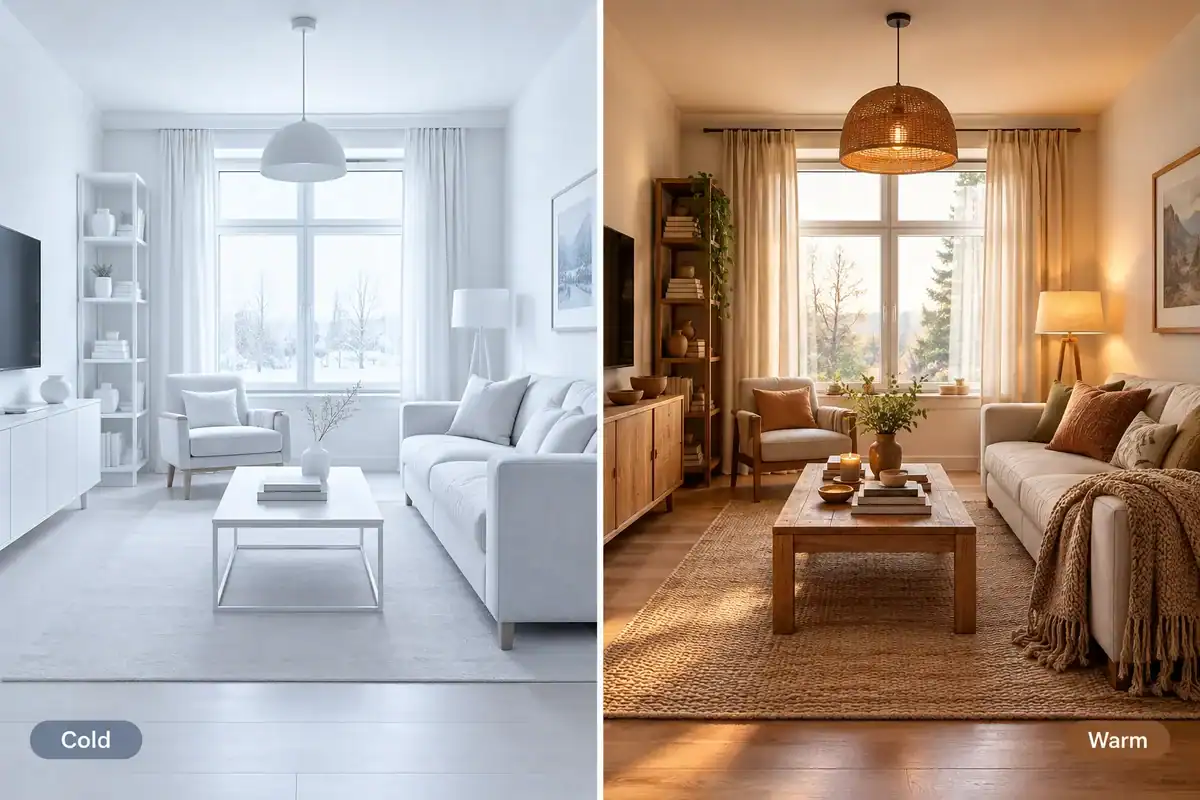
Here’s how it compares:
| Style | Core goal | Feels like |
|---|---|---|
| Nordic minimalism | Warmth + function | Soft, tactile, lived-in |
| Modern minimalism | Visual purity | Sleek, gallery-like |
| Japandi | Calm + craft | Quiet, low, sculptural |
| Showroom “Scandi” | Photographability | Pretty but hollow |
Current Nordic design coverage has moved firmly past strict minimalism. Scandification’s analysis of Nordic interior trends beyond minimalism describes a rise in “dark Scandi” rooms using charcoal, deep forest green, and navy as main wall colours, with honey oak, walnut, and smoked oak replacing the uniformly pale woods of the past decade.
Decision rule: if your room photographs beautifully but nobody wants to sit in it, you’ve built a showroom, not a Nordic home.
How do I keep minimalist Nordic rooms from looking cold and empty?
Add warmth in layers, not objects. Three warm light sources, two textile layers, and one piece of natural imperfection (a handmade bowl, a weathered wood stool) will fix a cold room faster than ten new accessories.
Practical moves:
- Lower the light. Replace 4000K+ bulbs with dimmable 2200-2700K.
- Layer the floor. A wool rug over bare wood instantly softens acoustics and mood.
- Rumple something. A throw tossed over an arm, not folded into a perfect triangle.
- Break the matching. One contrasting wood tone, one vintage piece.
- Leave evidence of life. A stack of books, a bowl of keys, a half-burned candle.
A Nordic room should look like someone just got up from the sofa, not like no one has ever sat on it.
Our guide to minimalist home ideas that still feel warm goes deeper on the warmth-versus-emptiness balance.
What colors work best for minimalist Nordic home design?
Warm neutrals as the base, one muted nature tone as the accent. Brown has largely replaced cool beige as the default Nordic neutral, and olive green, terracotta, dusty blue, and clay now appear as full wall colours rather than tiny accents.
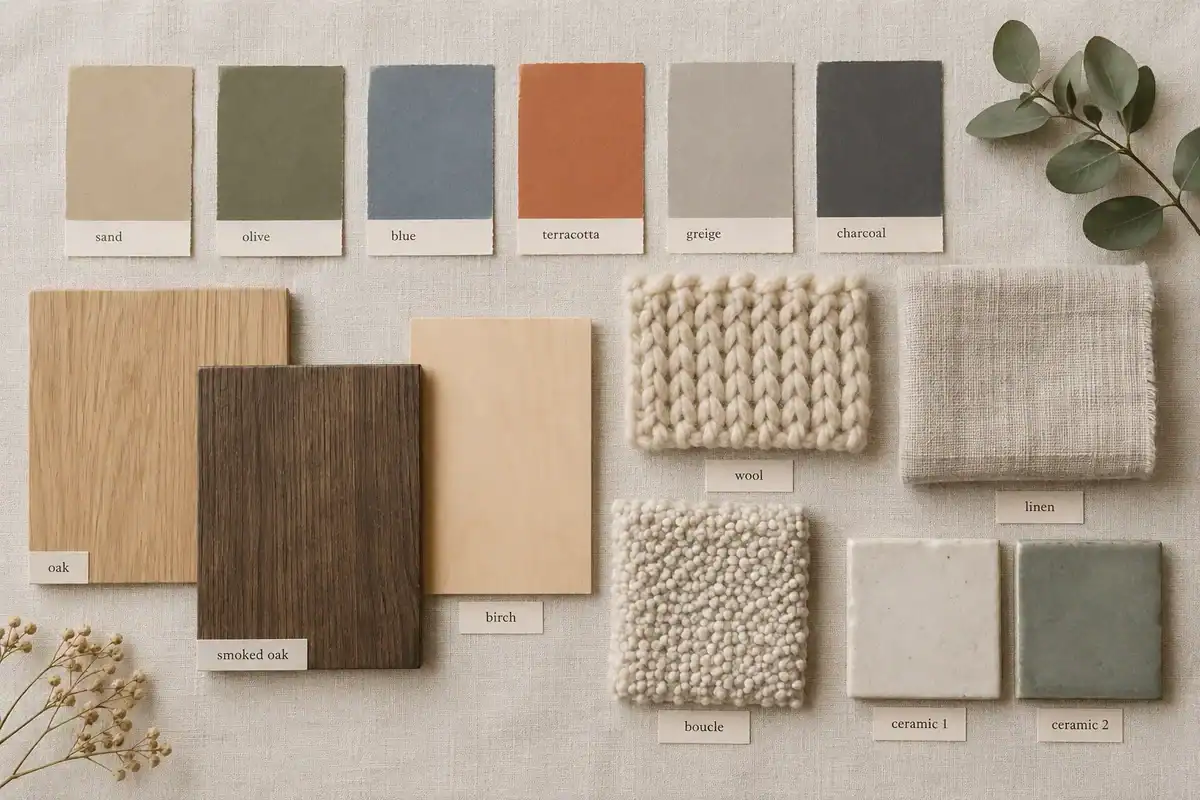
A reliable palette:
- 70% base: warm white, oat, greige, or soft putty
- 20% secondary: natural oak, walnut, rattan, stone
- 10% accent: olive, dusty blue, clay, burgundy, or charcoal
Nordic Nest’s Scandinavian interior design trend guide treats colour as a cornerstone of the Scandinavian home, pointing to retro hues like cloudberry yellow and burgundy paired with sky blue to keep interiors personal rather than vacant. Renters who can’t paint can carry the accent through cushions, curtains, a throw, and art instead, see our minimalist color palette hacks for small homes.
Common mistake: choosing a cool grey-white in a north-facing room. It will read blue and clinical by 4 p.m. Go a half-step warmer than feels right on the paint chip.
What textiles and materials define minimalist Nordic style?
Wool, linen, boucle, oak, birch, stoneware, and woven fibers. Texture is what gives a sparse room depth, which is why current Scandinavian design reporting describes a clear shift toward texture-led spaces over smooth, pale surfaces.
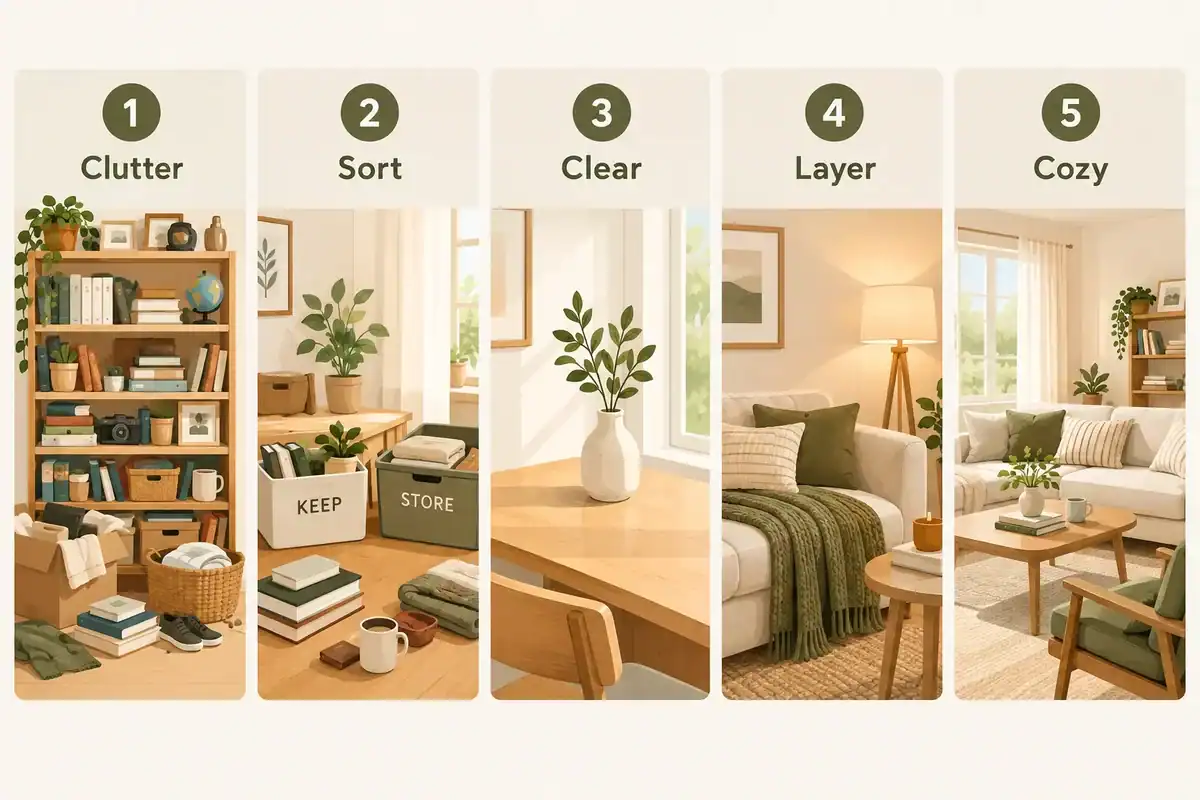
- Wool, rugs, throws, cushion covers; durable and pet-friendly
- Linen, bedding and curtains; the slubby, slightly wrinkled kind
- Boucle, one upholstered chair is plenty
- Oak, birch, walnut, matte or brushed, never high-gloss
- Handmade ceramics, uneven glazes read as warmth
- Jute, rattan, seagrass, baskets that hide clutter in plain sight
Livingetc’s look at Scandinavian design trends notes this same move toward tactility, and trend scouts reporting from 3 Days of Design describe less focus on individual product staging and a stronger emphasis on whole-room atmosphere.
How do I add warmth and personality to minimalist Nordic spaces?
Keep the objects that carry a story and remove the ones that were bought to fill space. Personality in a Nordic room comes from a small number of specific things, not a large number of generic ones.
- Frame two or three family photographs in matching oak or black frames instead of a sprawling gallery wall.
- Display books spine-out in a short stack, they add colour and texture for free.
- Keep one inherited or vintage piece per room: a chair, a mirror, a bowl.
- Hang art you chose, not art that matched the sofa.
Grouping personal items into small, intentional vignettes keeps surfaces calm. Our post on minimalist shelf decor that makes a room feel stunning walks through the three-object grouping rule.
How much does it cost, and where can I buy affordable minimalist Nordic decor?
You can shift a room convincingly for the price of textiles and bulbs, no furniture replacement required. Cost depends entirely on whether you buy the look or build it.
Rough order of spend, cheapest first:
- Warm dimmable bulbs (cheapest change with the biggest payoff)
- Cushion covers and a wool throw
- Woven storage baskets
- A second-hand solid wood side table or stool
- A large natural-fiber or wool rug
- Upholstered seating (last, and only if genuinely uncomfortable)
Where to look: thrift and estate sales for solid oak, teak, and birch; Facebook Marketplace for mid-century pieces that suit Nordic lines; big-box retailers for linen bedding and simple lighting; local potters or craft markets for ceramics. Vintage mixing isn’t just budget-friendly, Torr Decor’s Scandinavian interior guide lists blending new and vintage pieces and prioritizing long-term purchases as defining traits of the style.
Can you mix minimalist Nordic with other styles, and does it work for families?
Yes to both. Nordic minimalism is one of the easiest styles to blend because its neutral base flatters almost anything, and its emphasis on durability and function makes it genuinely practical with kids and pets.
Mixing that works:
- Nordic + mid-century, shared wood tones and tapered legs (see our 60s mid-century decor ideas)
- Nordic + boho, formalized by manufacturers as “Scandic Bohemia,” a lighter mix of styles with Scandinavian clarity
- Nordic + rustic/farmhouse, keep the wood, drop the signage
- Nordic + Japandi, low furniture, darker woods, more restraint
For families: choose wool and performance linen (both forgiving), cover feet of wood furniture with felt pads, use closed storage at kid height, and skip glass-topped anything. Our small space solutions for an organized minimalist home covers toy storage that hides in plain sight.
Does minimalist Nordic work in apartments with low light?
It works especially well, the style was developed in places with very short winter days. The trick is adding layers of warm artificial light rather than chasing brightness.
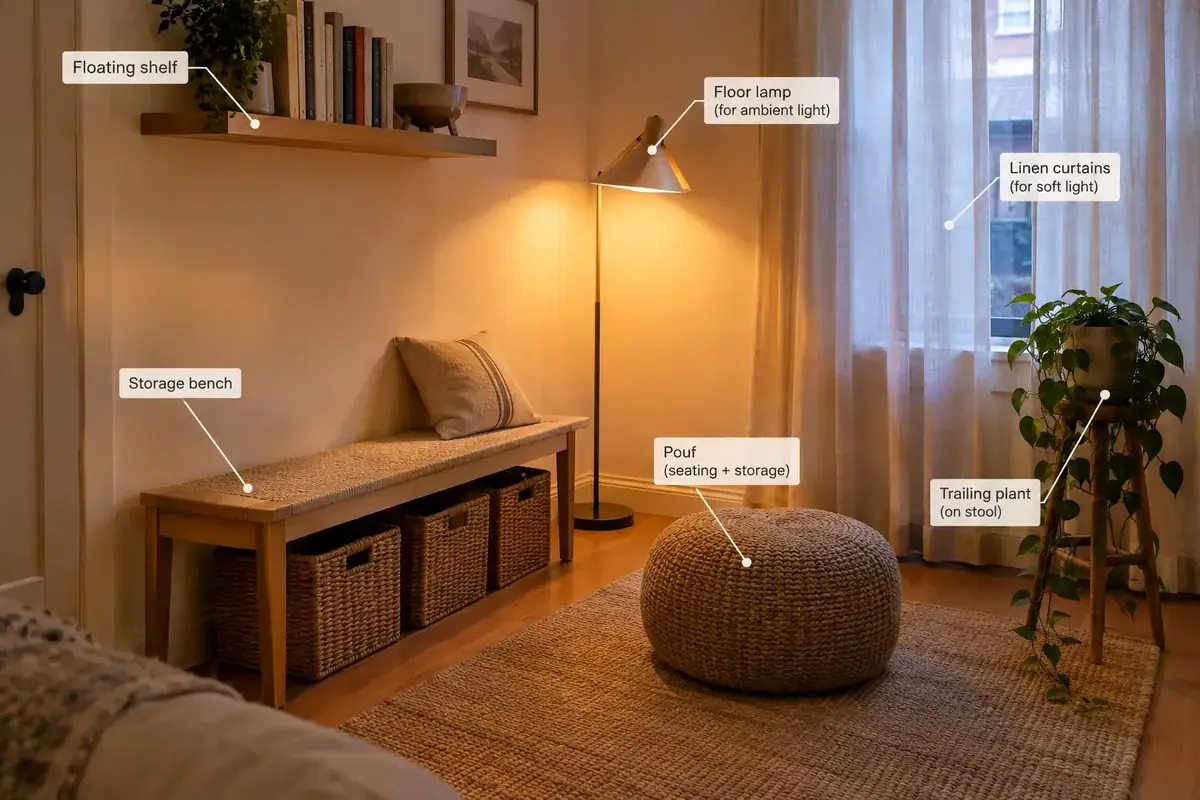
- Use three light sources minimum per room: overhead, table, floor.
- Aim lamps at walls and ceilings to bounce light instead of spotlighting the floor.
- Hang sheer linen instead of heavy drapes; mount the rod high and wide.
- Add a mirror opposite the window, not opposite a blank wall.
- Keep bulbs at 2700K and dimmable so the room reads intimate at 7 p.m., not fluorescent.
Warm, layered lighting is consistently described as the single most transformative element in a Nordic room, more impactful than any furniture purchase. For compact layouts, our minimalist apartment aesthetic ideas covers furniture arrangement in tight square footage.
What about plants and greenery?
A few large plants beat many small ones. Three well-chosen plants, a fiddle leaf or olive tree, a trailing pothos on a shelf, and a small eucalyptus or branch arrangement in a stoneware vase, give you life and colour without visual noise. Choose matte ceramic or terracotta pots in your neutral palette and skip plastic. For bedrooms, bedroom decor with plants that looks lush, not messy has placement guidance.
How do I transition my home from cluttered to minimalist Nordic?
Work surface by surface over a few weekends rather than purging everything at once. The goal is clear horizontal surfaces and hidden storage, not fewer possessions overall.
A five-step path:
- Clear every flat surface completely. Boxes, bowls, counters, nightstands.
- Return only what you use or love. Usually three or four items per surface.
- Buy storage for the rest. Lidded baskets, a bench with a cavity, a closed cabinet.
- Soften with textiles. Rug, throw, cushions, curtains.
- Warm the lighting last. Then reassess, most rooms need nothing more.
If downsizing isn’t an option, our guide to achieving a minimalist home look without getting rid of everything is built for exactly that constraint.
What are the most common minimalist Nordic decorating mistakes?
The biggest errors are over-whitening, over-matching, and choosing furniture that looks good but feels bad.
- ❌ All-white everything, reads clinical, shows every mark
- ❌ Matching accessory sets, the fastest route to showroom flatness
- ❌ Uncomfortable seating, a beautiful chair nobody sits in is wasted square footage
- ❌ Empty walls plus empty surfaces, pick one, not both
- ❌ Cool-toned bulbs, undoes every other warm choice
- ❌ Only pale wood, mix at least two tones for depth
- ❌ Sofas shoved against walls, pulling seating inward creates conversational zones
How do you make minimalist Nordic feel lived in and not like a showroom?
Leave the traces of daily use visible and let a few things be imperfect. Editorial coverage of the style now describes people turning away from pristine, camera-ready rooms toward spaces that show books, art, and everyday objects.
Room-by-room:
- Living room: one statement rug, mixed wood tones, a reading lamp, a basket of actual blankets. See our minimalist living room styling guide.
- Bedroom: layered linen bedding left softly unmade, two warm bedside lamps, one wood bench at the foot of the bed.
- Entry: a hook rail, a bench, a basket for shoes, function on display is very Nordic.
- Kitchen: wooden boards leaning, a linen towel on the rail, open shelves with the bowls you use.
The point is a personalized space that supports breakfast, homework, muddy paws, and Tuesday evenings, all inside the same calm, clutter-free styling.
Showroom Effect Check
Showroom Effect Check
Tick everything that’s true of your main living space.
Tick the boxes to see your result.
Frequently Asked Questions
Does Nordic decor have to be white?
No. Warm brown, olive green, clay, dusty blue, and charcoal are all used as main colours in contemporary Nordic interiors. White is one option, not a requirement.
Can I get the look without buying Scandinavian furniture?
Yes. Simple silhouettes, solid wood, and tapered legs matter more than brand. Secondhand mid-century and basic big-box pieces work well.
What bulb temperature should I use?
2200-2700K, dimmable. Anything 3000K or cooler-toned will make a minimalist room feel clinical after dark.
Is minimalist Nordic decor practical with pets?
Very. Wool resists dirt and wears well, linen washes easily, and solid wood survives better than veneer. Avoid white upholstery and glass tops.
How many decorative objects per surface?
Three to four is a comfortable maximum, grouped together rather than spread evenly.
What's the single fastest upgrade?
Change your bulbs to warm dimmable ones and add one large textured rug. Both are reversible and renter-safe.
Can Nordic style work in a dark basement apartment?
Yes, use three layers of warm light, bounce light off pale walls, hang a mirror opposite the brightest source, and lean into deeper, cocooning colours rather than fighting for brightness.
Should wood finishes match?
No. Mixing pale oak with a walnut or smoked oak piece adds depth and avoids the matched-set showroom look.
Conclusion: Where Style Meets Comfort
Minimalist Nordic home decor isn't a blank room, it's an edited one. Keep the clean lines, clear surfaces, and calming neutral tones, then put the warmth back in through natural wood, cozy textures, soft lamplight, and the handful of objects that make the space yours.
Start this week:
- Swap every bulb in your main room to 2700K dimmable.
- Clear one surface completely, then return only three items.
- Add a wool throw and one textured cushion in a muted accent colour.
- Pull the sofa six inches off the wall.
- Browse more minimalist home decor ideas for your next room.
The best Nordic homes look like someone lives there. Yours should too.