
Quick Answer
Modern Mexican aesthetic home decor pairs a calm, contemporary shell, warm neutral walls, clean-lined furniture, open floor space, with a small number of genuinely handmade Mexican pieces: clay vessels, woven leather, carved wood, handmade tile, natural textiles. The trick is restraint.
Mexican design studios now describe this look as minimalismo cálido (warm minimalism), where texture and craft do the talking instead of pattern-on-pattern color, according to Mexican interior design trend reporting. Done right, a room reads as elegant modern style with soul, not a themed cantina.
Table of Contents
Key Takeaways
- Warm neutrals first, color second. Sand, cream, terracotta, mocha, plus greens like sage and olive form the base palette in current Mexican interiors.
- One statement craft piece beats ten souvenirs. A reclaimed wood dining table or woven leather bench anchors the room; small trinkets clutter it.
- Materials matter more than motifs. Solid wood, hand-pressed clay, linen, boucle, rattan, matte stone, real texture is the whole point.
- Floors and walls carry the story. Handmade tile and limewashed plaster reference tradition without adding a single decorative object.
- It works beautifully in small spaces because the palette is warm, the lines are simple, and clutter-free styling is built in.
- Budget-friendly entry point: paint, one thrifted wood piece, a jute or wool rug, and two clay vessels can shift a room for a few hundred dollars.
- Biggest mistake: buying a matched “Mexican decor set” instead of collecting slowly.
- It pairs naturally with Scandinavian, Japandi, mid-century, and desert-modern styles because all four value honest materials and negative space.
What Is Modern Mexican Aesthetic Home Decor?
Modern Mexican aesthetic home decor is a contemporary interior style that keeps clean lines and calming neutral tones as its foundation, then layers in Mexican craft traditions, clay, carved wood, woven leather, handmade tile, natural fiber textiles, as focal points rather than wall-to-wall decoration. It’s less about pattern and more about material honesty.
Mexican design studios use the phrase “materiales honestos” to describe the shift: surfaces that look and feel natural, with visible grain, slight irregularity, and a matte finish instead of glossy perfection. Reports on current Mexican decoration trends even describe a Wabi-Sabi mexicano mindset, where a slightly uneven glaze or a chip in the clay is a feature, not a flaw.
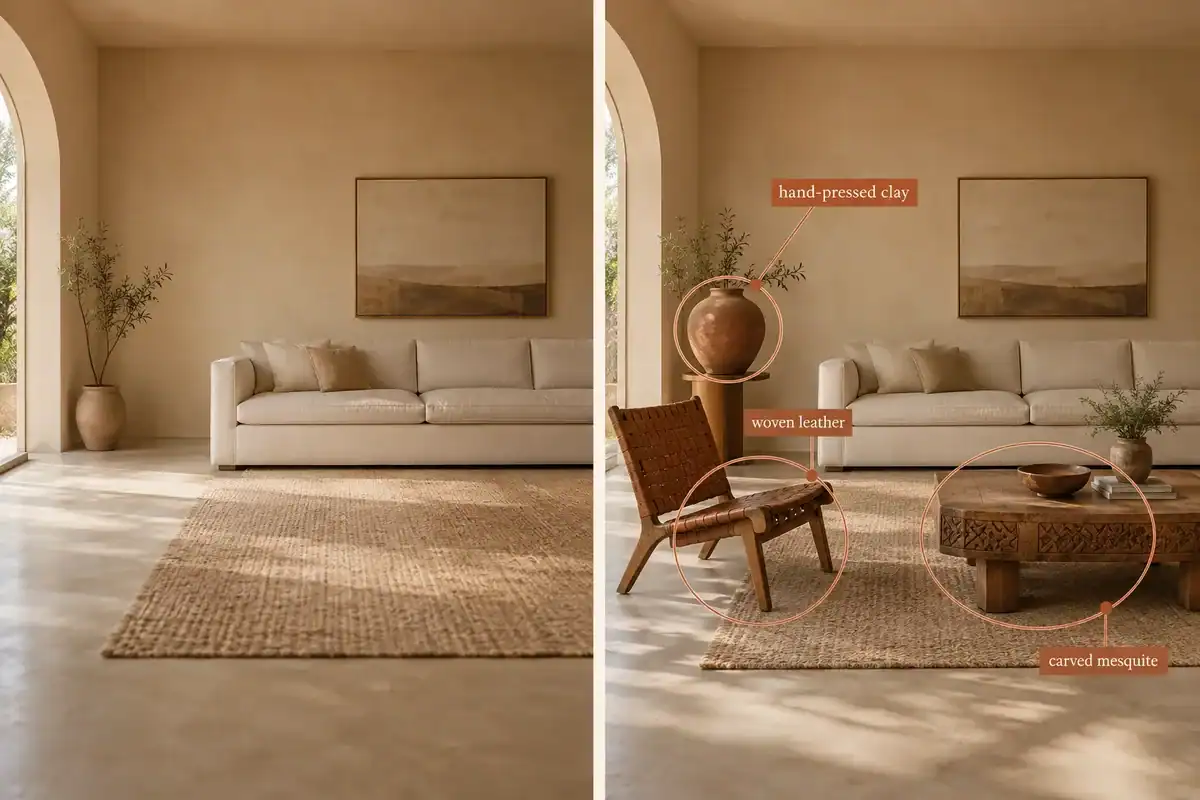
Who it’s for: anyone drawn to warmth, texture, and craftsmanship who still wants a tidy, uncluttered room. Who it’s not for: people who want maximalist color everywhere, or people who want an all-white gallery box with nothing tactile in it.
The goal is a home that feels made by hands, not bought in one trip.
Modern Mexican Decor vs Traditional Mexican Style: What’s the Difference?
Traditional Mexican style layers saturated color, dense pattern, and heavy carved furniture throughout a room. Modern Mexican decor uses the same materials and crafts but edits hard: neutral walls, fewer pieces, more empty space, and color used as an accent rather than a flood.
| Element | Traditional Mexican | Modern Mexican Aesthetic |
|---|---|---|
| Wall color | Bright cobalt, fuchsia, saffron | Limewash cream, sand, soft terracotta |
| Pattern | Talavera tile across large areas | One tiled niche, riser, or backsplash strip |
| Furniture | Ornately carved, dark, heavy | Low, simple silhouettes in solid wood |
| Textiles | Multiple bold serapes layered | One striped or hand-loomed piece per room |
| Metal | Ornate wrought iron scrollwork | Matte black iron, aged brass, simple forms |
| Styling density | Every surface filled | Negative space intentionally kept |
Decision rule: if a piece is handmade and functional, it probably belongs. If it’s decorative-only and patterned, keep just one per room.
How Do You Blend Traditional and Contemporary Mexican Design?
Start with a modern shell, then add heritage in three layers: one large crafted furniture piece, one architectural texture (plaster or tile), and two or three small clay or textile objects. Mexican designers call this edited approach “colonial contemporáneo” and “vintage curado”, colonial and vintage references simplified rather than recreated literally, as described in analysis of Mexican design directions.
A repeatable five-step method:
- Neutralize the base. Paint walls a warm off-white, sand, or pale clay. Skip cool grays, they fight the palette.
- Choose one hero. A reclaimed wood dining table, hand-carved console, or woven leather bench. Furniture trend reports on Mexican furniture directions describe this “Romantic Hacienda” approach: one substantial artisanal focal point against a calm modern backdrop.
- Add a texture surface. Limewashed plaster on one wall, terracotta tile on a hearth, or handmade tile on a single backsplash run.
- Layer soft texture. Linen curtains, a wool or jute rug, a cotton throw with hand-loomed edges. This is where layered living room textures really pay off.
- Edit. Remove a third of what you added. Space is part of the design.
Common mistake: doing steps 2, 3, and 4 at full volume in the same room. Pick one to dominate.
What Materials Work Best for Modern Mexican Interior Design?
The best materials are natural, matte, and slightly imperfect: solid wood with visible grain, hand-pressed clay and terracotta, linen, boucle, rattan, woven leather, and matte stone. Glossy laminate, high-shine chrome, and synthetic velvet undercut the whole look.
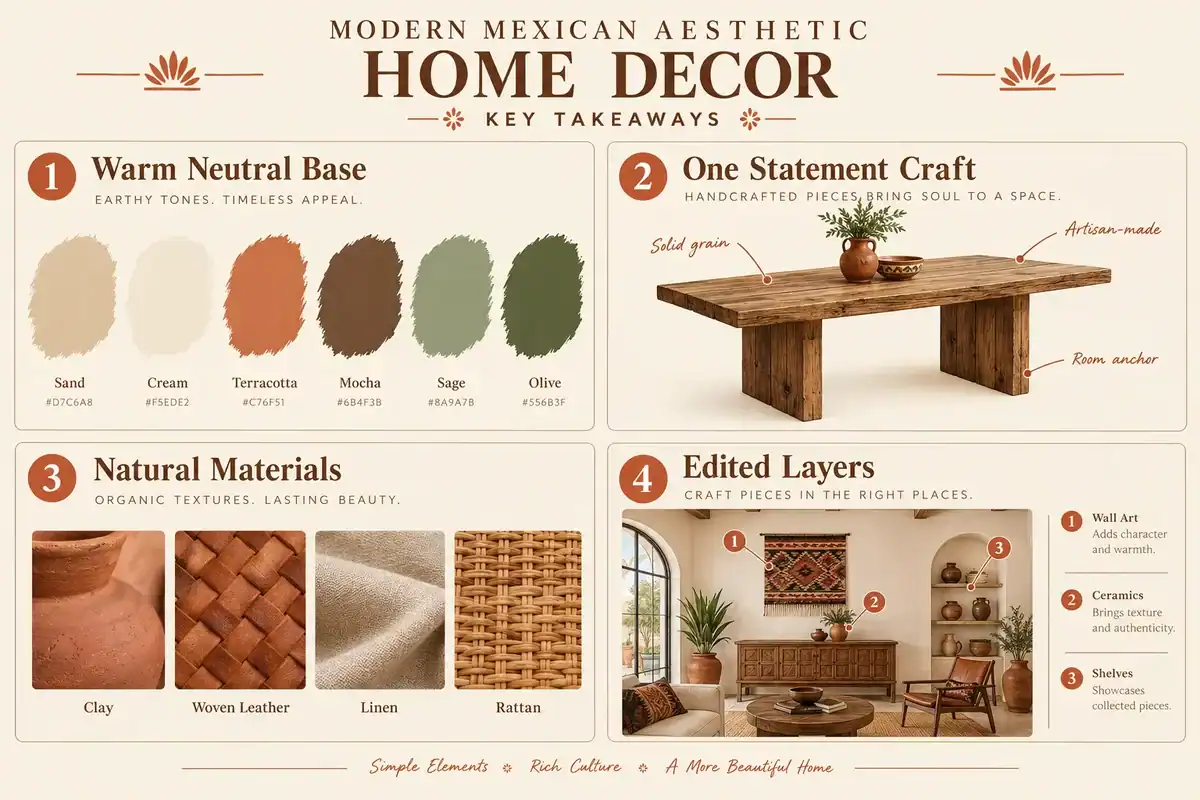
Material shortlist worth building around:
- Barro negro and terracotta clay, vases, plates, lamp bases. One large vessel does more than six small ones.
- Solid mesquite, parota, or reclaimed pine, tables, benches, floating shelves.
- Woven leather (equipal-inspired), chairs, stools, bench seats. Ages beautifully.
- Handmade tile, cement, zellige-style, or talavera used in a contained area.
- Limewash and microcement, soft, cloudy depth on walls with zero pattern.
- Natural fiber, jute, sisal, palm, rattan for rugs, baskets, and light shades.
- Matte black iron and aged brass, hardware, pot racks, sconces.
Studios covering Mexican material trends emphasize that the appeal comes from touch: a wall you want to run your hand across, a mug that isn’t perfectly round.
Modern Mexican Decor Color Palettes and Paint Ideas
Build on warm neutrals, sand, cream, mocha, soft terracotta, then add one or two accent colors, most often a green (sage, olive, forest) or a deep clay red. Current Mexican interiorismo palette reporting consistently points to earth tones and warm neutrals across walls, textiles, and furniture.
Three palettes that work in real homes:
Warm Adobe (easiest)
Walls in creamy limewash, oak and mesquite wood tones, terracotta accents, black iron hardware. Calm, bright, forgiving in small rooms.
Desert Sage (most modern)
Sand walls, sage or olive lower cabinetry or an accent wall, natural linen, brass. Reads fresh and current.
Clay and Cocoa (moodiest)
Mocha or deep clay walls, cream textiles, dark wood, one glazed green vessel. Best in rooms with good natural light or a cozy den you want to feel enveloping.
Paint tip: test warm whites next to your wood tones before committing. A white that looks fine on a chip can go pink or gray against parota wood. For broader palette planning, our guide to chic modern home decor that stops rooms looking plain covers how accent colors behave in modern rooms.
How Much Does It Cost to Decorate a Room in Modern Mexican Style?
Costs vary widely by region and sourcing, so treat these as planning estimates, not quotes. A refreshed living room using paint, one thrifted or vintage wood piece, a natural fiber rug, and a few clay accessories commonly lands in the low hundreds; a room built around a new artisan-made dining table or custom tile can run into several thousand.
Rough tiers to plan against (US/Canada retail, estimated):
- Refresh tier, paint, two clay vessels, one throw, a jute rug, swapped cabinet hardware. Weekend project, lowest spend.
- Anchor tier, add one real statement piece: solid wood table, woven leather bench, or carved console. This is where the style clicks.
- Renovation tier, handmade tile installation, limewash or microcement application, custom millwork. Highest cost, biggest visual payoff.
Where to spend: the hero furniture piece and any tile you’ll live with for years. Where to save: textiles, baskets, and small ceramics, thrift stores, markets, and estate sales are full of them.
Can You Do Modern Mexican Decor on a Budget?
Yes, and it’s one of the more budget-friendly aesthetics because its core ingredients are paint, texture, and secondhand wood. A limewash-effect wall plus one solid wood piece plus a woven rug delivers most of the look before you buy a single accessory.
Budget moves that punch above their price:
- Thrift the wood. Older solid-wood dressers and dining tables are heavy, cheap, and exactly the right material. Strip or oil, don’t paint.
- DIY limewash. Mineral limewash paint over a base coat gives soft, cloudy depth for the price of a gallon.
- Buy one big basket instead of five small decor objects. Storage plus texture in one purchase.
- Swap hardware to matte black or brass. Under $50 in most kitchens, instantly warmer.
- Shop plants over decor. A tall potted cactus, olive tree, or pothos adds the biophilic layer for very little. Our bedroom decor with plants guide covers keeping it lush without mess.
Edge case: renters who can’t paint should go textile-heavy instead, a large jute rug, linen curtains hung high, and a woven wall piece shift the room’s temperature without touching the walls.
Where to Buy: Modern Mexican Home Decor Brands and Authentic Furniture
The most reliable sourcing mix is: artisan-direct shops for ceramics and textiles, specialty importers for equipal and solid-wood furniture, secondhand markets for vintage wood, and mainstream retailers only for the neutral basics (sofa, linen curtains, simple lighting).
Where to look, by category:
| What you need | Best sources |
|---|---|
| Clay, barro negro, ceramics | Artisan-direct shops, Mexican craft cooperatives, Oaxacan and Puebla makers |
| Equipal / woven leather seating | Specialty Mexican furniture importers |
| Solid wood tables and consoles | Vintage and estate sales, reclaimed wood makers |
| Handmade tile | Cement and zellige tile specialists, talavera importers |
| Textiles and rugs | Weaving cooperatives, fair-trade importers, secondhand |
| Neutral upholstery, lighting | Mainstream modern retailers |
Authenticity check before you buy:
- Is a maker, region, or workshop named?
- Are pieces described as one-of-a-kind or slightly variable?
- Does the price make sense for hand labor? Suspiciously cheap “handmade” usually isn’t.
- Are photos of actual inventory, not repeated stock images?
Emerging Mexican studios working at the crossroads of craft, sculpture, and contemporary furniture are increasingly worth following directly, reporting on Mexican design and craft studios notes that a few strong crafted objects in an otherwise calm space is now the defining residential move.
Modern Mexican Aesthetic for Small Spaces and Apartments
Modern Mexican decor suits small spaces well because it relies on warm light-reflecting neutrals, low simple furniture, and only a handful of objects. In a studio or one-bedroom, use one craft focal point per sightline and let everything else stay quiet.
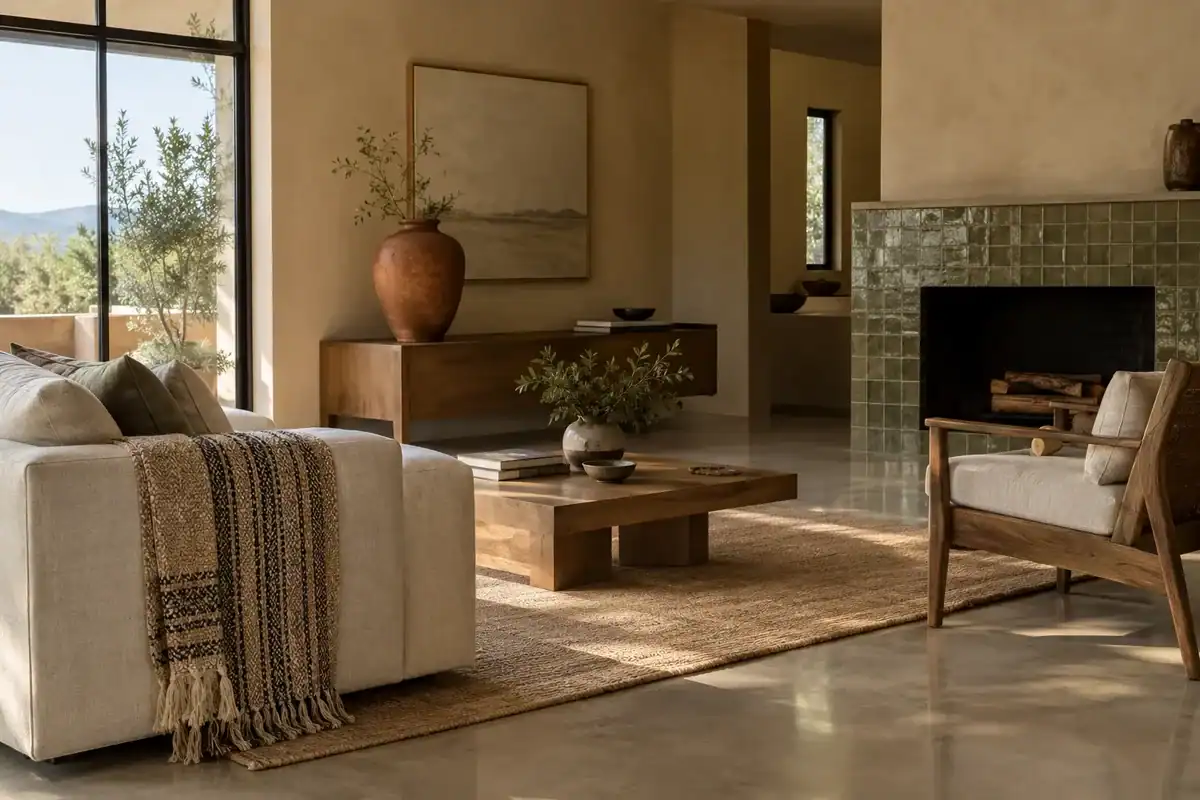
Apartment-scale tactics:
- Go vertical with texture, not stuff. One woven wall hanging or a limewashed accent wall beats a shelf of ceramics.
- Pick furniture with visible legs. Airflow under seating keeps small rooms breathing.
- Use a single large rug rather than two small ones, it makes the floor read bigger.
- Cluster clay in threes on one surface only. Everywhere else stays clear.
- Warm your lighting. Swap cool bulbs for 2700K; the whole palette depends on it.
If square footage is the main constraint, pair this with our minimalist apartment aesthetic ideas and small living room corner decor for layout-level fixes.
Is Modern Mexican Decor Good for Minimalist Homes? And How to Mix It With Other Styles
It’s an excellent fit for minimalist homes, arguably the friendliest way to warm up a minimal space without adding clutter. Mexican craft gives a spare room texture and human warmth while the object count stays low.
Why it works with minimalism: both value negative space, quality over quantity, and honest materials. Design commentary on lujo silencioso (quiet luxury) in Mexican interiors describes exactly this, choosing high-quality woods, natural stone, and artisanal ceramics for longevity and subtlety instead of display, as covered in reporting on 2026 decorating styles.
Blending guide:
- + Japandi: near-perfect match. Keep wood tones consistent, add clay instead of porcelain.
- + Scandinavian: warm up the palette (swap gray for sand) and add one leather or woven piece.
- + Mid-century modern: tapered legs and walnut sit happily beside terracotta and woven leather.
- + Desert / Southwest: already close; avoid doubling up on cactus motifs and kilim pattern.
- + French country: possible if you let plaster and wood be the shared language. Our modern French country style guide shows how the neutral base overlaps.
- + Boho: the riskiest mix. Boho’s pattern volume can tip the room into “souvenir shop.” Cap pattern at two instances per room.
For warmth-without-clutter fundamentals, see minimalist home ideas that still feel warm and timeless.
Modern Mexican Kitchen and Bathroom Decor Ideas
In kitchens, aim for a lived-in, social feel: freestanding artisanal furniture, open shelving with real dishes, and handmade tile in one contained run. In bathrooms, lean on terracotta or cement floor tile, microcement or limewash walls, a wood vanity, and one clay accessory.

Kitchen moves that read modern, not themed:
- A freestanding wood island or hutch instead of all built-ins, spatial trend reporting notes kitchens shifting toward informal, furniture-like pieces that make the room feel part of the social space.
- Handmade tile on one surface only (backsplash strip, range niche, or open shelf riser).
- Matte black iron pot rack with actual clay cookware hung on it.
- Open shelves styled sparsely, stacked plates, two vessels, one wood board. See what to put on kitchen counters for keeping surfaces clear.
Bathroom moves:
- Terracotta or unglazed cement floor tile, warm grout.
- Microcement or limewash shower walls for a spa-style, seamless-looking surface without shine.
- Carved or solid wood vanity, aged brass fixtures.
- One black clay soap dish, one natural cotton towel with woven trim. That’s the styling.
Renters can get much of this with peel-and-stick tile and swapped fixtures, see renter friendly bathroom decor.
Common Mistakes People Make With Modern Mexican Decor
The number one mistake is buying a themed “set” all at once. Matched sets read commercial; slow collecting reads personal. The second is treating pattern as the style’s core when texture actually is.
Mistakes to sidestep:
- Talavera everywhere. Beautiful tile, but full-wall coverage plus patterned textiles plus painted furniture equals restaurant.
- Mass-produced “Mexican-style” prints. Skip generic sombrero, cactus, and Day of the Dead graphics unless they’re by a maker you can name.
- Cool grays and stark whites. They flatten the palette. Warm every neutral.
- Too many small objects. Ten trinkets on a shelf isn’t craft, it’s clutter. Try minimalist shelf decor instead.
- Cool-toned lighting. 4000K bulbs make terracotta look muddy.
- Glossy finishes. High-shine tile or lacquered wood fights the material story.
- Ignoring plants. Biophilic elements and natural light are part of the look, not extras.
FAQ
Is modern Mexican decor the same as Southwestern style?
No. Southwestern style leans on kilim patterns, turquoise, and cowhide from the US desert tradition. Modern Mexican decor centers Mexican craft specifically, barro clay, equipal leather, talavera, hand-loomed cotton, with a warmer, more neutral base.
What paint colors work best for modern Mexican interiors?
Warm off-whites, sand, pale clay, mocha, and soft terracotta for the base, with sage, olive, or forest green as an accent. Avoid cool grays and blue-toned whites.
How many patterned pieces should one room have?
Two at most. One larger patterned surface (tile or rug) plus one smaller patterned textile keeps the room modern instead of themed.
Can I use talavera tile without it looking like a restaurant?
Yes, if you contain it. Use it in one place only: a single backsplash strip, a stair riser, a shower niche, or a small floor inset, surrounded by plain plaster or neutral tile.
Does this style work in a home with no natural light?
It can, but shift the palette lighter. Use cream and sand rather than mocha or deep clay, add warm 2700K lighting at three heights, and choose lighter wood tones.
What’s the single fastest upgrade?
Warm bulbs plus one large clay vessel. Both cost little and immediately change how a neutral room feels.
Is modern Mexican decor a passing trend?
Trend analyses describe it as atemporal, timeless, and expect warm minimalism, earth palettes, and craft-driven materials to keep growing in value. Because it’s built on solid wood, clay, and natural fiber, the pieces age well regardless of trend cycles.
How do I keep it from looking like a souvenir collection?
Buy fewer, larger, functional pieces. A dining table, a bench, a serving bowl you actually use. Then leave visible empty space around each one.
Conclusion
Modern Mexican aesthetic home decor works because it solves the two problems most modern homes have: they feel a little cold, and they feel a little anonymous. Warm neutrals, real clay, solid wood, and woven texture fix both, without adding clutter and without turning your living room into a themed set.
Your next three steps:
- Warm your base this week. Swap to 2700K bulbs, then choose a warm off-white, sand, or clay paint sample and live with it for two days.
- Hunt one hero piece. Set a budget and look for a solid wood table, console, or woven leather bench, secondhand first, artisan-direct second.
- Add texture, then edit. Bring in a natural fiber rug, one linen or hand-loomed textile, and two clay vessels. Remove a third of what’s already on your surfaces.
Where style meets comfort is exactly where this look lives. Start small, collect slowly, and let the handmade pieces earn their space. For more curated décor ideas and room styling tips, browse our full home decor library.